SHS3 Mathematics · Semester 1, Week 11
Patterns and Relations
Full lesson notes coming
Notes for this lesson are being prepared. The curriculum details below are complete and ready to use for your planning.
Curriculum details
- Strand
- Algebraic Reasoning (Strand 2)
- Sub-strand
- Patterns and Relations (2.2)
- Content standard
- 3.2.2.CS.1 - Demonstrate understanding of the concept of quadratic functions and equations and solve real-life problems with them. 3.2.2.LO.1 Solve problems on quadratic functions and equations, including real-life problems.
- Indicator
- 3.2.2.LI.3 - Identify and explain the axis of symmetry, write its equation and solve linear and quadratic equations simultaneously using graphs.
- Suggested placement
-
Semester 1, Week 11
(Week 11 of the year)
Our suggestion, laid out in curriculum order across three terms of twelve weeks. NaCCA does not fix the week, so follow your school's scheme of learning.
- Source document note
-
The official curriculum document has a fault in this entry, so the curriculum text above is transcribed exactly as printed:
- exemplars - p.317: the equation text on this page is set in a CambriaMath subset whose /ToUnicode map doubles every letter and gets many of them wrong, and the glyph ids could not be lined up with the extraction to repair it, so any italic variable here may be doubled or be the wrong letter; read the page
- exemplars - p.318: this exemplar sets a two-dimensional construct - a stacked fraction, an index or a column vector - which the text layer flattens into separate lines, so the parts are present but their vertical arrangement is lost; read the page
- Curriculum reference
- NaCCA curriculum document, p. 317
Exemplars (from the NaCCA curriculum)
In collaborative and gender-responsive groups, use an integrated learning approach to establish, analyse and interpret quadratic graphs using diagrams to carry out investigation on quadratic equations concurrently through problem-solving approaches.
Using Problem-based Learning in a whole class discussion, identify and brainstorm the meaning of axes of symmetry.
Example 1: The axis or line of symmetry is a line that divides the graph into two equal parts.
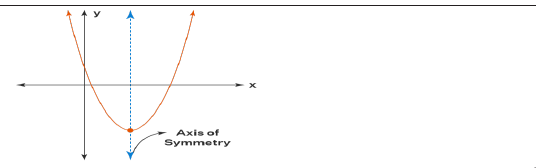
𝑎𝑎+𝑏𝑏 −𝑏𝑏 Note that the line of symmetry is always on the x-axis, and so its equation is 𝑥𝑥 = (𝑜𝑜𝑜𝑜 𝑥𝑥 = ) 2 2𝑎𝑎
Example 2: Draw the graph of 𝑦𝑦 = (𝑥𝑥 − 1)(𝑥𝑥 − 5) and write the equation of the line of symmetry.
Solution
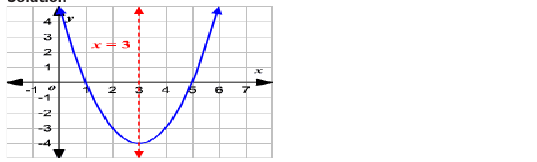
From the graph, the equation of the line of symmetry is 𝑥𝑥 = 3
Using small gender-responsive grouping, identify and brainstorm the connection between straight line and quadratic equations and find their points of intersections.
Using a Problem-based Learning strategy, task learners to determine the solution set of equations.
Teaching and Learning Resources:
- Teaching and Learning Resources
- Manipulative (dice, coins, spinners, playing cards, counters, digit cards),
- Simple Probability Mazes (Printable & Digital),
- Worksheets
- Task Cards
Assessment (3.2.2.AS.3). The document marks these depth-of-knowledge levels for this indicator: Level 1 Recall; Level 2 Skills of conceptual understanding; Level 3 Strategic reasoning.