SHS1 Additional Mathematics · Semester 1, Week 2
Number and Algebraic Patterns
Lesson notes
Learning Objectives
Indicator: 1.1.1.LI.4 - Establish the properties of operations on set, including commutative, associative, and distributive, sets algebra and apply them to solve problems.
By the end of the lesson, learners can:
- State the commutative, associative, and distributive properties of set operations using correct set notation (A ∪ B = B ∪ A, etc.).
- Verify set identities algebraically by listing elements for given sets A, B, and C.
- Use Venn diagrams to confirm the distributive and associative properties for three sets.
- Apply set identities and properties to solve real-life problems involving two or three sets.
- Write simplified set expressions using the properties of set algebra.
Sign in with your phone number to read the full note and download the GES plan - free.
Sign in with phone numberCurriculum details
- Strand
- Modelling with Algebra (Strand 1)
- Sub-strand
- Number and Algebraic Patterns (1.1)
- Content standard
- 1.1.1.CS.1 - Demonstrate knowledge and understanding of binary operations, sets and binomial theorem and solve related problems in real life situations. 1.1.1.LO.1 Solve problems involving properties of binary operations. 1.1.1.LO.2 Model and solve real life problems on sets. 1.1.1.LO.3 Expand binomials with positive integral indices and simplify coefficients of the terms. 1.1.1.LO.4 Perform basic operations on surds as well as solve simple indicial and logarithmic equations.
- Indicator
- 1.1.1.LI.4 - Establish the properties of operations on set, including commutative, associative, and distributive, sets algebra and apply them to solve problems.
- Suggested placement
-
Semester 1, Week 2
(Week 2 of the year)
Our suggestion, laid out in curriculum order across three terms of twelve weeks. NaCCA does not fix the week, so follow your school's scheme of learning.
- Source document note
-
The official curriculum document has a fault in this entry, so the curriculum text above is transcribed exactly as printed:
- exemplars - p.46: adjacent duplicated CambriaMath characters were collapsed, but this PDF also maps some equation glyphs to the wrong letter or operator; verify every mathematical expression in this row against the rendered page
- Curriculum reference
- NaCCA curriculum document, p. 46
Exemplars (from the NaCCA curriculum)
Collaborative Learning: Learners will be working in convenient groups (ability, mixed-ability, mixed gender, or pairs etc.) to establish set identities, set operations, and apply them to solve problems in different contexts.
Talk for Learning Approaches: Learners will brainstorm through think-pairshare/square and debate to discuss set identities and properties of set operations.
Experiential Learning: Learners will collaboratively engage in hands-on activity (learning by doing) to create problems and apply set identities, algebra, and operations to solve.
Activity 1: Set identities and set operations. Use Talk for Learning Approaches (building on what others say, managing Talk for Learning, structuring Talk for Learning), collaborative learning approaches and experiential learning approaches to investigate set identities, set algebra, and set operations and solve related problems.
 Small group discussions/Think-pair-share
- Learners in small convenient groups (for instance, mixed gender, mixed-ability, etc.) investigate and establish set identities and verify these properties.
- Learners use set algebra to verify that for any three Sets 𝐴, 𝐵 and 𝐶:
Example 1: Verify that for any three Sets 𝐴, 𝐵 and 𝐶:
- Commutative Properties : 𝐴 ∪ 𝐵 = 𝐵 ∪ 𝐴 𝐴 ∩ 𝐵 = 𝐵 ∩ 𝐴
- Distributive Properties: 𝐴 ∪ (𝐵 ∩ 𝐶) = (𝐴 ∪ 𝐵) ∩ (𝐴 ∪ 𝐶) 𝐴 ∩ (𝐵 ∪ 𝐶) = (𝐴 ∩ 𝐵) ∪ (𝐴 ∩ 𝐶)
- Associative properties: 𝐴 ∩ (𝐵 ∩ 𝐶) = (𝐴 ∩ 𝐵) ∩ 𝐶 𝐴 ∪ (𝐵 ∪ 𝐶) = (𝐴 ∪ 𝐵) ∪ 𝐶
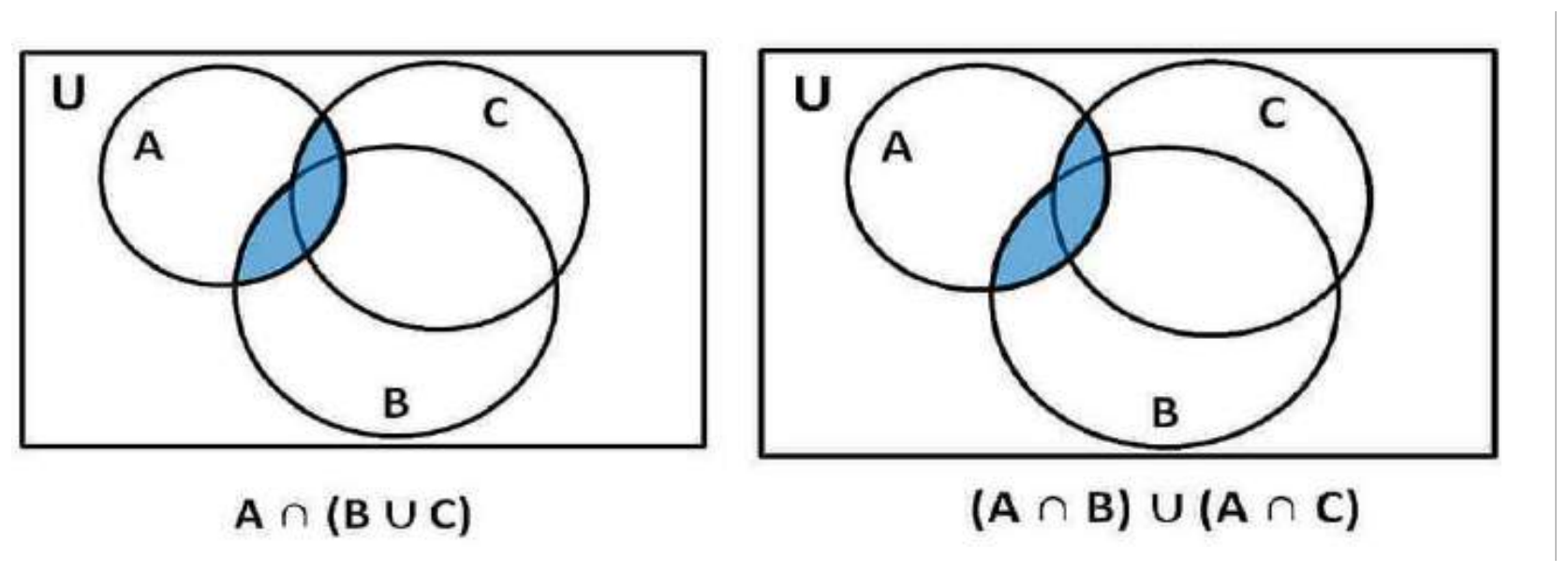
Activity 2: Use of Venn diagram to verify three set identities/operations.
Small group discussions/Think-pair-share: Learners in small convenient groups (for instance, mixed gender, mixed-ability, etc.) investigate and establish set identities and use Venn diagrams to verify that for any three Sets 𝐴, 𝐵 and 𝐶:
- 𝐴 ∪ 𝐵 = 𝐵 ∪ 𝐴
- 𝐴 ∪ (𝐵 ∩ 𝐶) = (𝐴 ∪ 𝐵) ∩ (𝐴 ∪ 𝐶)
- 𝐴 ∩ (𝐵 ∪ 𝐶) = (𝐴 ∩ 𝐵) ∪ (𝐴 ∩ 𝐶)
Example of illustration of 𝐴 ∩ (𝐵 ∪ 𝐶) = (𝐴 ∩ 𝐵) ∪ (𝐴 ∩ 𝐶) in a Venn diagram
Inter-group competition: Learners from one group create real life problems involving 2 sets whilst the other group applies set algebra, operations, and identities to solve the problems. Group switch roles.
Example: A pharmaceutical company is considering manufacturing new toothpaste. They are considering two charcoal flavours, strawberry and mint. In a sample of 74 people, it was found that 45 liked strawberries, 37 liked mints and 21 liked both types
- Create a Venn diagram to model the information.
- How many liked only strawberries?
- How many liked only mints?
- How many liked exactly one of the two (that is, they liked one but not the other)?
Teaching and Learning Resources:
- Textbooks
- Rectangular paper cut-out
- Addition pyramid
- Curriculum
- Cardboards
- Reading resources
- Colour pens
- Notebook
- Graph sheets
- Mathematical sets
- Technological tools.
Assessment (1.1.1.AS.4). The document marks these depth-of-knowledge levels for this indicator: Level 1 Recall; Level 3 Strategic reasoning.
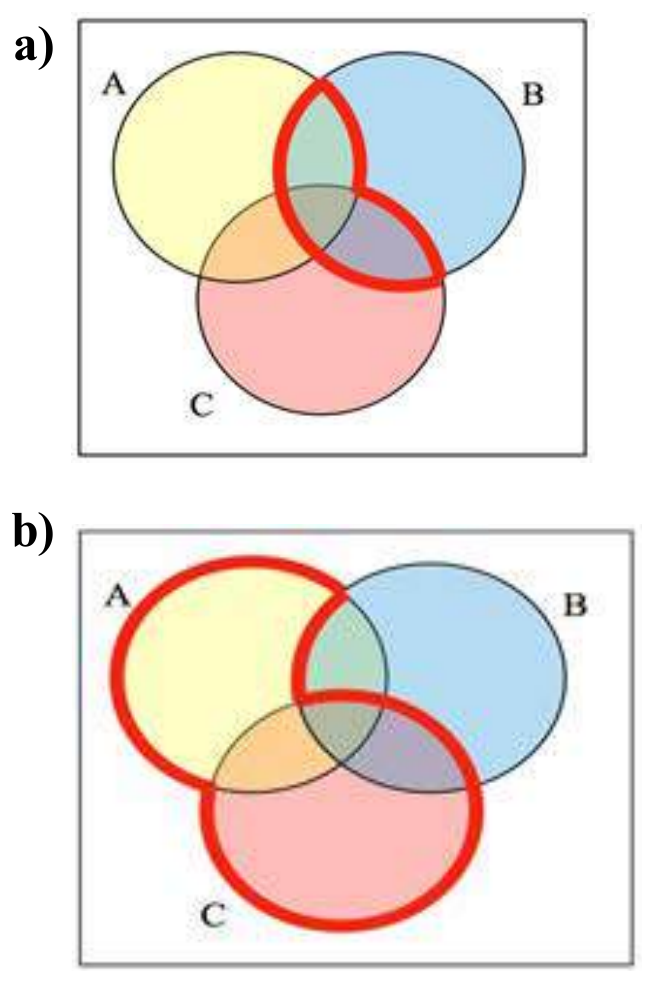
Consider the sets: A={red, green, blue}, B={red, yellow, orange}, C={red, orange, yellow, green, blue, purple} D={yellow, white} and the universal set 𝑈 = 𝐴 ∪ 𝐵 ∪ 𝐶 ∪ 𝐷 a) find 𝐴' ∩ 𝐶 b) find 𝐴 ∪ 𝐶 and 𝐵 - ∩ 𝐴. Strategic Reasoning A survey asks: "Which online social media have you used in the last month: WhatsApp, Facebook, Both". The results show 42% of those surveyed have used WhatsApp, 70% have used Facebook, and 20% have used both. How many people have used neither WhatsApp nor Facebook? Write an expression for the regions outlined in red a) b)