SHS1 Additional Mathematics · Semester 1, Week 3
Number and Algebraic Patterns
Lesson notes
Learning Objectives
Indicator: 1.1.1.LI.5 - Expand binomial expressions for positive integer indices using Pascal’s triangle.
By the end of the lesson, learners can:
- Construct Pascal’s triangle up to the row for n = 6, explaining how each row is generated from the one above it.
- Expand binomial expressions of the form (a + b)ⁿ for positive integer values of n using Pascal’s triangle to obtain the coefficients.
- Expand binomial expressions involving subtraction, such as (a - b)ⁿ, correctly handling the alternating signs.
- Apply Pascal’s triangle to expand binomials with numerical coefficients and constants, such as (2a - 3b)ⁿ.
- Use a binomial expansion to evaluate a numerical expression such as (2.01)⁵ without a calculator, showing all working.
Sign in with your phone number to read the full note and download the GES plan - free.
Sign in with phone numberCurriculum details
- Strand
- Modelling with Algebra (Strand 1)
- Sub-strand
- Number and Algebraic Patterns (1.1)
- Content standard
- 1.1.1.CS.1 - Demonstrate knowledge and understanding of binary operations, sets and binomial theorem and solve related problems in real life situations. 1.1.1.LO.1 Solve problems involving properties of binary operations. 1.1.1.LO.2 Model and solve real life problems on sets. 1.1.1.LO.3 Expand binomials with positive integral indices and simplify coefficients of the terms. 1.1.1.LO.4 Perform basic operations on surds as well as solve simple indicial and logarithmic equations.
- Indicator
- 1.1.1.LI.5 - Expand binomial expressions for positive integer indices using Pascal's triangle.
- Suggested placement
-
Semester 1, Week 3
(Week 3 of the year)
Our suggestion, laid out in curriculum order across three terms of twelve weeks. NaCCA does not fix the week, so follow your school's scheme of learning.
- Source document note
-
The official curriculum document has a fault in this entry, so the curriculum text above is transcribed exactly as printed:
- exemplars - p.48: adjacent duplicated CambriaMath characters were collapsed, but this PDF also maps some equation glyphs to the wrong letter or operator; verify every mathematical expression in this row against the rendered page
- exemplars - p.49: a stacked fraction, matrix, vector or other two-dimensional construct is flattened by the text layer; all visible parts require comparison with the rendered page
- Curriculum reference
- NaCCA curriculum document, p. 48
Exemplars (from the NaCCA curriculum)
Collaborative Learning: Learners will be working in convenient groups (ability, mixed-ability, mixed gender, or pairs etc.) to establish personal and conventional strategies for determining coefficients of the terms in a binomial expansion with positive integer indices in different contexts.
Talk for Learning Approaches: Learners will brainstorm through think-pairshare/square and debate to discuss strategies for determining coefficients of the terms in a binomial expansion with positive integer indices in different contexts.
Experiential Learning: Learners will collaboratively engage in hands-on activity (learning by doing) to create set problems and apply personal and conventional strategies to determine the coefficients of the terms in a binomial expansion with positive integer indices in different contexts.
Activity 1: Co-efficient and terms of binomial expansions (Pascal's triangle) Use Talk for Learning Approaches (building on what others say, managing Talk for Learning, structuring Talk for Learning), collaborative learning and experiential learning approaches to investigate strategies for determining the coefficients of the terms in a binomial expansion with positive integer indices in different contexts.
Small group discussions/Think-pair-share: In small convenient groups (for instance, mixed gender, mixed-ability, etc.) establish the coefficients of binomial expansions involving positive integer powers using personal methods.
Example 1: Obtain the terms in the binomial expansion of:
- (𝑎 + 𝑏) )
- (𝑎 + 𝑏) ,
- (𝑎 − 𝑏) .
Small group discussions/Think-pair-share: Learners in small convenient groups (i.e. mixed gender, mixed-ability, etc. where appropriate) establish the coefficients of binomial expansions involving positive integer powers using Pascal's triangle.
Example1: Use Pascal's triangle to expand the following:
- (𝑎 + 𝑏) )
- (𝑎 + 𝑏) ,
- (𝑎 − 𝑏) .
- (2𝑎 − 3𝑏) .
Differentiation: Support emerging proficiency learners with manipulatives (cut-out paper cards) containing terms of binomial expansions for them to use to build a pyramid and use the addition pyramid to establish the coefficients of given binomial expansions.
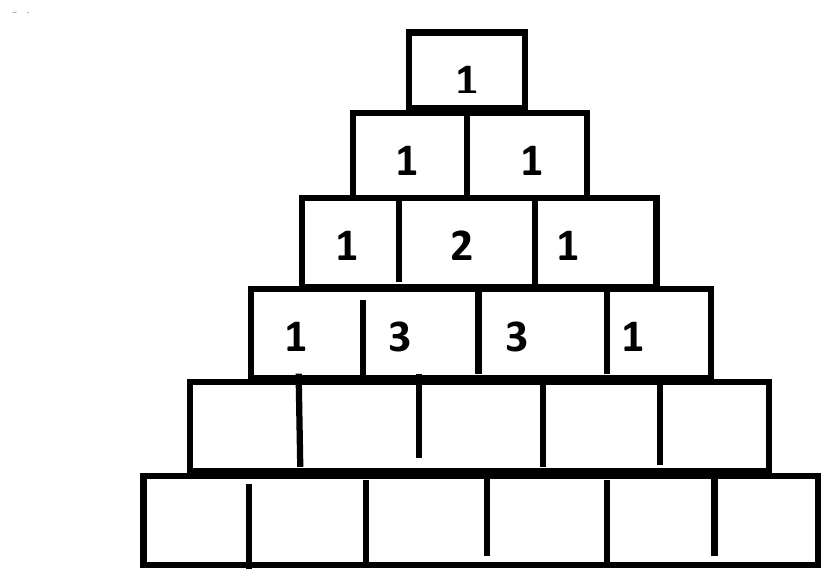
 1
1 1
1 2 1
1 3 3 1
Example: Write down the binomial expansion of (𝑎 + 𝑏) , . Use your expansion to evaluate(2.01) , .
/ Example: Without using tables and calculators, find the value of l2 + √3n + / l2 − √3n
Teaching and Learning Resources:
- Textbooks
- Rectangular paper cut-out
- Addition pyramid
- Curriculum
- Cardboards
- Reading resources
- Colour pens
- Notebook
- Graph sheets
- Mathematical sets
- Technological tools.
Assessment (1.1.1.AS.5). The document marks these depth-of-knowledge levels for this indicator: Level 2 Skills of conceptual understanding.
! , Obtain the expansion of i2𝑥 − ) j in descending powers of 𝑥 using Pascal's triangle Using the terms in the expansion of (𝑥 + 𝑦) . , find ∑(𝑥 + 𝑦) . , if 𝑥 = 1 and 𝑦 = 0.05 Write down the binomial expansion of (𝑎 + 𝑏) , and use your expansion to evaluate (2.01)