B5 English Language · Term 3, Week 4
Narrative Writing
Lesson notes
Learning Objectives
Indicator: B5.4.10.1.1
By the end of the lesson, learners can:
- Identify the stages of the writing process (prewriting, writing, revising, editing and publishing) and explain what happens at each stage.
- Use a Time Line graphic organiser to list the events of a personal narrative in chronological order.
- Use a 5 W’s Chart to gather details about who, what, when, where and why for a personal narrative.
- Write a personal narrative with a clear beginning, middle and ending, using descriptive words that appeal to the senses.
- Use appropriate linking words (first, then, next, after that, finally, suddenly) within and across paragraphs, and include at least one example of direct speech to make the story lively.
Sign in with your phone number to read the full note and download the GES plan - free.
Sign in with phone numberCurriculum details
- Strand
- Writing (Strand 4)
- Sub-strand
- Narrative Writing (4.10)
- Content standard
- B5.4.10.1 - Narrate situations, express feelings and convey point of view about the world/ or fictional world
- Indicator
- B5.4.10.1.1 - Create settings, characters and at least one plot in a narrative text, using appropriate linking words within and across paragraphs to aid cohesion, and using simple literary devices, e.g. direct speech
- Suggested placement
-
Term 3, Week 4
(Week 28 of the year)
Our suggestion, laid out in curriculum order across three terms of twelve weeks. NaCCA does not fix the week, so follow your school's scheme of learning.
- Source document note
-
The official curriculum document has a fault in this entry, so the curriculum text above is transcribed exactly as printed:
- exemplars - p.130
- Curriculum reference
-
English Language Curriculum (Basic 4-6), 2019, p. 128
Transcribed from the official NaCCA publication. Check this page against the source.
Exemplars (from the NaCCA curriculum)
- Revise the stages of the writing process with learners.
E.g. prewriting, writing, revising, editing and publishing.
- Guide learners through the process to write about real or imagined experiences or events.
E.g. personal narrative
- Discuss personal narrative with learners: Note: A personal narrative is a true story told from the writer's point of view. It is the retelling of an event or experience that has affected the writer's life. The story should be told naturally to allow readers to experience the event(s) for themselves.
Prewriting
- Put learners into groups of five (5) and have them select a topic, purpose and audience for their narrative writing.
E.g. Topic: How I spent my Christmas holidays. Purpose: to share an important experience.
Audience: Classmates
- Guide learners to individually use appropriate graphic organizers to generate, gather and organise ideas and details for writing.
E.g. Time Line, 5 Ws Chart.
Time Line Organiser
- Use Time Line for personal narratives to list actions or events in the order in which they occurred.
E.g. Topic………
Events in Chronological Order 1. Event 1 2. Event 2 3. Event 3
5 W's Chart
- Use 5 W's Chart to collect the who? what? when? where? and why?" details for personal narratives and news stories. How could be added to the list.
e.g. Topic____________________ Who? What? When? Where? Why?
- Guide learners to organise their details into writing plant (beginning, middle and ending).
Writing stage
- Learners then revise their first draft by ensuring the writing has a beginning, middle and ending.
- Learners should ensure they have used descriptive words. They have written about what they saw, heard, smelled, tasted and touched.
Revising: checklist for narrative writing i. Does my essay have beginning, middle and ending? ii. Have I used descriptive words? iii. Are my ideas/events arranged in the order in which they occurred?
iv. Does my narrative sound natural? v. Do I express how I feel about what happened?
Editing
- Have learners use the checklist above to edit their first draft for the conventions of punctuation, capitalisation, spelling and grammar.
Publish
- Have learners share their work with peers.
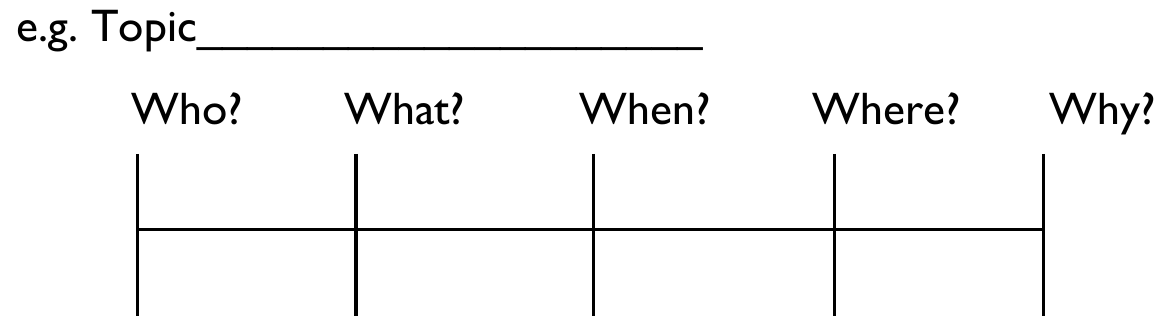
The planning chart on printed p.130 is drawn: a "Topic" rule with the columns Who? What? When? Where? Why? hanging off a horizontal line. Only the labels reach the text layer; the figure shows the chart.