JHS1 Creative Arts And Design · Term 2, Week 5
Media and Techniques
Lesson notes
Learning Objectives
Indicator: B7.2.1.2.7 - Conduct songs in simple duple, triple and quadruple time
By the end of the lesson, learners can:
- Define time signature and explain what the two numbers in a time signature mean.
- Identify simple duple, triple and quadruple time signatures from written examples (2/4, 3/4 and 4/4).
- Demonstrate the correct conducting beat patterns for simple duple, triple and quadruple time with their hands.
- Lead the class in conducting a short familiar song in at least one of the three simple time signatures.
- Use peer and self evaluation to assess their own and others’ conducting performances.
Sign in with your phone number to read the full note and download the GES plan - free.
Sign in with phone numberCurriculum details
- Strand
- Creative Arts (Strand 2)
- Sub-strand
- Media and Techniques (2.1)
- Content standard
- B7.2.1.2 - Performing Arts - Music: Demonstrate understanding and apply scale, note durational values and simple time beat patterns in music.
- Indicator
- B7.2.1.2.7 - Conduct songs in simple duple, triple and quadruple time
- Suggested placement
-
Term 2, Week 5
(Week 17 of the year)
Our suggestion, laid out in curriculum order across three terms of twelve weeks. NaCCA does not fix the week, so follow your school's scheme of learning.
- Curriculum reference
-
Creative Arts and Design, Common Core Programme (JHS1-JHS3), 2023, p. 19
Transcribed from the official NaCCA publication. Check this page against the source.
Exemplars (from the NaCCA curriculum)
1. Explain the concept of time signature in simple time in music.
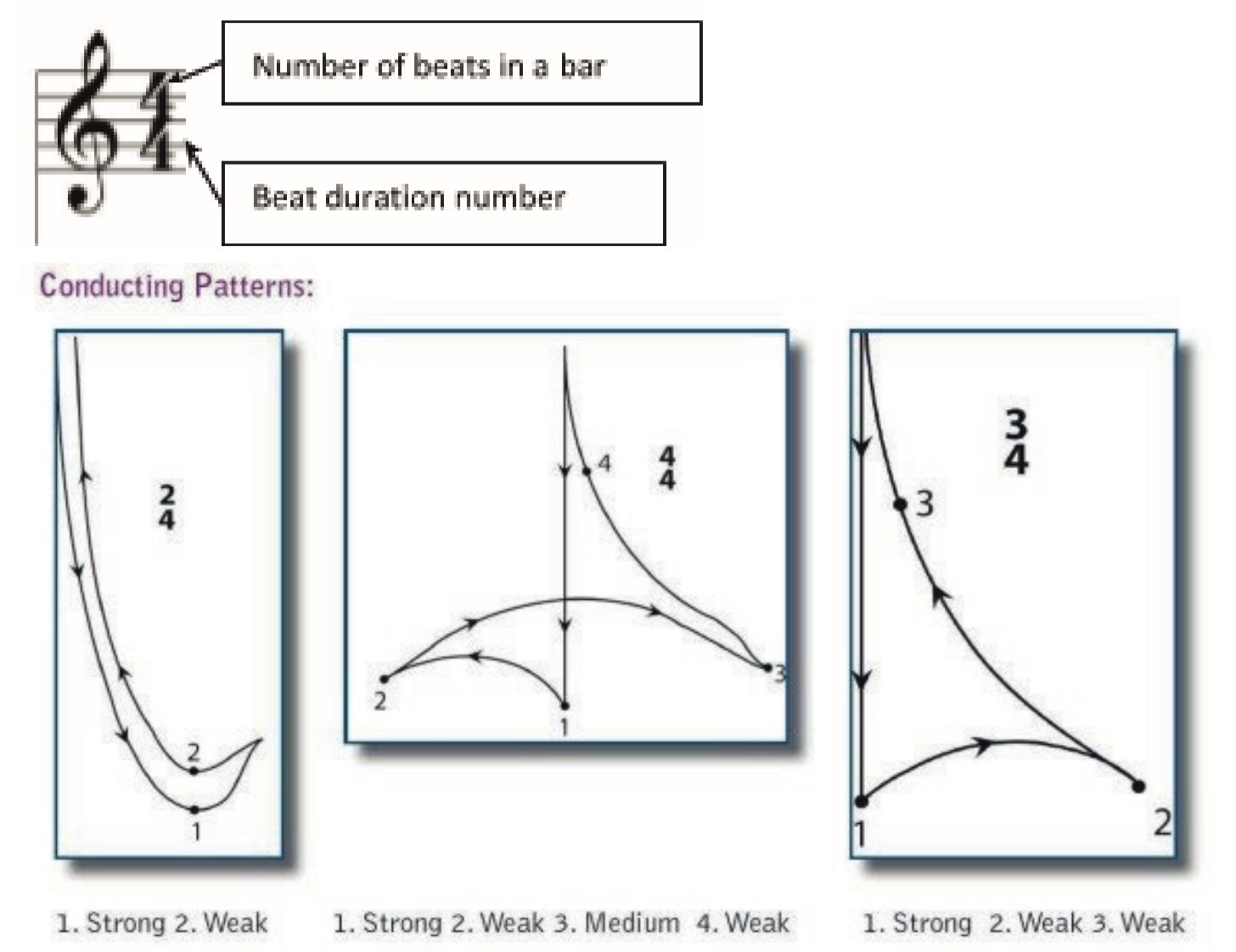
2. Rehearse and conduct a group by using simple time beat patterns and use peer- and self-evaluation to review work.