SHS2 Mathematics · Semester 2, Week 9
Measurement
Lesson notes
Learning Objectives
Indicator: 2.3.2.LI.1 - Solve problems that involve SI and imperial units in surface area measurements and verify the solutions.
By the end of the lesson, learners can:
- Distinguish between surface area and volume using practical examples and nets of 3D objects.
- State and apply the formulae for total surface area of cubes, cuboids, cylinders, cones, spheres, and prisms in both SI units (cm², m²) and imperial units (in², ft²).
- Convert between SI and imperial units of area (e.g., 1 inch = 2.54 cm, 1 foot = 30.48 cm) when solving surface area problems.
- Solve word problems involving surface area of 3D objects in real-life contexts and verify solutions by checking reasonableness and re-calculation.
- Use nets and technology tools (e.g., GeoGebra) to estimate and verify surface areas of 3D objects.
Sign in with your phone number to read the full note and download the GES plan - free.
Sign in with phone numberCurriculum details
- Strand
- Geometry Around Us (Strand 3)
- Sub-strand
- Measurement (3.2)
- Content standard
- 2.3.2.CS.3 - Demonstrate conceptual understanding of the measurement of surface area, volume and capacity of solid shapes. 2.3.2.LO.3 Determine the volume and capacity of solid shapes and Solve problems that involve SI and imperial units in surface area, volume and capacity measurements.
- Indicator
- 2.3.2.LI.1 - Solve problems that involve SI and imperial units in surface area measurements and verify the solutions.
- Suggested placement
-
Semester 2, Week 9
(Week 29 of the year)
Our suggestion, laid out in curriculum order across three terms of twelve weeks. NaCCA does not fix the week, so follow your school's scheme of learning.
- Curriculum reference
- NaCCA curriculum document, p. 250
Exemplars (from the NaCCA curriculum)
Experiential Learning: In convenient groups, explain, showing practical examples, the difference between volume and surface area. Reward honesty as a strong moral principle as learners discuss their challenges solving problems on surface area measurements.
Example: The area or region that an object's surface occupies is known as its surface area. Volume, on the other hand, refers to how much room an object has. Using examples, including nets, show the relationship between area and surface area.
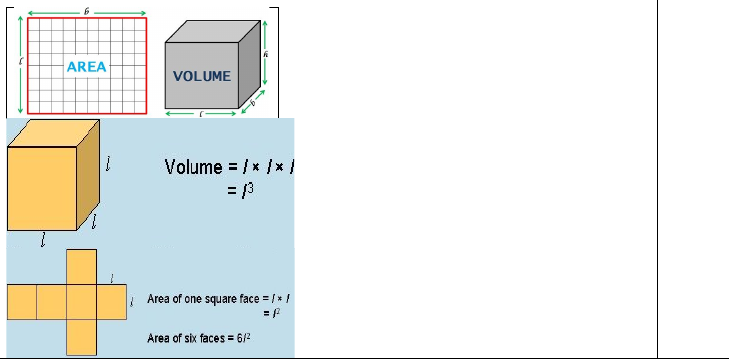
Experiential Learning: Explain how a referent can be used to estimate surface area.
Example: Engage learners to determine the area of, say a rectangular box and use the knowledge of nets to estimate the surface area of the box using the area calculated as a reference point.
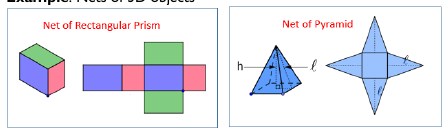
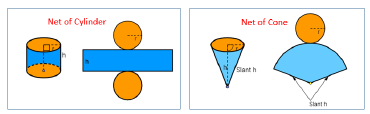
Experiential Learning: In pairs, learners draw nets of 3D objects (prisms, cones, pyramids, spheres, etc.), including the use of computer programmes like GeoGebra.
Example: Nets of 3D objects
Example: Nets of 3D objects using GeoGebra
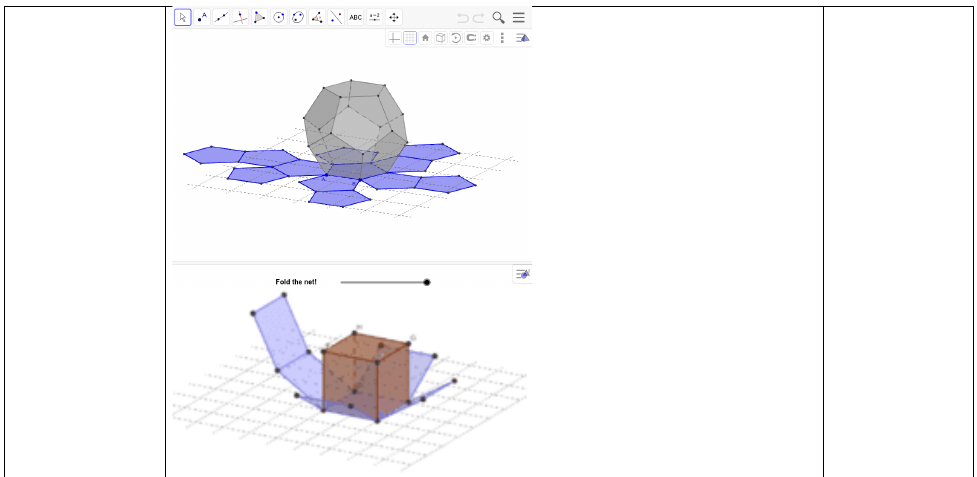
Think-pair share activities: In pairs, task learners to estimate the surface area of a 3D object (prisms, cones, pyramids, spheres, etc.). Encourage learners to see the need to embrace technology in solving problems in surface area measurements while appreciating the need to use them appropriately. Learners draw on their experiences in nets, area, perimeter, etc., to discuss how the various formulae can be generated.
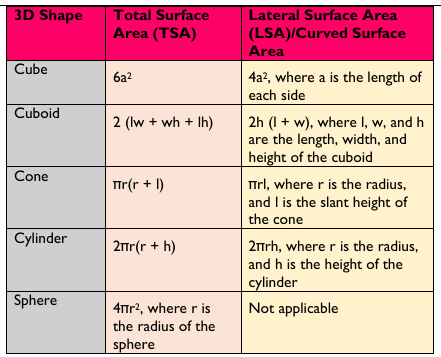
3D Shape Total Surface Lateral Surface Area Area (TSA) (LSA)/Curved Surface Area Cube 6a 2 4a 2 , where a is the length of each side Cuboid 2 (lw + wh + lh) 2h (l + w), where l, w, and h are the length, width, and height of the cuboid Cone πr(r + l) πrl, where r is the radius, and l is the slant height of the cone Cylinder 2πr(r + h) 2πrh, where r is the radius, and h is the height of the cylinder Sphere 4πr 2 , where r is Not applicable the radius of the sphere
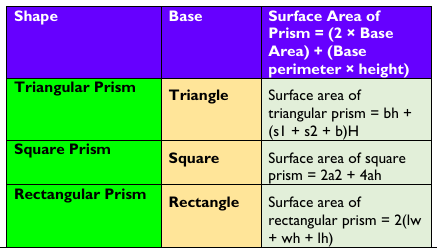
Shape Base Surface Area of Prism = (2 × Base Area) + (Base perimeter × height) Triangular Prism Triangle Surface area of triangular prism = bh + (s1 + s2 + b)H Square Prism Square Surface area of square prism = 2a2 + 4ah Rectangular Prism Rectangle Surface area of rectangular prism = 2(lw + wh + lh)
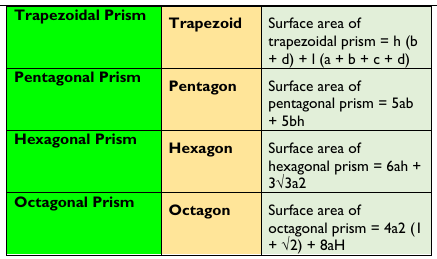
 Trapezoidal Prism Trapezoid Surface area of trapezoidal prism = h (b + d) + l (a + b + c + d) Pentagonal Prism Pentagon Surface area of pentagonal prism = 5ab + 5bh Hexagonal Prism Hexagon Surface area of hexagonal prism = 6ah + 3√3a2 Octagonal Prism Octagon Surface area of octagonal prism = 4a2 (1 + √2) + 8aH
Example 1: Find the total surface area of a cylinder if its radius is 3.5 units and height is 6 units.
Solution: We know that the formula to find the total surface area of a cylinder = 2πr(r + h) = 2 × 22/7 × 3.5 × (3.5 + 6) = 2 × 22/7 × 3.5 × (9.5) = 209 unit 2 Therefore, the total surface area of the cylinder is 209 unit 2
Example 2: If the radius and slant height of an ice cream cone are 4 inches and 7 inches, respectively. What is its surface area?
Solution: Given: radius = 4 inches and slant height = 7 inches. The surface area of cone = πr(r + l) = π × 4(4 + 7) = 3.14 × 4 × 11 = 138.16 inches 2 ∴ The surface area of the cone is 138.16 inches 2 .
Example 3: The total surface area considers all the faces of the 3D shape, including the flat surfaces and the curved surfaces. Why?
Experiential Learning: In pairs, task learners to illustrate, using examples, the effect of dimensional changes on the surface area. Promote divergent views to ensure inclusivity in the learning environment.
Example: The edge length of a small cube is increased by a scale factor of 5 to form a larger cube. How many times greater is the surface area of the large cube? x 5x 4) Hint: Plug in a number for x and find the surface area of both cubes.
Collaborative learning: Learners discuss and solve contextual problems that involve the surface area of 3-D objects, including spheres, and that require the manipulation of formulas.
Examples: i. If you decide to paint a building, you need to know the surface area of the building in order to buy the correct amount of paint. ii. The gift is in a box that has a length of 9 inches, a width of 12 inches and a height of 4 inches. Covering the box requires us to know the surface area. Now, using the surface area formula for a rectangular prism, we can determine. SA = 2lw + 2wh + 2lh SA = 2(9×12)+2(12×4)+2(9×4) SA = 216 + 96 + 72 SA = 384 cubic inches.
iii. What is the surface area of the figure below?
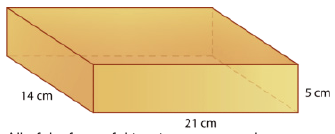
All of the faces of this prism are rectangles, so you can use the formula for finding the surface area of a rectangular prism as follows. First, plug the values given above into the surface area formula and multiply the values together within each of the parentheses:
SA = 2lw + 2wh + 2lh
Work out the answer: The answer is that the rectangular prism has a surface area of 938 square centimetres.
Teaching and Learning Resources:
- Mathematical sets.
- Technology tools such as computers, mobile phones, etc.
- * Computer software applications like GeoGebra
Assessment (2.3.2.AS.1). The document marks these depth-of-knowledge levels for this indicator: Level 1 Recall; Level 2 Skills of conceptual understanding.