SHS2 Mathematics · Semester 2, Week 4
Measurement
Lesson notes
Learning Objectives
Indicator: 2.3.2.LI.1 - Perform addition, subtraction, and scalar multiplication on vectors represented as directed line segments in two-space and in Cartesian form in two and three-space.
By the end of the lesson, learners can:
- Represent vectors as directed line segments (using the nose-to-tail method) and in Cartesian component form in two-space and three-space.
- Add two or more vectors using the triangular (head-to-tail) law, both by drawing and by adding corresponding components.
- Subtract one vector from another by adding the negative of the vector, using both geometric and component methods.
- Multiply a vector by a scalar and describe how the scalar affects the direction and magnitude (length) of the vector.
- Perform mixed operations involving addition, subtraction, and scalar multiplication on vectors given in component form in two and three dimensions.
Sign in with your phone number to read the full note and download the GES plan - free.
Sign in with phone numberCurriculum details
- Strand
- Geometry Around Us (Strand 3)
- Sub-strand
- Measurement (3.2)
- Content standard
- 2.3.2.CS.1 - Demonstrate knowledge and understanding of measurement with respect to operations on bearings and vectors. 2.3.2.LO.1 Carry out addition, subtraction and scalar multiplication of vectors and investigate with and without technology some properties (e.g., commutative, associative, and distributive properties) of the operations.
- Indicator
- 2.3.2.LI.1 - Perform addition, subtraction, and scalar multiplication on vectors represented as directed line segments in two-space and in Cartesian form in two and three-space.
- Suggested placement
-
Semester 2, Week 4
(Week 24 of the year)
Our suggestion, laid out in curriculum order across three terms of twelve weeks. NaCCA does not fix the week, so follow your school's scheme of learning.
- Source document note
-
The official curriculum document has a fault in this entry, so the curriculum text above is transcribed exactly as printed:
- exemplars - p.237: the equation text on this page is set in a CambriaMath subset whose /ToUnicode map doubles every letter and gets many of them wrong, and the glyph ids could not be lined up with the extraction to repair it, so any italic variable here may be doubled or be the wrong letter; read the page
- exemplars - p.238: this exemplar sets a two-dimensional construct - a stacked fraction, an index or a column vector - which the text layer flattens into separate lines, so the parts are present but their vertical arrangement is lost; read the page
- Curriculum reference
- NaCCA curriculum document, p. 237
Exemplars (from the NaCCA curriculum)
Using Talk for Learning strategy, review learners' previous knowledge of vectors and their types.
Group discussions: In small groups, task learners to discuss the triangular law of addition. As learners talk about laws, encourage discussions on the need to obey laws and the consequences of doing otherwise in everyday life.
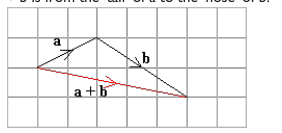
Example: Vectors can be added using the 'nose-to-tail' method or "head-to-tail" method. Two vectors, a and b, represented by the line segments, can be added by joining the 'tail' of vector b to the 'nose' of vector a. Alternatively, the 'tail' of vector a can be joined to the 'nose' of vector b.
E.g.1: Find the sum of the two given vectors, a and b.

Solution: Draw the vector a. Draw the 'tail' of vector b joined to the 'nose' of vector a. The vector a + b is from the 'tail' of a to the 'nose' of b.
E.g.2: Given that, 𝑃𝑃𝑃𝑃 ⃗⃗⃗⃗⃗ = ( 2 ) 𝑎𝑎𝑎𝑎𝑎𝑎 𝑄𝑄𝑄𝑄 ⃗⃗⃗⃗⃗ = ( 2 ), find the sum of the vectors. 3 −2
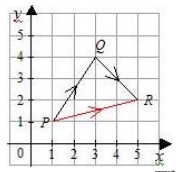
The sum of the vectors ⃗⃗⃗⃗⃗ ⃗⃗⃗⃗⃗ is the same as the vector 𝑃𝑃𝑃𝑃 ⃗⃗⃗⃗⃗ . That is ⃗⃗⃗⃗⃗ 𝑃𝑃𝑃𝑃 + ⃗⃗⃗⃗⃗ ⃗⃗⃗⃗⃗ . Therefore, 𝑃𝑃𝑃𝑃 𝑎𝑎𝑎𝑎𝑎𝑎 𝑄𝑄𝑄𝑄 𝑄𝑄𝑄𝑄 = 𝑃𝑃𝑃𝑃 ⃗⃗⃗⃗⃗ ⃗⃗⃗⃗⃗ 2 2 4 ⃗⃗⃗⃗⃗ we add the corresponding components of the vectors as 𝑃𝑃𝑃𝑃 + 𝑄𝑄𝑄𝑄 = ( 3 ) + ( −2 ) = ( 1 ) = 𝑃𝑃𝑃𝑃
Group discussions: In small groups, task learners to discuss how to use the triangular law of addition to doing subtraction of vectors. As learners discuss the triangular law, they come up with a discussion on the need for one to manage emotions and conflicts in order not to be on the wrong side of the law.
Example: The vector subtraction of two vectors a and b is represented by a - b, and it is nothing but adding the negative of vector b to the vector a., i.e., a - b = a + (-b). Thus, subtraction of vectors involves the addition of vectors and the negative of a vector.
Interpreting the subtraction of vectors using the triangle law of vector addition.
First, denote the vector drawn from the endpoint of b to the endpoint of a by c.
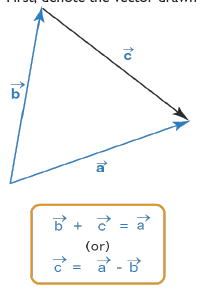
Note that b + c = a. Thus, c = a - b. In other words, the vector a - b is the vector drawn from the tip of b to the tip of a (if a and b are co-initial).
Group discussions: In small groups, task learners to discuss scalar multiplication on vectors.
Example
- Multiplying a vector by a positive scalar (real number) preserves its direction and scales its length by the magnitude of the scalar.
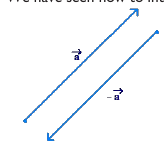
- Multiplying a vector by a negative scalar reverses its direction and scales its length by the magnitude of the scalar.
- If the magnitude of the scalar is greater than 1, then the new vector is longer than the original vector; if it is less than 1, then the new vector is shorter; if the scalar is equal to 1, the new vector has the same length as the original.
E.g., Consider a vector. 𝑎𝑎 . What happens if you multiply this vector by 2? What will the vector 2𝑎𝑎 represent?
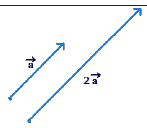
1 The vector 𝑎 will be a vector in the same direction as 𝑎 , but with a length equal to half of the length 2 of 𝑎 :
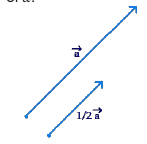
We have seen how to interpret the vector −𝑎 Given the vector 𝑎 :
Group discussions: In groups, task learners to solve some addition, subtraction and scalar multiplication of vectors in component form.
Teaching and Learning Resources:
- * Mathematical sets. * Technology tools such as computers, mobile phones, etc.
- * Computer software applications like
Assessment (2.3.2.AS.1). The document marks these depth-of-knowledge levels for this indicator: Level 1 Recall; Level 2 Skills of conceptual understanding; Level 3 Strategic reasoning.