SHS2 Mathematics · Semester 2, Week 8
Measurement
Lesson notes
Learning Objectives
Indicator: 2.3.2.LI.2 - Solve real-life problems involving angles of elevation and depression and identify everyday life situations of these concepts.
By the end of the lesson, learners can:
- Define angle of elevation as the upward angle from a horizontal line to an object above, and angle of depression as the downward angle from a horizontal line to an object below.
- Identify everyday situations in Ghana where angles of elevation and depression occur, such as viewing the top of a water tower, a crane lifting building materials, or observing a boat from a cliff.
- Draw and label clear diagrams for word problems, showing the horizontal line, the angle, and the right-angled triangle formed.
- Apply the tangent ratio and its inverse to calculate unknown heights, distances, and angles in real-life problems involving elevation and depression.
- Use the fact that the angle of depression equals the angle of elevation to the same object to solve problems using the alternate interior angle approach.
Sign in with your phone number to read the full note and download the GES plan - free.
Sign in with phone numberCurriculum details
- Strand
- Geometry Around Us (Strand 3)
- Sub-strand
- Measurement (3.2)
- Content standard
- 2.3.2.CS.2 - Demonstrate an understanding of the inverse of trigonometric ratios and angles of elevation/depression, and apply the knowledge to calculate distances and heights. 2.3.2.LO.2 Determine the inverse of trigonometric ratios, calculate angles of elevation and depression in everyday life situations and apply the knowledge to calculate distances and heights.
- Indicator
- 2.3.2.LI.2 - Solve real-life problems involving angles of elevation and depression and identify everyday life situations of these concepts.
- Suggested placement
-
Semester 2, Week 8
(Week 28 of the year)
Our suggestion, laid out in curriculum order across three terms of twelve weeks. NaCCA does not fix the week, so follow your school's scheme of learning.
- Source document note
-
The official curriculum document has a fault in this entry, so the curriculum text above is transcribed exactly as printed:
- exemplars - p.246: the equation text on this page is set in a CambriaMath subset whose /ToUnicode map doubles every letter and gets many of them wrong, and the glyph ids could not be lined up with the extraction to repair it, so any italic variable here may be doubled or be the wrong letter; read the page
- exemplars - p.248: this exemplar sets a two-dimensional construct - a stacked fraction, an index or a column vector - which the text layer flattens into separate lines, so the parts are present but their vertical arrangement is lost; read the page
- Curriculum reference
- NaCCA curriculum document, p. 246
Exemplars (from the NaCCA curriculum)
Group discussions: In convenient groups, task learners to discuss angles of elevation and depression. In their group task, learners to show respect for individual views, beliefs, religions, and cultures.
Example 1 Angle of Elevation:
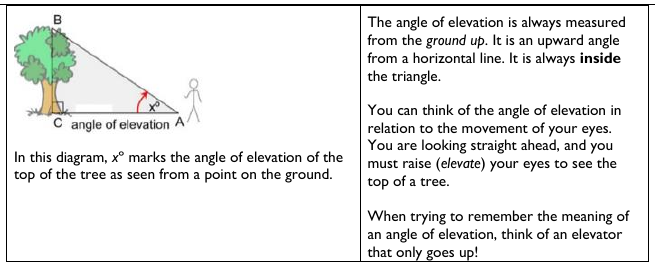
 The angle of elevation is always measured from the ground up. It is an upward angle from a horizontal line. It is always inside the triangle.
You can think of the angle of elevation in relation to the movement of your eyes. You are looking straight ahead, and you In this diagram, xº marks the angle of elevation of the must raise (elevate) your eyes to see the top of the tree as seen from a point on the ground. top of a tree.
When trying to remember the meaning of an angle of elevation, think of an elevator that only goes up!
Example 2
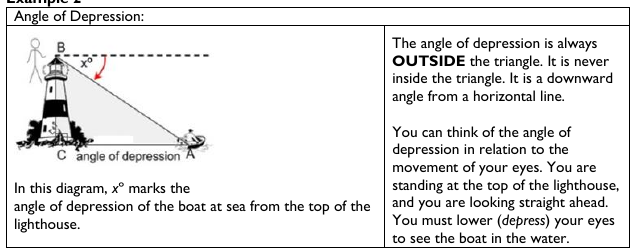
 Angle of Depression:
The angle of depression is always OUTSIDE the triangle. It is never inside the triangle. It is a downward angle from a horizontal line.
You can think of the angle of depression in relation to the movement of your eyes. You are standing at the top of the lighthouse, In this diagram, xº marks the and you are looking straight ahead. angle of depression of the boat at sea from the top of the lighthouse. You must lower (depress) your eyes to see the boat in the water.
Other examples
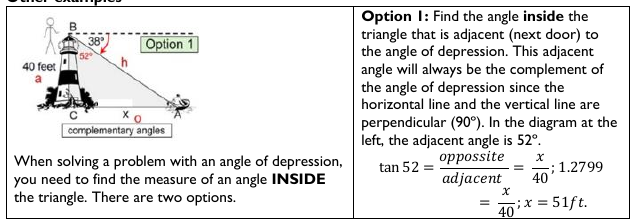
Option 1: Find the angle inside the triangle that is adjacent (next door) to the angle of depression. This adjacent angle will always be the complement of the angle of depression since the horizontal line and the vertical line are perpendicular (90º). In the diagram at the left, the adjacent angle is 52º. 𝑜𝑜𝑜𝑜𝑜𝑜𝑜𝑜𝑜𝑜𝑜𝑜𝑜𝑜𝑜𝑜𝑜𝑜 𝑥𝑥 When solving a problem with an angle of depression, tan 52 = = ; 1.2799 𝑎𝑎𝑎𝑎𝑎𝑎𝑎𝑎𝑎𝑎𝑎𝑎𝑎𝑎𝑎𝑎 40 you need to find the measure of an angle INSIDE 𝑥𝑥 the triangle. There are two options. = ; 𝑥𝑥 = 51𝑓𝑓𝑓𝑓. 40
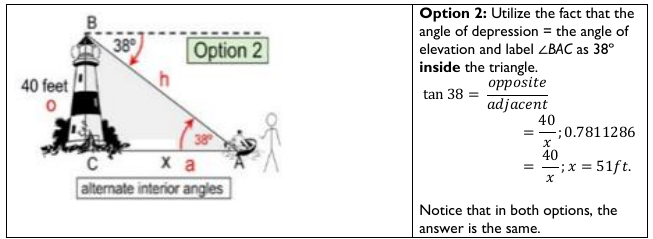
 Option 2: Utilize the fact that the angle of depression = the angle of elevation and label ∠BAC as 38º inside the triangle. 𝑜𝑜𝑜𝑜𝑜𝑜𝑜𝑜𝑜𝑜𝑜𝑜𝑜𝑜𝑜𝑜 tan 38 = 𝑎𝑎𝑎𝑎𝑎𝑎𝑎𝑎𝑎𝑎𝑎𝑎𝑎𝑎𝑎𝑎 40 = ; 0.7811286 𝑥𝑥 40 = ; 𝑥𝑥 = 51𝑓𝑓𝑓𝑓. 𝑥𝑥
Notice that in both options, the answer is the same.
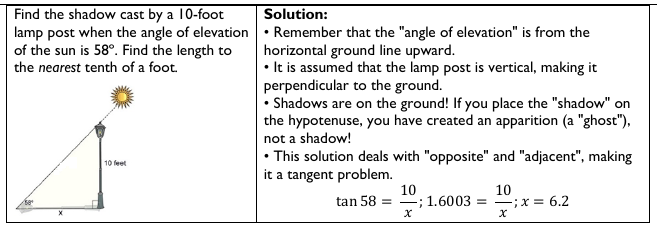
 Find the shadow cast by a 10-foot Solution: lamp post when the angle of elevation
- Remember that the "angle of elevation" is from the of the sun is 58º. Find the length to horizontal ground line upward. the nearest tenth of a foot.
- It is assumed that the lamp post is vertical, making it perpendicular to the ground.
- Shadows are on the ground! If you place the "shadow" on the hypotenuse, you have created an apparition (a "ghost"), not a shadow!
- This solution deals with "opposite" and "adjacent", making it a tangent problem. 10 10 tan 58 = ; 1.6003 = ; 𝑥 = 6.2 𝑥 𝑥
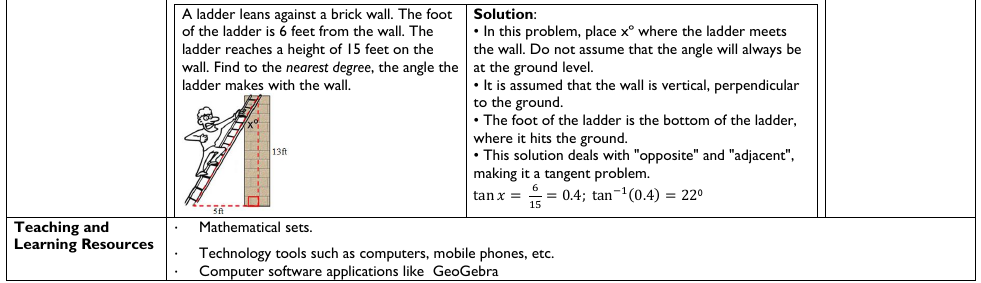
 A ladder leans against a brick wall. The foot Solution: of the ladder is 6 feet from the wall. The
- In this problem, place xº where the ladder meets ladder reaches a height of 15 feet on the the wall. Do not assume that the angle will always be wall. Find to the nearest degree, the angle the at the ground level. ladder makes with the wall.
- It is assumed that the wall is vertical, perpendicular to the ground.
- The foot of the ladder is the bottom of the ladder, where it hits the ground.
- This solution deals with "opposite" and "adjacent", making it a tangent problem. tan 𝑥 = 15 = 0.4; tan −1 (0.4) = 22 0 6
Teaching and Learning Resources:
- Mathematical sets.
- Technology tools such as computers, mobile phones, etc.
- Computer software applications like GeoGebra
Assessment (2.3.2.AS.2). The document marks these depth-of-knowledge levels for this indicator: Level 2 Skills of conceptual understanding.