SHS2 Mathematics · Semester 2, Week 10
Measurement
Lesson notes
Learning Objectives
Indicator: 2.3.2.LI.2 - Solve problems that involve SI and imperial units in volume and capacity measurements.
By the end of the lesson, learners can:
- Distinguish between volume and capacity of a solid object using appropriate mathematical language.
- Convert between SI units of volume (cm³, m³, litres, millilitres) and between SI and imperial units (gallons, pints, cubic inches).
- Calculate the volume of prisms, cylinders, pyramids, cones, spheres and composite solids using the correct formula.
- Convert a volume expressed in one unit cubed into another unit cubed (for example, m³ to cm³) and use this to state the capacity of a container in litres.
- Solve practical problems involving volume and capacity of everyday containers using both SI and imperial units.
Sign in with your phone number to read the full note and download the GES plan - free.
Sign in with phone numberCurriculum details
- Strand
- Geometry Around Us (Strand 3)
- Sub-strand
- Measurement (3.2)
- Content standard
- 2.3.2.CS.3 - Demonstrate conceptual understanding of the measurement of surface area, volume and capacity of solid shapes. 2.3.2.LO.3 Determine the volume and capacity of solid shapes and Solve problems that involve SI and imperial units in surface area, volume and capacity measurements.
- Indicator
- 2.3.2.LI.2 - Solve problems that involve SI and imperial units in volume and capacity measurements.
- Suggested placement
-
Semester 2, Week 10
(Week 30 of the year)
Our suggestion, laid out in curriculum order across three terms of twelve weeks. NaCCA does not fix the week, so follow your school's scheme of learning.
- Source document note
-
The official curriculum document has a fault in this entry, so the curriculum text above is transcribed exactly as printed:
- exemplars - p.259: this exemplar sets a two-dimensional construct - a stacked fraction, an index or a column vector - which the text layer flattens into separate lines, so the parts are present but their vertical arrangement is lost; read the page
- Curriculum reference
- NaCCA curriculum document, p. 256
Exemplars (from the NaCCA curriculum)
Using Talk for Learning strategy, engage learners to explain, using examples, the difference between volume and capacity. Bring learners' attention to the fact that as differences exist between volume and capacity, which are two close concepts, it is the same among humans and, therefore, the need to appreciate these differences and respect each and everyone irrespective of their background.
Examples: i. The total amount of any substance which is contained in a particular space is called the volume. The total potential amount of any substance that can be contained in a space is called the capacity of that space. Thus, the amount of space that a substance takes up is known as volume. The maximum amount of a substance that an object can contain is known as its capacity.

 The container here holds some amount of liquid. The total amount of liquid in the container is the volume of the liquid, but the capacity of the container is the potential amount of liquid that can be contained in the entire space of the container.
ii.
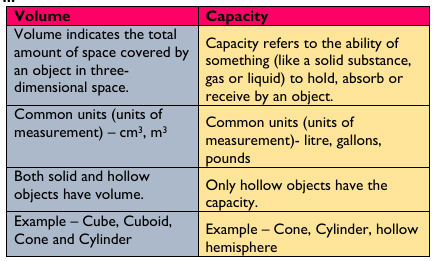
 Volume Capacity Volume indicates the total Capacity refers to the ability of amount of space covered by something (like a solid substance, an object in threegas or liquid) to hold, absorb or dimensional space. receive by an object. Common units (units of Common units (units of measurement) - cm 3 , m 3 measurement)- litre, gallons, pounds Both solid and hollow Only hollow objects have the objects have volume. capacity. Example - Cube, Cuboid, Example - Cone, Cylinder, hollow Cone and Cylinder hemisphere
iii. Find the volume and capacity (in litres) of a cylinder whose radius is 7 cm and height is 20 cm.
Solution: Given, r = 7 cm and h = 20 cm We know that, Volume of cylinder = πr 2 h = (22/7) × 7 × 7 × 20 = 22 × 7 × 20 = 3080 cm 3 Capacity of the cylinder = 3080/1000 litres (1000 cm 3 = 1 litre) = 3.08 litres
Note: We can also represent capacity in terms of cm 3 . Hence, in the above example, volume will be numerically equal to capacity.
Experiential Learning: In mixed-gender groups, task learners to identify and compare referents, then estimate volume and capacity measurements in SI and imperial units. Encourage learners to see the need to embrace technology in solving problems in surface area measurements while appreciating the need to use them appropriately.
Examples: Practical Activities for Learners
- How will you help Adzo use a 1-L milk carton to estimate 750 ml of water?
- Estimate the number of cubic metres in the classroom. Explain how you determined this estimate. Find the actual measurement. Use this information to help you estimate the volume of another differently sized room, such as the library.
- I need a box with a volume of 4000 cubic centimetres to hold a gift I have purchased. Describe what the box might look like. What is an example of a gift that would fit into this box?
- A container holds 1.5 litres. Is it large enough to make a jug of orange juice if the concentrate is 355 ml and you have to use the concentrate can to add three full cans of water? Explain your thinking.
- Investigate the capacities of various beverage containers to determine which size container is found most often. Record your findings in a graph or table and present this to the class.
Experiential Learning: Engage learners in pairs to identify a situation where a given SI or imperial volume unit would be used.
Example: I would measure water in a bath using L, but I would measure liquid in a baby-food bowl in ml.
Collaborative learning: Learners discuss and solve problems that involve the volume of 3-D objects and composite 3-D objects using formulae. Then, write the volume measurement expressed in one SI/imperial unit cubed in another SI/imperial unit cubed.
Example 1: Determine the volume of the following shapes (It should also include pyramids and all available solid shapes)
3D Object Formula
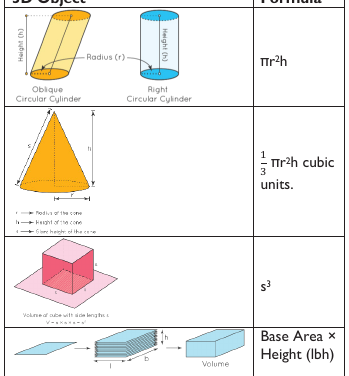
πr 2 h
1 πr 2 h cubic 3 units.
s 3
Base Area × Height (lbh)
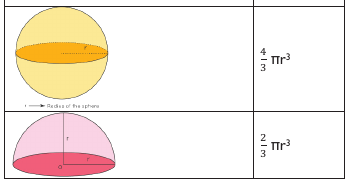
4 πr 3 3
2 πr 3 3
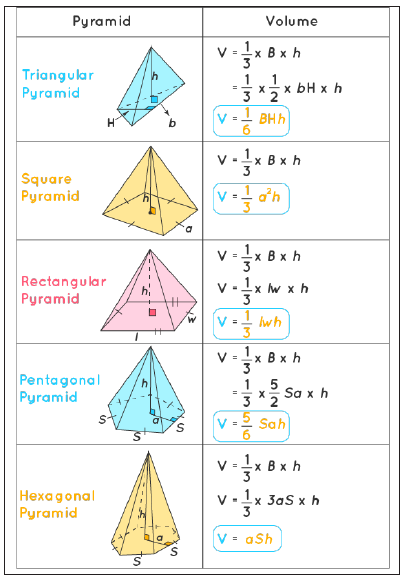
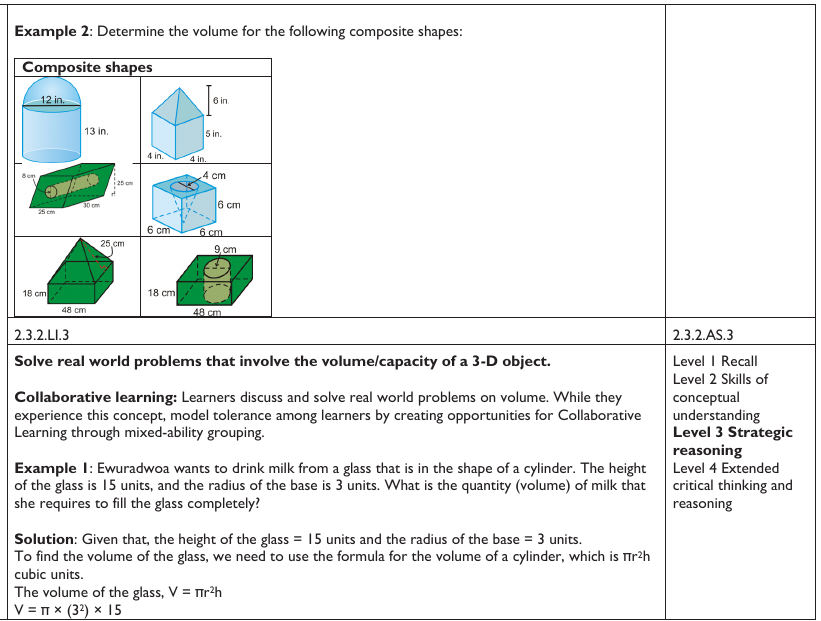
 Example 2: Determine the volume for the following composite shapes:
Composite shapes
Teaching and Learning Resources:
- Mathematical sets.
- Technology tools such as computers, mobile phones, etc.
- * Computer software applications like GeoGebra
Assessment (2.3.2.AS.2). The document marks these depth-of-knowledge levels for this indicator: Level 2 Skills of conceptual understanding.