SHS1 Additional Mathematics · Semester 2, Week 5
Measurement of Triangles
Lesson notes
Learning Objectives
Indicator: 1.2.2.LI.1 - Recall basic trigonometric ratios and use the knowledge to solve problems relating to triangles.
By the end of the lesson, learners can:
- State the three basic trigonometric ratios (sine, cosine, tangent) in terms of the sides of a right-angled triangle and recall Pythagoras theorem.
- Write the reciprocal trigonometric ratios (cosecant, secant, cotangent) for a given right-angled triangle.
- Sketch a right-angled triangle from a given description and label the opposite, adjacent and hypotenuse sides correctly.
- Determine the sign (positive or negative) of each trigonometric ratio in each of the four quadrants.
- Solve practical word problems involving right-angled triangles using trigonometric ratios and Pythagoras theorem.
Sign in with your phone number to read the full note and download the GES plan - free.
Sign in with phone numberCurriculum details
- Strand
- Geometric Reasoning and Measurement (Strand 2)
- Sub-strand
- Measurement of Triangles (2.2)
- Content standard
- 1.2.2.CS.1 - Demonstrate understanding of the measurement of triangles and radians. 1.2.2.LO.1 Describe diagrammatically and algebraically ways of representing problems involving angles of elevation and depression and solve related word problems. Identify values of the special angles, explain the radian measure orally and mathematically and find coordinates of the unit circle and their corresponding angles in the quadrants. 1.2.2.LO.2 Identify values of the special angles in degrees and radians and solve problems relating to the coordinates of the unit circle.
- Indicator
- 1.2.2.LI.1 - Recall basic trigonometric ratios and use the knowledge to solve problems relating to triangles.
- Suggested placement
-
Semester 2, Week 5
(Week 25 of the year)
Our suggestion, laid out in curriculum order across three terms of twelve weeks. NaCCA does not fix the week, so follow your school's scheme of learning.
- Source document note
-
The official curriculum document has a fault in this entry, so the curriculum text above is transcribed exactly as printed:
- exemplars - p.170: adjacent duplicated CambriaMath characters were collapsed, but this PDF also maps some equation glyphs to the wrong letter or operator; verify every mathematical expression in this row against the rendered page
- exemplars - p.170: a stacked fraction, matrix, vector or other two-dimensional construct is flattened by the text layer; all visible parts require comparison with the rendered page
- Curriculum reference
- NaCCA curriculum document, p. 170
Exemplars (from the NaCCA curriculum)
Collaborative learning, initiate Talk for Learning.
Learning Experience: Learners in groups recollect how to apply Pythagoras theorem to solve practical problems in trigonometry.
Activity 1: Using Think-Pair-Share, learners review trigonometric ratios, their reciprocals, and sketch right triangles and state the relationship among the sides and angles.
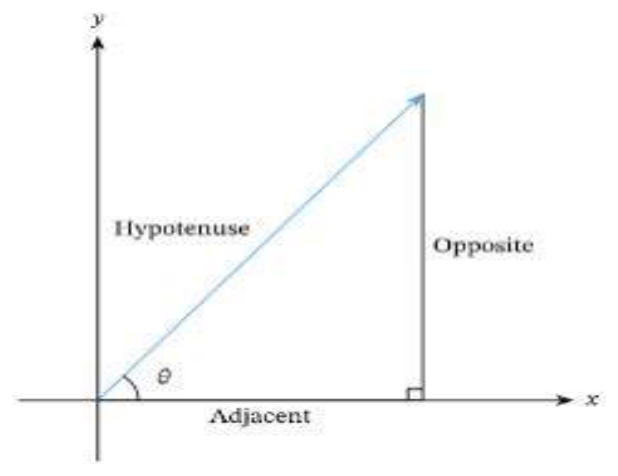
- Learners establish in their groups that P++POLGN &<Y&;N%G P++POLGN 𝑠 = , 𝑐 = and 𝑡 = WA+PGN%XON WA+PGN%XON &<Y&;N%G
WA+PGN%XON WA+PGN%XON
- Learners in pairs establish the reciprocals as 𝑐 = , 𝑠 = and 𝑐 = P++POLGN &<Y&;N%G &<Y&;N%G P++POLGN
Activity 2: Using collaborative learning, learners solve right triangles and state their observations about the sign (+, −) of the values.
Activity 3: Using collaborative learning, learners recall the signs each trigonometric ratio assumes in each of the four quadrants.
Quadrant Trigonometric Function
𝑠 𝑐 𝑡 𝑐 𝑠 𝑐 I + + + + + +
II + - - - - +
III - - + + - -
IV - + - - + -
Activity 4: With the use of collaborative learning, learners solve word problems involving angles of elevation and depression and share their solutions with the class.
Teaching and Learning Resources:
- Inclinometer Protractor rule tape measure
- SHS mathematics curriculum
- Video clips
Assessment (1.2.2.AS.1). The document marks these depth-of-knowledge levels for this indicator: Level 1 Recall; Level 2 Skills of conceptual understanding; Level 3 Strategic reasoning; Level 4 Extended critical thinking and reasoning.