JHS2 Social Studies · Term 2, Week 4
Colonialism and Nationalism
Lesson notes
Learning Objectives
Indicator: B8.6.2.1.1 - Analyse the historical roots of Ghanaian nationalism, including the role of traditional leaders and resistance movements.
By the end of the lesson, learners can:
- Identify at least six traditional leaders who resisted British colonial rule and describe the specific act of resistance associated with each.
- Explain at least four factors (1874 to 1957) that contributed to the rise of nationalism in the Gold Coast.
- Sequence the key nationalist movements (ARPS, NCBWA, GCYC, UGCC, CPP) in chronological order and state the main objective of each movement.
- Construct a timeline showing at least five key political events that led to Ghana’s independence in 1957.
- Discuss the contribution of women such as Sophia Oboshie Doku and Rebecca Naa Dedei Aryeetey to the nationalist struggle.
Sign in with your phone number to read the full note and download the GES plan - free.
Sign in with phone numberCurriculum details
- Strand
- Nationalism and Nationhood (Strand 6)
- Sub-strand
- Colonialism and Nationalism (6.2)
- Content standard
- B8.6.2.1 - Demonstrate understanding of the origins and development of nationalism in Ghana.
- Indicator
- B8.6.2.1.1 - Analyse the historical roots of Ghanaian nationalism, including the role of traditional leaders and resistance movements.
- Suggested placement
-
Term 2, Week 4
(Week 16 of the year)
Our suggestion, laid out in curriculum order across three terms of twelve weeks. NaCCA does not fix the week, so follow your school's scheme of learning.
- Curriculum reference
- NaCCA curriculum document, p. 47
Exemplars (from the NaCCA curriculum)
1. Using documentaries, pictures or other sources, learners identify key traditional leaders who opposed British colonial rule (E.g. Awulae Kaku Ackah (Aka) of Nzema, Nana Badu Bonsu II of Ahanta, King Tackie Tawiah I of Ga, King Aggrey of Cape Coast, Otumfuo Prempeh I of Asante, Nana Yaa Asantewaa of Edweso, Nana Adwoa Arduah of Wassa Fiase, etc.).
2. Using close reading protocol, learners examine the factors that contributed to the rise of nationalism (1874-1957).
3. Using a jigsaw strategy, learners analyse the activities of key nationalist movements in Ghana, including the Aborigines Rights Protection Society (ARPS), National Congress of British West Africa (NCBWA), Gold Coast Youth Conference (GCYC), United Gold Coast Convention (UGCC), Convention People's Party (CPP).
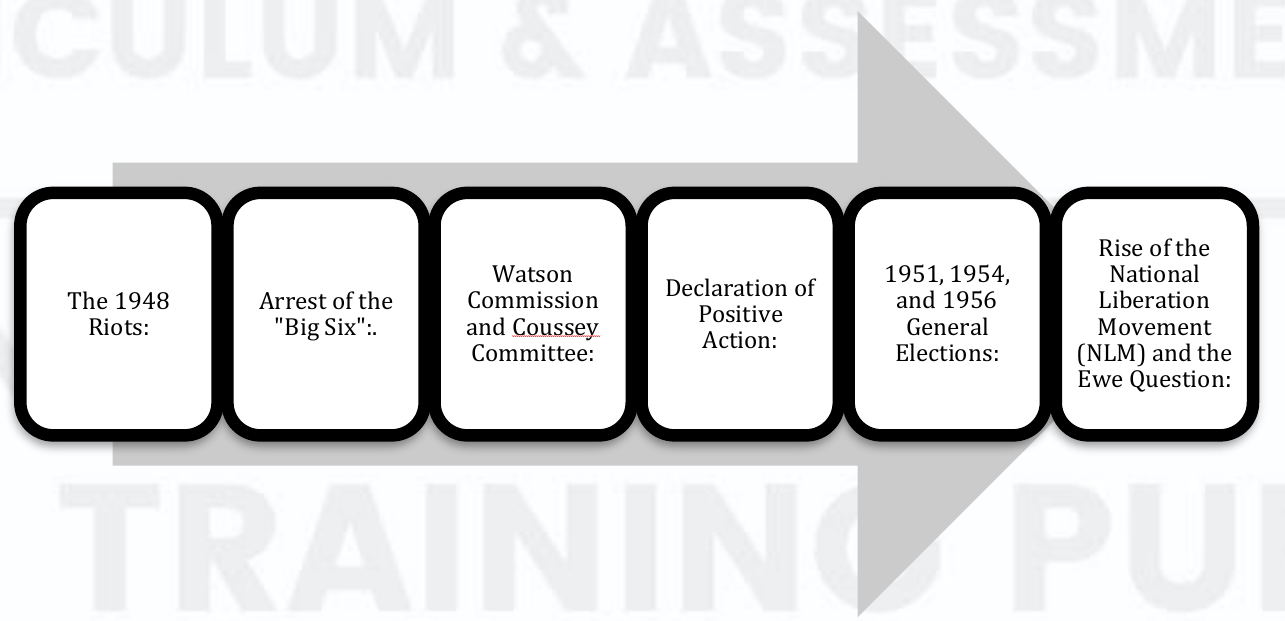
4. Learners create a chronological timeline identifying key political events that led to Ghana's Independence (E.g., the 1948 Riots, the arrest of the "Big Six," the setting up of the Watson Commission and the Coussey Committee, the Declaration of Positive Action, the 1951, 54, and 56 General Elections, the rise of the NLM, and the trans-volta Togoland plebiscite).
5. Learners assess the role of women in the struggle for Ghana's independence. (E.g., Sophia Oboshie Doku, Rebecca Naa Dedei Aryeetey, etc.).