SHS2 Additional Mathematics · Semester 2, Week 13
Applications of Calculus
Full lesson notes coming
Notes for this lesson are being prepared. The curriculum details below are complete and ready to use for your planning.
Curriculum details
- Strand
- Calculus (Strand 3)
- Sub-strand
- Applications of Calculus (3.2)
- Content standard
- 2.3.2.CS.1 - Find maximum and minimum values and points of a function, sketch the functions, and Solve some real life problems. 2.3.2.LO.1 Investigate the turning point of a function.
- Indicator
- 2.3.2.LI.1 - Find the maximum and minimum values and points of a function, sketch the functions and solve some real life problems.
- Suggested placement
-
Semester 2, Week 13
(Week 33 of the year)
Our suggestion, laid out in curriculum order across three terms of twelve weeks. NaCCA does not fix the week, so follow your school's scheme of learning.
- Source document note
-
The official curriculum document has a fault in this entry, so the curriculum text above is transcribed exactly as printed:
- exemplars - p.399: adjacent duplicated CambriaMath characters were collapsed, but this PDF also maps some equation glyphs to the wrong letter or operator; verify every mathematical expression in this row against the rendered page
- exemplars - p.402: a stacked fraction, matrix, vector or other two-dimensional construct is flattened by the text layer; all visible parts require comparison with the rendered page
- Curriculum reference
- NaCCA curriculum document, p. 399
Exemplars (from the NaCCA curriculum)
Talk for Learning, Think-pair-share, Experiential Learning and Group Work/Collaborative Learning.
Activity 1: Maximum values and points Learners in their small mixed-ability/gender groups discuss how to find maximum values and points.
Theorem: Let 𝑓 be a differentiable function on an open interval and suppose that 𝑓 - (𝑐) = 0 at a point 𝑐 inside this interval: If 𝑓 - (𝑥) < 0 for 𝑥 < 𝑐 and 𝑓 - (𝑥) > 0 for 𝑥 > 𝑐, then 𝑓 has a local minimum at 𝑐 If 𝑓 - (𝑥) > 0 for 𝑥 < 𝑐 and 𝑓 - (𝑥) < 0 for 𝑥 > 𝑐, then 𝑓 has a local maximum at 𝑐 If 𝑓 - does not change sign at 𝑐 for 𝑥 < 𝑐 or 𝑥 > 𝑐. Even though 𝑓(c)=0), 𝑓 has neither a local minimum nor maximum at 𝑐.
Example: Find the turning point(s) and sketch of the following
- 𝑦 = 𝑥 ) − 3𝑥 − 4
- 𝑦 = 𝑥 ) − 𝑥 − 6
- 𝑦 = 𝑥 " − 9𝑥 ) − 21𝑥 − 4
Solution 𝑦 = 𝑓(𝑥) = 𝑥 " − 9𝑥 ) − 21𝑥 − 4
Step 1 Find the derivative of y <A = 3𝑥 ) − 18𝑥 − 21 <0
<A Step 2 Equate <0 to zero and solve for 𝑥. <A = 3𝑥 ) − 18𝑥 − 21 = 0 <0 3𝑥 ) − 18𝑥 − 21 = 0 Solving the above, we have 𝑥 = 7 or −1
Step 3 Find the turning points At 𝑥 = −1, 𝑓(−1) = 7 is a critical value; hence (−1,7) is a turning/critical point. At 𝑥 = 7, 𝑓(7) = −249 is a critical value; hence (7, −249) is a turning point.
Sketching Step 1: Find the zeros of the function; find the values of x for which f(x)=0. Step 2: Find the turning points. Step 3: Investigate the turning points, whether it is maximum or minimum. Step 4: Sketch.
Activity 2: Application of differentiation Learners in mixed-ability groups discuss and apply differentiation to solve life problems.
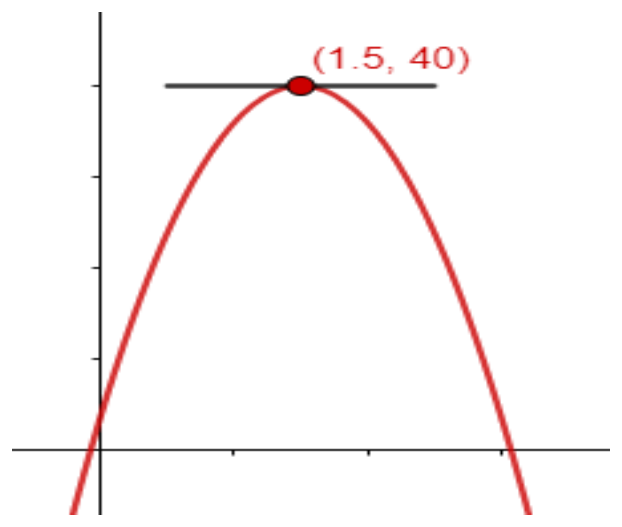
- Suppose that a ball is thrown straight up into the air and its height after 𝑡 seconds is 4 + 48𝑡 − 16𝑡 ) feet. Determine how long it will take for the ball to reach its maximum height and determine the maximum height.
Solution: Let ℎ be the height of the ball. Such that ℎ = 𝑓(𝑡), 𝑡 in seconds 𝑓(𝑡) = 4 + 48𝑡 − 16𝑡 ) = 48 − 32𝑡 At turning point, 𝑓 - (𝑡) = 0 48 − 32𝑡 = 0 " 𝑡 = = 1.5 𝑠 ) Maximum height of the ball 𝑓(1.5) = 4 + 48(1.5) − 16(1.5) ) = 40 𝑓
The ball reaches its maximum height of 40 feet in 1.5 seconds
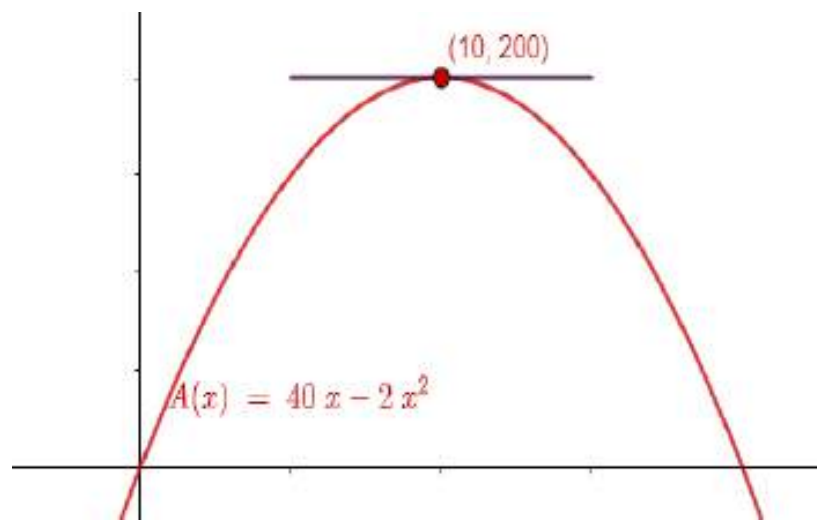
- A person wants to plant a rectangular garden along one side of a house, with a picket fence on the other three sides of the garden. Find the dimensions of the largest garden that can be enclosed using 40 feet of fencing.
Solution: Let 𝑤 𝑎 𝑥 denote the dimensions of the rectangular garden, the area, 𝐴 = 𝑤 The perimeter of the rectangular garden fencing 3 sides: 2𝑥 + 𝑤 = 40 𝑤 = 40 − 2𝑥 ∴ 𝐴 = (40 − 2𝑥)𝑥 = 40𝑥 − 2𝑥 ) At turning point, 𝐴 - = 0 40 − 4𝑥 = 0 𝑥 = 10 feet The maximum area, 𝐴 = 40(10) − 2(10) ) = 200 𝑠 𝑓 𝑤 = 40 − 2(10) = 20 feet
- The manager of a department store wants to build a 600-square-foot rectangular enclosure on the store's parking plot in order to display some equipment. Three sides on the enclosure will be built of redwood fencing at a cost of GHC14 per running foot. The fourth side will be built of cement blocks at a cost of GHS28 per running foot. Find the dimensions of the enclosure that will minimize the total of the building materials.
Solution: Let 𝑥 𝑎 𝑦 be the length of the side built out of cement blocks and the adjacent side, respectively. Cost of redwood= (𝑥 + 2𝑦) ∙ 14 = 14𝑥 + 28𝑦 Cost of cement blocks = 28𝑥
If 𝐶 denotes the total cost of the materials, then 𝐶 = (14𝑥 + 28𝑦) + 28𝑥 𝐶 = 42𝑥 + 28𝑦 Area, 𝐴 = 𝑥 = 600 /(( 𝑦 = 0 /(( 𝐶 = 42𝑥 + 28 i 0 j
𝐶 = 42𝑥 + !/,1(( 0
By sketching the curve:
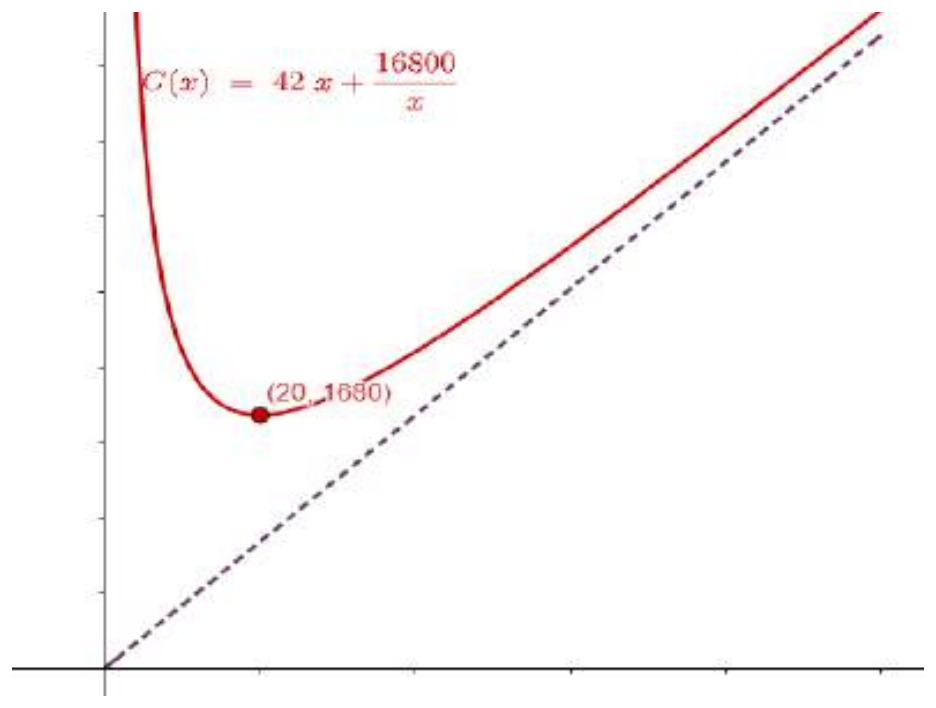
The minimum total cost of GHC1680 occurs at 𝑥 = 20 /(( By this, 𝑦 = )( = 30
∴ 𝑥 = 20 𝑓, 𝑦 = 30 𝑓
- Ghana's regulations on posting parcels state that packages must have a length plus girth of no more than 84 inches. Find the dimensions of the cylindrical package of the greatest volume that is mailable by parcel post.
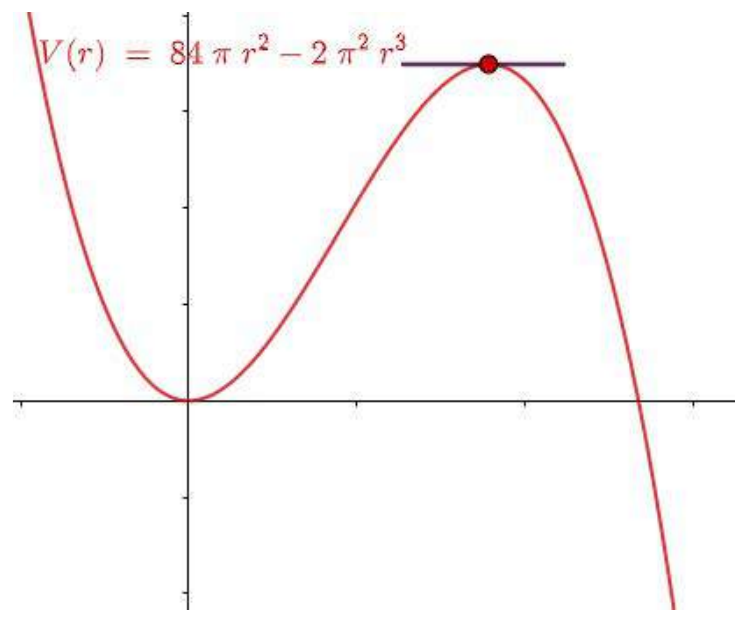
Solution: Let 𝑙 and 𝑟 denote the length of the package and radius of the circular end, respectively. The volume, 𝑉 = 𝜋𝑟 ) 𝑙The girth is the circumference of the circular end = 2𝜋 𝑙ℎ + 𝑔ℎ = 84 𝑙 + 2𝜋 = 84 𝑙 = 84 − 2𝜋
⟹ 𝑉 = 𝜋𝑟 ) (84 − 2𝜋) = 84𝜋𝑟 ) − 2𝜋 ) 𝑟 " At maximum, 𝑉 - = 0 ∴ 𝑉 - = 168𝜋 − 26𝑟 ) = 0 )1 𝑟 = \
The maximum volume, )1 ) )1 " 𝑉 = 84𝜋 i j − 2𝜋 ) i j \ \ )1 " = \ )1 𝑙 = 84 − 2𝜋 i \ j = 28
)1 𝑔ℎ = 2𝜋 i j = 56 \ ∴ 𝑙 = 28 𝑖ℎ𝑒, 𝑟 = )1 𝑖ℎ𝑒 \ 𝑔ℎ = 56 𝑖ℎ𝑒
- Suppose that, on a certain route, an airline carries 8000 passengers per month, each paying GHC50. The airline wants to increase the fare. However, the market research department
estimates that for each GHC1 increase in fare, the airline will lose 100 passengers. Determine the price that maximizes the airline's revenue.
Solution: Let 𝑥 and 𝑛 be the price per ticket and number of passengers, respectively. Revenue, 𝑅 = 𝑛 Number of passengers =original number of passengers-(number of passengers lost due to fare increase) 𝑛 = 8000 − (𝑥 − 50) ∙ 100 = 13,000 − 100𝑥 ∴ 𝑅 = (13,000 − 100𝑥)𝑥 = 13,000𝑥 − 100𝑥 ) At maximum, 𝑅 - = 0 13,000 − 200𝑥 = 0 𝑥 = 65 The maximum revenue occurs when the price per ticket is GHC65.
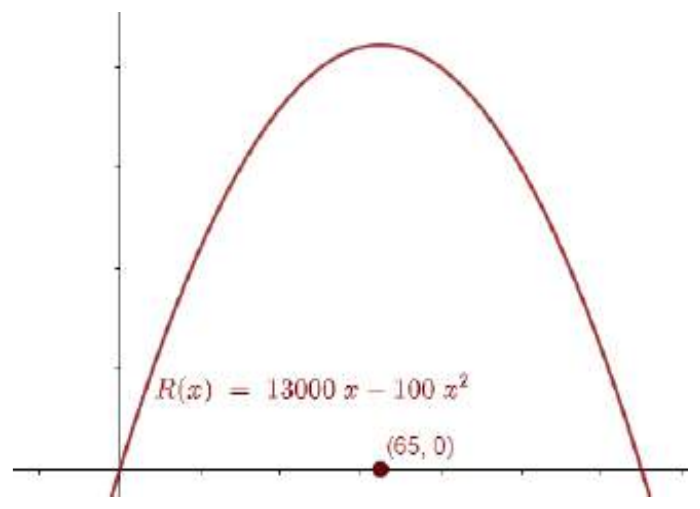
- Suppose that, from Takoradi to Ho, a VIP bus carries 8000 passengers per month, each paying GHC50. The VIP wants to increase the fare. However, the market research department estimates that for each GHS1 increase in fare, the airline will lose 100 passengers. Determine the price that maximizes the VIP's revenue.
Solution: Let 𝑥 and 𝑛 be the price per ticket and number of passengers, respectively. Revenue, 𝑅 = 𝑛 Number of passengers =original number of passengers-(number of passengers lost due to fare increase) 𝑛 = 8000 − (𝑥 − 50) ∙ 100 = 13,000 − 100𝑥 ∴ 𝑅 = (13,000 − 100𝑥)𝑥 = 13,000𝑥 − 100𝑥 ) At maximum, 𝑅 - = 0 13,000 − 200𝑥 = 0 𝑥 = 65 The maximum revenue occurs when the price per ticket is GHC65.
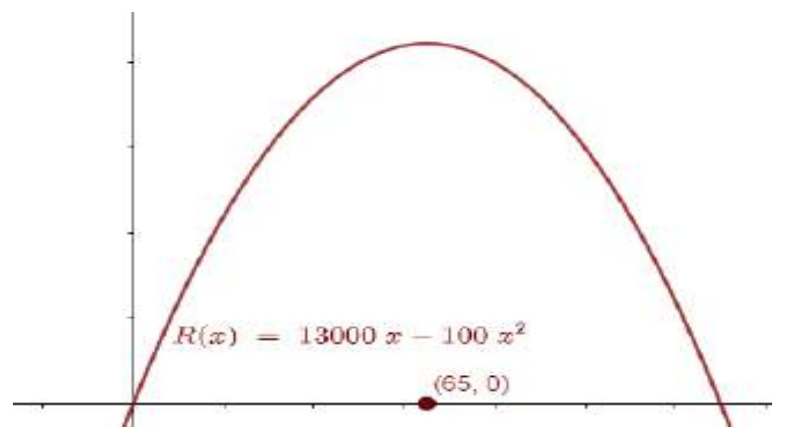
- After an injection, the concentration of the drug in a muscle varies according to a function of time, 𝑓(𝑡). Suppose that 𝑡 is measured in hours and 𝑓(𝑡) = 𝑒 *(.()G − 𝑒 *(.,)G . Determine the time when the maximum concentration of the drug occurs.
Solution: The maximum time concentration occurs when 𝑓 - (𝑡) = 0 ⟹ 𝑓 - (𝑡) = −0.02𝑒 *(.()G + 0.42𝑒 *(.,)G = 0 0.42𝑒 *(.,)G = 0.02𝑒 *(.()G 21𝑒 *(.,)G = 𝑒 *(.()G N .2.2!4 21 = N .2.'!4
21 = 𝑒 (*(.()$(.,))G 𝑙21 = 0.4𝑡 (t≈ 7.6) 𝑡 ≈ 8 ℎ𝑜
- After an injection, the concentration of the drug in a muscle varies according to a function of time, 𝑓(𝑡). Suppose that 𝑡 is measured in hours and 𝑓(𝑡) = 𝑒 *(.()G − 𝑒 *(.,)G . Determine the time when the maximum concentration of the drug occurs.
- Freddy Phones Company limited market its product in Kumasi and Accra and can charge different amounts in each city. Let 𝑥 be the number of units to be sold in Kumasi and 𝑦 the number of units to be sold in Accra. Due to the law of demand, Freddy phones must set the price at 97 − (𝑥/10) Ghana cedi in Kumasi and 83 − (𝑦/20) Ghana cedi in Accra in order to sell all the units. The cost of producing these units is 20,000 + 3(𝑥 + 𝑦). Find the values of 𝑥 and 𝑦 that maximise the profit.
- Find the path to minimise pigeon flight energy if a pigeon released 1 mile from the shore needs to reach a point on the shore 2 miles from the closest shore point, and the pigeon needs 4/3 more energy to fly over water.
- A tetramer is a protein with four subunits. In the study of tetramer binding, the equation 𝑥 + 3𝑥 ) + 3𝑥 " + 10𝑥 , 𝑌 = 1 + 4𝑥 + 𝑥 ) + 4𝑥 " + 10𝑥 ,
expresses a typical relationship between saturation 𝑌 and ligand concentration 𝑥(𝑥 ≥ 0). Ordinarily, the variable 𝑌/𝑥 is plotted as a function of 𝑥. Explain why 𝑌/𝑥 an absolute maximum value has. Find this value to three decimal places.
- Suppose a large computer file is sent over the internet. If the probability that it reaches its destination without any errors is 𝑥, then the probability that an error is made is 1 − 𝑥. The field of Information Theory studies such situations. An important quantity is entropy (a measure of unpredictability), defined by
𝐻 = −𝑥 − (1 − 𝑥)𝑙(1 − 𝑥), 𝑓 0 < 𝑥 < 1. Find the value of 𝑥 that maximises this quantity. Explain why this value makes sense to the probability that maximises entropy.
Teaching and Learning Resources:
- Cardboards
- Reading resource
- Colour pens
- Notebook
- Graph sheets
- Mathematical sets
- Technological tools
Assessment (2.3.2.AS.1). The document marks these depth-of-knowledge levels for this indicator: Level 1 Recall; Level 2 Skills of conceptual understanding; Level 3 Strategic reasoning; Level 4 Extended critical thinking and reasoning.