SHS2 Additional Mathematics · Semester 2, Week 14
Applications of Calculus
Lesson notes
Learning Objectives
Indicator: 2.3.2.LI.2 - Use the second derivative of a function to classify the maximum, minimum and saddle point of that function and perform curve sketching.
By the end of the lesson, learners can:
- State the second derivative test theorem and explain what each condition (f’’(c) > 0, f’’(c) < 0, f’’(c) = 0) tells us about a turning point.
- Compute the second derivative of a given polynomial function accurately.
- Classify turning points as local maximum, local minimum, or saddle point using the second derivative test.
- Sketch the curve of a cubic or quartic function by locating intercepts, turning points, and using the classification from the second derivative test.
- Use the second derivative test to solve a real-life optimisation problem set in a Ghanaian context.
Sign in with your phone number to read the full note and download the GES plan - free.
Sign in with phone numberCurriculum details
- Strand
- Calculus (Strand 3)
- Sub-strand
- Applications of Calculus (3.2)
- Content standard
- 2.3.2.CS.1 - Find maximum and minimum values and points of a function, sketch the functions, and Solve some real life problems. 2.3.2.LO.1 Investigate the turning point of a function.
- Indicator
- 2.3.2.LI.2 - Use the second derivative of a function to classify the maximum, minimum and saddle point of that function and perform curve sketching.
- Suggested placement
-
Semester 2, Week 14
(Week 34 of the year)
Our suggestion, laid out in curriculum order across three terms of twelve weeks. NaCCA does not fix the week, so follow your school's scheme of learning.
- Source document note
-
The official curriculum document has a fault in this entry, so the curriculum text above is transcribed exactly as printed:
- exemplars - p.408: adjacent duplicated CambriaMath characters were collapsed, but this PDF also maps some equation glyphs to the wrong letter or operator; verify every mathematical expression in this row against the rendered page
- Curriculum reference
- NaCCA curriculum document, p. 408
Exemplars (from the NaCCA curriculum)
Talk for Learning, Think-pair-share, Experiential Learning and Group Work/Collaborative Learning.
Activity 1: Turning points Learners are to work in pairs or small groups to discuss how to classify turning points.
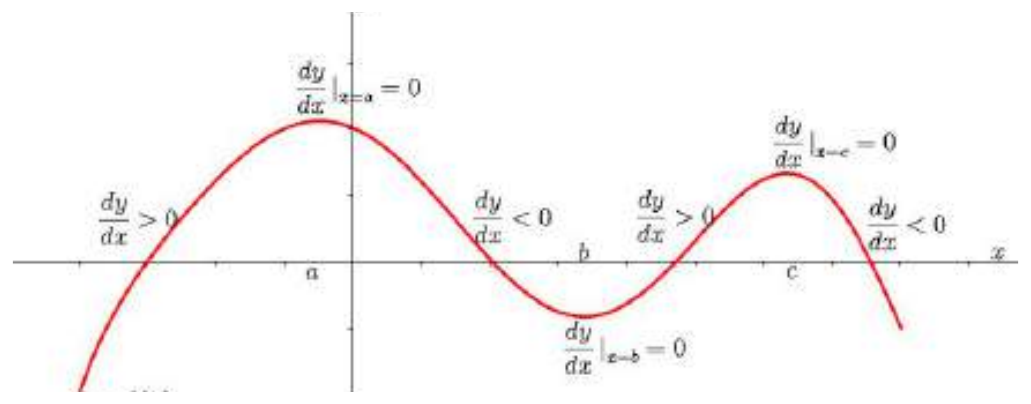
From the first derivative test, if f' moves from positive to negative about a point, then that point is local maximum. Likewise, if f' moves from negative to positive about a point, then that point is local minimum.
Theorem (Second derivative Test) Given a continuous function 𝑓 if 𝑓 -- (𝑥)| 04; > 0 then the point (𝑐, 𝑓(𝑐) is a minimum and if 𝑓 -- (𝑥) < 0 the point (𝑐, 𝑓(𝑐) is maximum if 𝑓 -- (𝑥) = 0 then (𝑐, 𝑓(𝑐) a saddle point
Example: Classify the turning point(s) of the following 𝑦 = 𝑥 " − 9𝑥 ) + 24𝑥 , ) 𝑦 = 𝑥 − 9𝑥
Teaching and Learning Resources:
- Cardboards
- Reading resource
- Colour pens
- Notebook
- Graph sheets
- Mathematical sets
- Technological tools
Assessment (2.3.2.AS.2). The document marks these depth-of-knowledge levels for this indicator: Level 1 Recall; Level 2 Skills of conceptual understanding; Level 3 Strategic reasoning; Level 4 Extended critical thinking and reasoning.