SHS3 Additional Mathematics · Semester 1, Week 6
Applications of Algebra
Full lesson notes coming
Notes for this lesson are being prepared. The curriculum details below are complete and ready to use for your planning.
Curriculum details
- Strand
- Modelling with Algebra (Strand 1)
- Sub-strand
- Applications of Algebra (1.2)
- Content standard
- 3.1.2.CS.2 - Demonstrate the ability to use and apply knowledge of matrices in linear transformations and apply a linear transformation to solve problems in context. 3.1.2.LO.1 Construct compound statements and truth tables using connectives. 3.1.2.LO.2 Apply linear transformation in: finding images of points and object points. finding reflections and rotations of points and plane figures.
- Indicator
- 3.1.2.LI.3 - Find the composition of linear transformations.
- Suggested placement
-
Semester 1, Week 6
(Week 6 of the year)
Our suggestion, laid out in curriculum order across three terms of twelve weeks. NaCCA does not fix the week, so follow your school's scheme of learning.
- Source document note
-
The official curriculum document has a fault in this entry, so the curriculum text above is transcribed exactly as printed:
- exemplars - p.455: adjacent duplicated CambriaMath characters were collapsed, but this PDF also maps some equation glyphs to the wrong letter or operator; verify every mathematical expression in this row against the rendered page
- Curriculum reference
- NaCCA curriculum document, p. 455
Exemplars (from the NaCCA curriculum)
Think-pair-share, Talk for Learning, and Building on what others say.
Learning Experience: Learners in convenient groups discuss and determine the composition of linear transformations.
Activity 1: Composition of linear transformations This occurs when an object undergoes two or more transformations, one after the other. Thus, 𝐴(𝑥, 𝑦 ). 𝐵(𝑥, 𝑦 ) is defined as the transformation the matrix 𝐵, followed by the transformation of matrix 𝐴. This is calculated as follows:
- Write the matrix 𝐴 and 𝐵 of the linear transformation.
- Find the matrix product 𝐴.
- Write the linear transformation for 𝐴. That is 𝐴(𝑥, 𝑦 ).
- Notice that the matrix that represents the first transformation, A, is placed on the right, and the second transformation, B, is placed on the left in the matrix product.
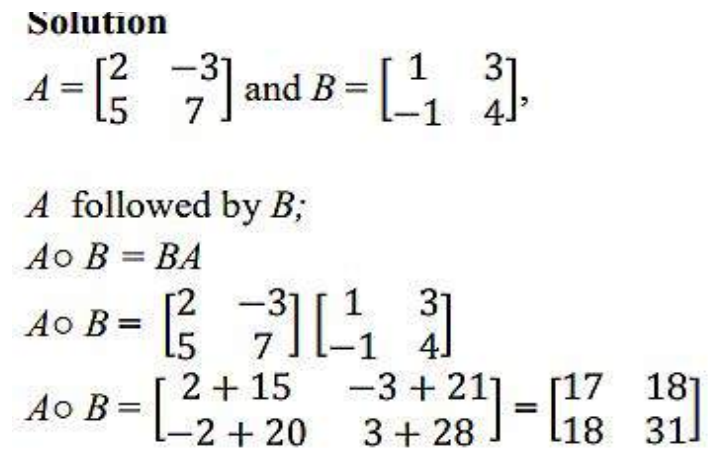
2 −3 1 3 Example 1: Given the matrices 𝐴 = É Ê and 𝐵 = É Ê, find the matrix of the transformation 5 7 −1 4 𝐴, followed by 𝐵.
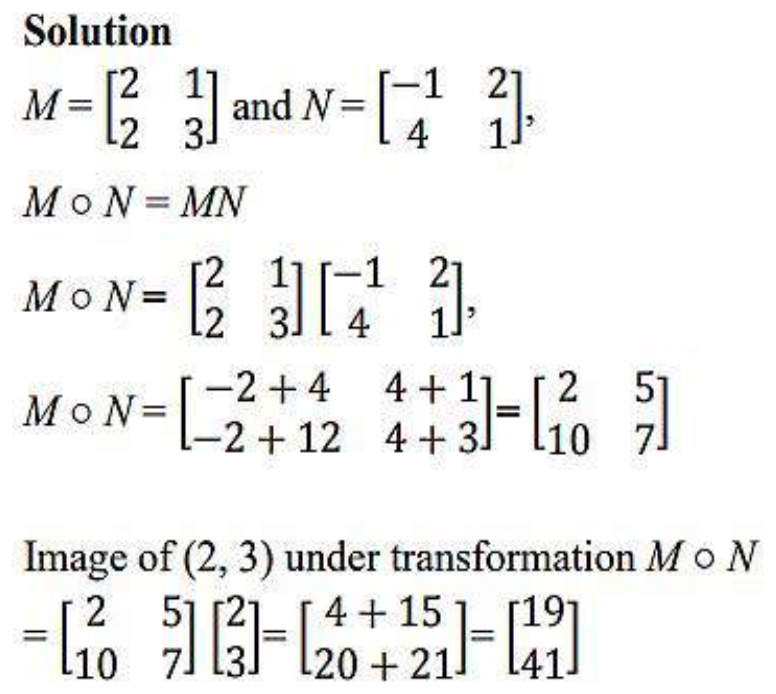
2 1 −1 2 Example 2: Given that 𝑀 = É Ê and 𝑁 = É Ê, find the image of the point (2, 3) under the 2 3 4 1 transformation 𝑀 ○ 𝑁.
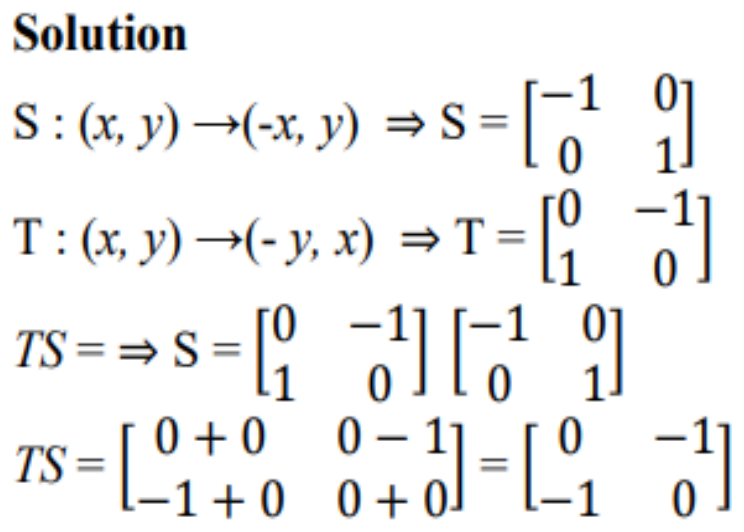
Example 3: Let𝑆: (𝑥, 𝑦) → (−𝑥, 𝑦) and 𝑇(𝑥, 𝑦) → (−𝑦, 𝑥) be two linear transformations in the 𝑥- 𝑦 plane. Find a single matrix representing the composite transformation TS.
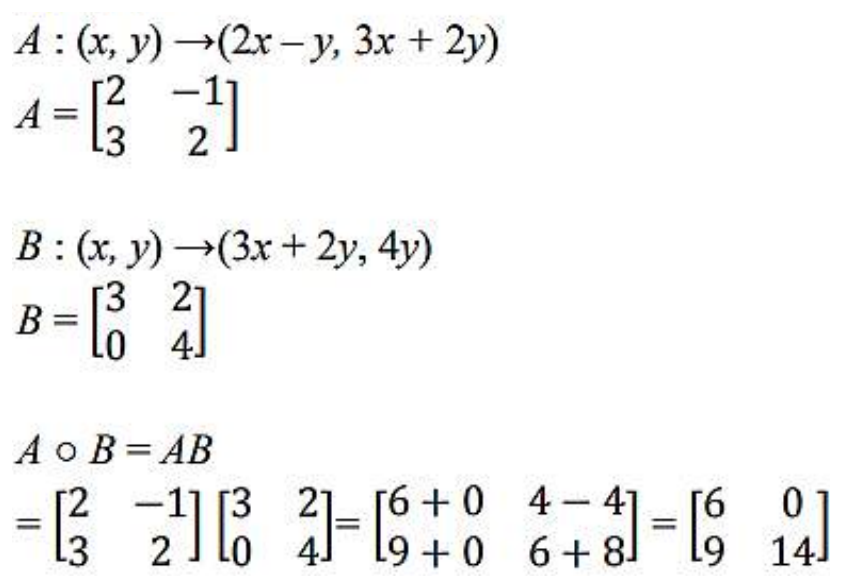
Example 4: Two linear transformations are defined by: 𝐴(𝑥, 𝑦) → (2𝑥- 𝑦, 3𝑥 + 2𝑦) and 𝐵(𝑥, 𝑦) → (3𝑥 + 2𝑦, 4𝑦) Find the matrix representing 𝐴 ○ 𝐵.
Teaching and Learning Resources:
- SHS Curriculum, Graph boards, mathematical set, ICT tools
Assessment (3.1.2.AS.3). The document marks these depth-of-knowledge levels for this indicator: Level 2 Skills of conceptual understanding; Level 3 Strategic reasoning.