SHS1 Additional Mathematics · Semester 1, Week 7
Applications of Algebra
Lesson notes
Learning Objectives
Indicator: 1.1.2.LI.1 - Recognise sequences in mathematics as an enumerated collection of objects in which repetitions are allowed and classify sequences into linear or exponential.
By the end of the lesson, learners can:
- Define a sequence as an enumerated collection of objects, numbers, or symbols in which repetitions are allowed.
- Identify and describe the pattern rule in a given sequence, whether it is made of numerals, objects, shapes, or actions.
- Classify a given sequence as linear (constant difference) or exponential (constant multiplier or ratio).
- Create their own sequences from real-life situations and state the pattern rule that governs them.
- Distinguish between a sequence and a series, recognising that a series is the sum of the terms of a sequence.
Sign in with your phone number to read the full note and download the GES plan - free.
Sign in with phone numberCurriculum details
- Strand
- Modelling with Algebra (Strand 1)
- Sub-strand
- Applications of Algebra (1.2)
- Content standard
- 1.1.2.CS.1 - Demonstrate knowledge and understanding of applying algebraic processes and reasoning involving sequence, functions, and linear programming. 1.1.2.LO.1 Examine, analyse, determine and predict other terms in a pattern/sequence. 1.1.2.LO.2 Distinguish among various types of relations, find the domain and range of, and evaluate functions. 1.1.2.LO.3 Show that a function is injective (into) and/or surjective (onto). Find the inverse, describe the relationship between two variables and establish composite functions. 1.1.2.LO.4 Graph linear and quadratic functions and determine the intercepts. 1.1.2.LO.5 Find graphical and algebraic solutions to a system of three linear equations in three variables and apply them to solve real life problems. 1.1.2.LO.6 Perform algebraic manipulations on polynomial functions and graph polynomial functions. 1.1.2.LO.7 Find the domain, range, and zero of a rational function and state when it is undefined. 1.1.2.LO.8 Identify and describe the order of a matrix, the identity matrix and the zero matrix; find the determinant and perform basic arithmetic operations on 2 by 2 matrices (addition and subtraction).
- Indicator
- 1.1.2.LI.1 - Recognise sequences in mathematics as an enumerated collection of objects in which repetitions are allowed and classify sequences into linear or exponential.
- Suggested placement
-
Semester 1, Week 7
(Week 7 of the year)
Our suggestion, laid out in curriculum order across three terms of twelve weeks. NaCCA does not fix the week, so follow your school's scheme of learning.
- Source document note
-
The official curriculum document has a fault in this entry, so the curriculum text above is transcribed exactly as printed:
- exemplars - p.93: a stacked fraction, matrix, vector or other two-dimensional construct is flattened by the text layer; all visible parts require comparison with the rendered page
- Curriculum reference
- NaCCA curriculum document, p. 88
Exemplars (from the NaCCA curriculum)
Collaborative Learning: Learners will work in convenient groups (ability, mixed-ability, mixed gender etc.) to solve problems and present answers related to sequence and series.
Talk for Learning Approaches: Learners will brainstorm through think-pair-square and debate and discuss the types and features of sequences.
Project-based Learning: Learners will collaboratively embark on a project to develop a sequence that is relevant and applicable to real life and make presentations.
Experiential Learning: Learners will collaboratively engage in hands-on activity (learning by doing) to create sequences using objects, symbols and numerals and discuss pattern rules.
Problem-based Learning: Learners will collaboratively undertake a research inquiry into what happens when terms of sequence are summed up.
Activity 1: Sequence in real life situations Discuss sequences in the natural environment and create sequences using objects, symbols, and numerals.
Talk for Learning: Initiate TfL approaches for learners to brainstorm, debate, and discuss reasons for learning about sequence:
Example: Some important facts about sequence and series:
- The knowledge of sequence and series helps to shape our logical skills.
- Sometimes, we want to find out all the possible things out there because we want to know the most probable terms to satisfy our curious minds. Sequence and series help to settle this curiosity in us.
- Knowledge equips us with skills and strategies to find the sum of things going on even up to infinity, which is useful in scientific thesis.
Note: A Sequence is any set of objects, often numbers, that follow a particular pattern infinitely. A series refers to the description of the operation that would add all of the items in a sequence.
Collaborative and Problem-based: Learners work in small mixed-ability groups to investigate, identify and discuss real life patterns in their environment and talk about the pattern rule. For instance, have learners act out and talk about:
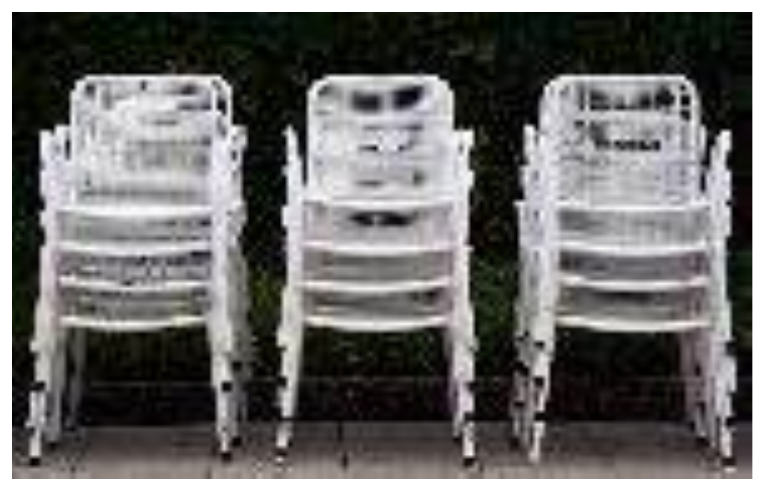
- Stacking cups, chairs, bowls etc., to compare the number of objects to the height of the object.
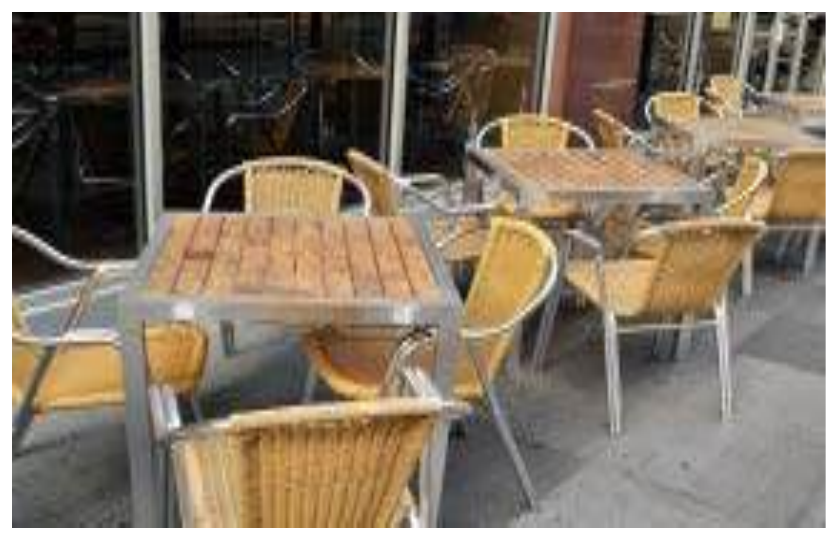
- Seating around tables: Consider a restaurant with a square table that fits 4 people. What happens when two square tables are put together, now 6 people are seated. Put 3 square tables together, and now 8 people are seated, etc. Learners may visualise this better if they are allowed to model this sequence.
Note: A rectangular table can also be used to model the sequence, but it starts with 6 seats.
- Filling something: Consider the rate at which the object is being filled, using time as the variable. An example could be a sink being filled or a pool being filled. Also, consider draining a liquid, sand, sugar, etc., out of a container with a small hole beneath.
- Fencing and perimeter: Discuss how adding a fence panel to each side of a rectangular fence would change the perimeter. For example, the first figure concept could have one panel on
each side (or change it so it is not a square). The next figure concept could have two panels on each side and so on. Each time, find the new perimeter.
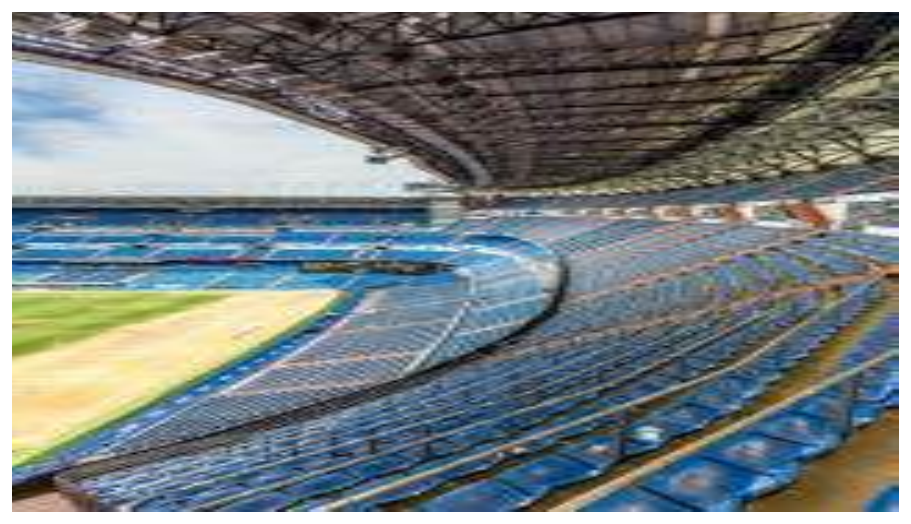
- Building pyramid-like patterns, where objects are constantly increasing or decreasing, such as in seats in a stadium or an auditorium. For example, a situation might be that seats in each row decrease by 4 from the previous row.
- Negative number patterns: Think about temperature and places below sea level on Earth. Create situations like, during rainfall, the surface of the water started at 153 feet below sea level and rose at a rate of such and such per hour or diving in the ocean.

Activity 2: Modelling instances of sequences Collaborative, Problem-based and Experiential Learning: Learners work in small mixed-ability groups and model sequences (numerical and non-numerical - using colours, cut-out shapes, objects, fabrics, sound, actions, etc.) and talk about the pattern rule. For instance,
- Learners work in smaller groups/pairs to produce/create a sequence and record their findings in tables,
- Learners in one group create a sequence and then challenge another/other groups to:
- continue or extend the pattern to include the next term;
- describe the pattern rule and record them in tables;
- write a rule that will allow you to find any large shape form.
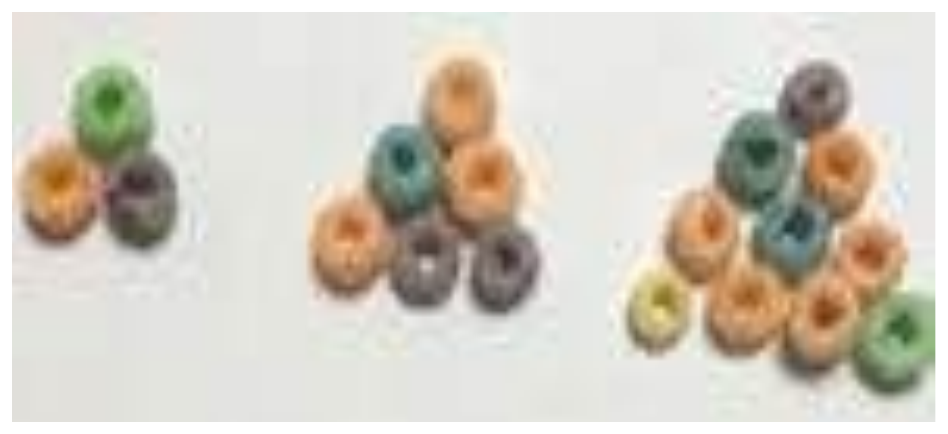
Example 1: Study the sequence, extend it to complete the table below and answer the questions that follow.
Pattern no. 1 2 3 4 5 6 ...
No. of bottle caps 3 6 10
- Describe the pattern rule.
- Write a rule which will allow you to find the number of small pebbles in any large pebbles.
Example 2: Study the pattern, draw a picture of the next likely shapes and complete the table. Write a pattern rule which will allow you to find:
- the number of squares
- the number of joints in any large shape.
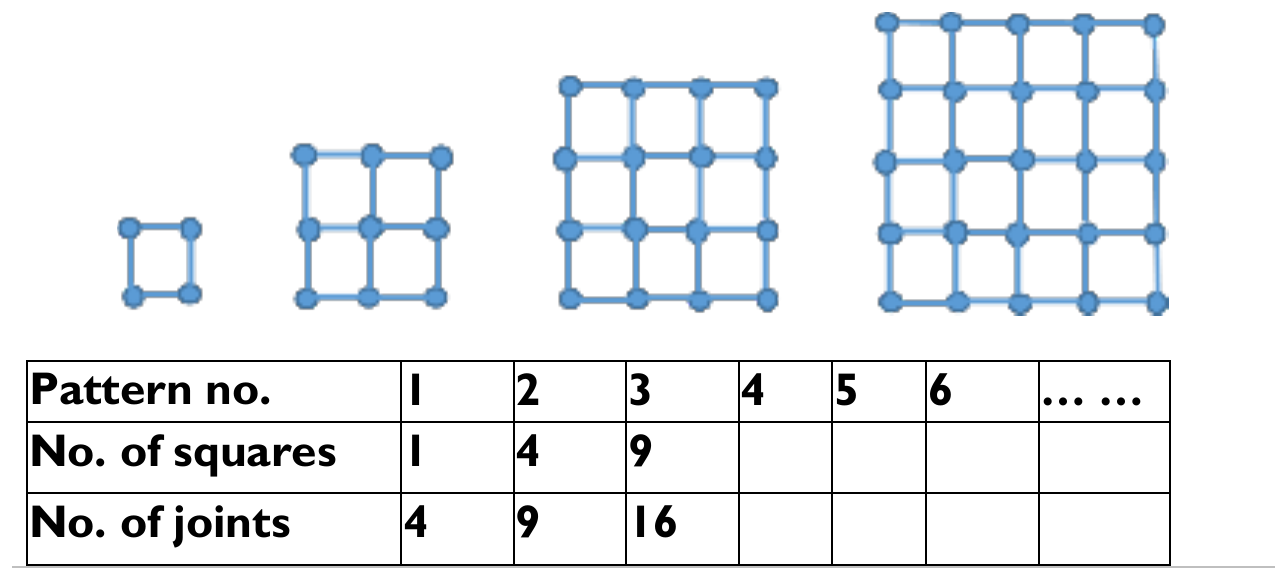
Pattern no. 1 2 3 4 5 6 ... ... No. of squares 1 4 9
No. of joints 4 9 16
Teaching and Learning Resources:
- Cut out shapes of different colours and orientation
- Maths Technology learning apps, tools and devices
- Chalkboard illustrations
- Worksheets
- Cut-out geometrical shapes of different colours and orientation
Assessment (1.1.2.AS.1). The document marks these depth-of-knowledge levels for this indicator: Level 1 Recall.