SHS3 Additional Mathematics · Semester 2, Week 8
Application of Calculus
Full lesson notes coming
Notes for this lesson are being prepared. The curriculum details below are complete and ready to use for your planning.
Curriculum details
- Strand
- Calculus (Strand 3)
- Sub-strand
- Application of Calculus (3.2)
- Content standard
- 3.3.2.CS.1 - Demonstrate conceptual Find the area under a constant function, curves and distinguish between total, net and understanding of integration to find distances, areas under curve, volumes and other related real life problems. 3.3.2.LO.1 Determine distance, area under curve and solid of volumes formed under revolution.
- Indicator
- 3.3.2.LI.4 - Find the volume of a solid formed after rotation about horizontal or vertical axis.
- Suggested placement
-
Semester 2, Week 8
(Week 28 of the year)
Our suggestion, laid out in curriculum order across three terms of twelve weeks. NaCCA does not fix the week, so follow your school's scheme of learning.
- Source document note
-
The official curriculum document has a fault in this entry, so the curriculum text above is transcribed exactly as printed:
- exemplars - p.529: adjacent duplicated CambriaMath characters were collapsed, but this PDF also maps some equation glyphs to the wrong letter or operator; verify every mathematical expression in this row against the rendered page
- exemplars - p.530: a stacked fraction, matrix, vector or other two-dimensional construct is flattened by the text layer; all visible parts require comparison with the rendered page
- Curriculum reference
- NaCCA curriculum document, p. 529
Exemplars (from the NaCCA curriculum)
Talk for Learning, Think-pair-share, Experiential Learning; and Group Work/Collaborative Learning.
Inter-group competition: Learners from one group create two binary operations for the other group to investigate volume of solid formed after revolution about and axis.
Volume: Method of Disks Suppose that 𝑓(𝑥) ≥ 0 and 𝑓 is continuous on the interval [a, b]. Take the region bounded by the curve 𝑦 = 𝑓(𝑥) and the 𝑥 − 𝑎, for 𝑎 ≤ 𝑥 ≤ 𝑏 and revolve it about the 𝑥 − 𝑎 generating a solid (figure 1a and 1b). We can find the volume of this solid by slicing it perpendicular to the 𝑥 − 𝑎 and Recognising that each cross section is a circular disk of radius 𝑟 = 𝑓 (𝑥). We then have that the volume of the solid as % ' 𝑉 = t[𝐴(𝑐 L )] ∆𝑥 = î 𝜋[𝑓(𝑥)] ) 𝑑 & L4!
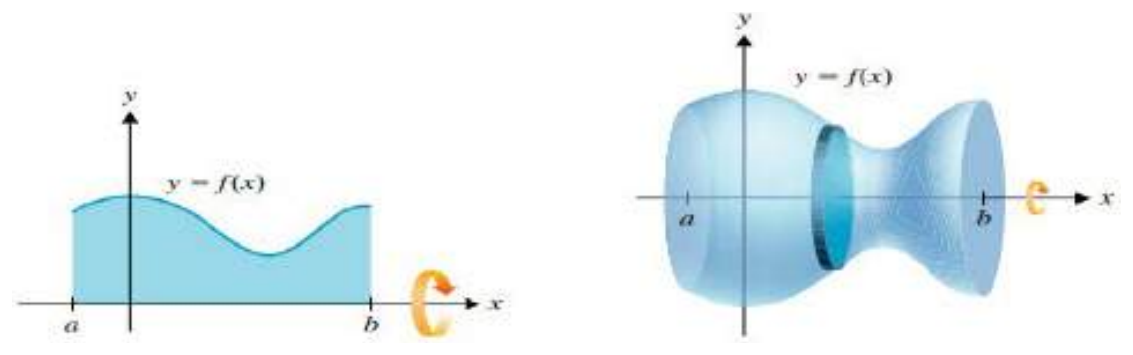
𝑦 = 𝑓(𝑥) ≥ 0 Solid of revolution
Example
- Revolve the region under the curve 𝑦 = √𝑥 on the interval [0, 4] about the 𝑥 − 𝑎 and find the volume of the resulting solid of revolution.
Solution:
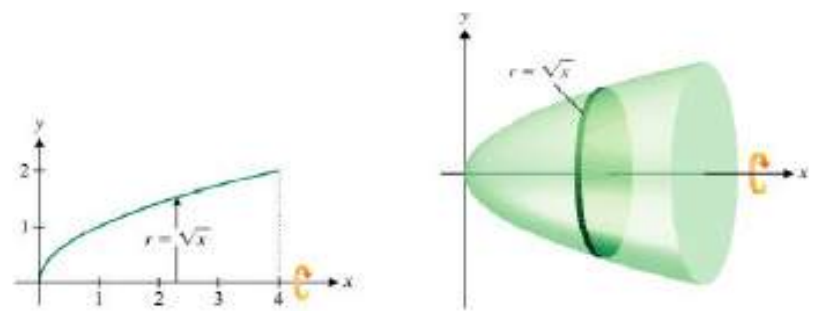
, 𝑉 = î 𝜋[√𝑥] ) 𝑑 ( , = 𝜋 î [√𝑥] ) 𝑑 ( , = 𝜋 î 𝑥 𝑑 ( 𝑥 ) = 𝜋 ) * 4 0 = 8𝜋 2 NB: In a similar way, suppose that g(y) ≥ 0 and g is continuous on the interval [c, d]. Then, revolving the region bounded by the curve x = g(y) and the y − axis, for c ≤ y ≤ d, about the y − axis generates a solid. (See Figures 3a and 3b.) Once again, notice from Figure 3b that the cross sections of the resulting solid of revolution are circular disks of radius r = g(y). All that has changed here is that we have interchanged the roles of the variables x and y. The volume of the solid is then given by < 𝑉 = î 𝜋[𝑔(𝑦)] ) 𝑑 ;
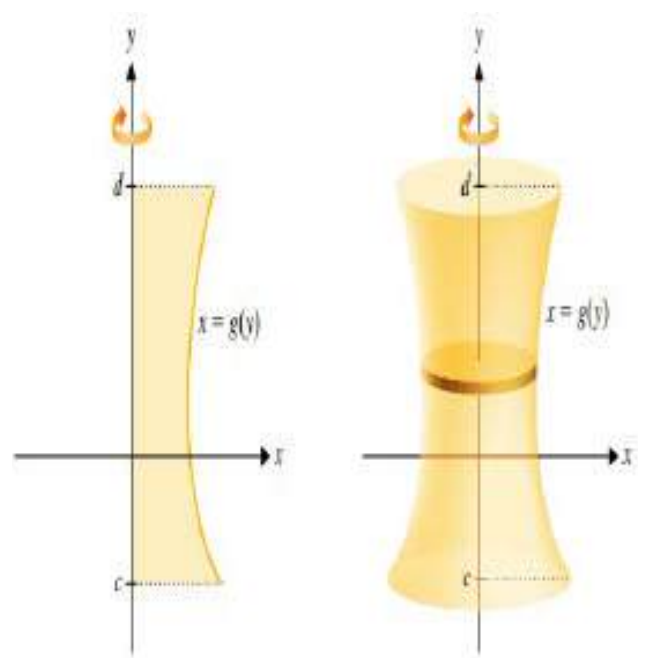
Revolve about the 𝑦 − 𝑎 Example: Find the volume of the solid resulting from revolving the region bounded by the curve 𝑦 = 4 − 𝑥 ) and 𝑦 = 1 from 𝑥 = 0 to 𝑥 = √3.
Solution: By solving for 𝑥, we have 𝑥 = w4 − 𝑦, 𝑦 = 1 to 𝑦 = 4 , , ) 𝑉 = î 𝜋lw4 − 𝑦n 𝑑 = î 𝜋(4 − 𝑦) 𝑑 ! ! 𝑦 ) 1 9𝜋 = 𝜋 )4𝑦 − * 4 1 = 𝜋 ö(16 − 8) − £4 − ¤÷ = 2 2 2 𝑦 = 4 − 𝑥 )
0 ! Find the volume of the solid resulting from revolving the portion of the curve 𝑦 = 2 − from 𝑥 = ) 0 𝑡 𝑥 = 2 about the 𝑦 − 𝑎.
Teaching and Learning Resources:
- Reading resource colour pens
- Notebook
- Graph sheets
- Mathematical sets,
- Technological tools.
- Curriculum
- Cardboard
Assessment (3.3.2.AS.4). The document marks these depth-of-knowledge levels for this indicator: Level 3 Strategic reasoning; Level 4 Extended critical thinking and reasoning.