SHS2 Additional Mathematics · Semester 1, Week 1
Application of Algebra
Lesson notes
Learning Objectives
Indicator: 2.1.1.LI.2 - Describe the set theory as a foundation for many subfields of mathematics, and create and model set problems in the areas pertaining to industry, commerce, sports, etc.
By the end of the lesson, learners can:
- Explain at least three real-life areas (industry, commerce, sports) where set theory is applied and describe how sets operate in those areas.
- Create original set problems based on Ghanaian contexts such as market trading, transport, sports competitions, or school life, using up to three sets.
- Model set problems involving up to three sets using Venn diagrams, correctly placing elements in appropriate regions.
- Solve set problems by applying the union, intersection, and complement operations, and interpret the results in the context of the problem.
- Present and justify their solutions to peers using correct mathematical vocabulary, defending their reasoning with evidence from the problem.
Sign in with your phone number to read the full note and download the GES plan - free.
Sign in with phone numberCurriculum details
- Strand
- Modelling with Algebra (Strand 1)
- Sub-strand
- Application of Algebra (1.1)
- Content standard
- 2.1.1.CS.1 - Demonstrate the ability Establish De Morgan's laws of set theory and use it to solve related problems. to use sets properties and theories to solve real Pedagogy and Learning Experience life problems and apply Collaborative Learning: Learners work in convenient groups (ability, mixed-ability, mixed gender, or binomial theorem to approximate numbers to a given index. 2.1.1.LO.1 Investigate De Morgan's law on sets algebraically and graphically, formulate and solve real life problems up to three sets. 2.1.1.LO.2 Model sequence recursively and explicitly, and establish the relationship between the two forms, as well as solve real life problems involving linear and exponential sequences and series. 2.1.1.LO.3 Apply indices and logarithms to solve real life problems, including logarithms with different bases, and sketch and interpret logarithmic functions. 2.1.1.LO.4 Formulate and derive appropriate strategies to solve quadratic inequalities. 2.1.1.LO.5 Graph systems of given inequality and identify the region that provides the feasible solution and apply it to real life situations. 2.1.1.LO.6 Determine the set of values for which a rational function is defined and resolve rational functions into partial fractions. 2.1.1.LO.7 Multiply matrices, determine the inverse of a 2 x 2 matrix, find the determinant up to a 3 x 3 matrix and represent matrices in linear transformations.
- Indicator
- 2.1.1.LI.2 - Describe the set theory as a foundation for many subfields of mathematics, and create and model set problems in the areas pertaining to industry, commerce, sports, etc.
- Suggested placement
-
Semester 1, Week 1
(Week 1 of the year)
Our suggestion, laid out in curriculum order across three terms of twelve weeks. NaCCA does not fix the week, so follow your school's scheme of learning.
- Curriculum reference
- NaCCA curriculum document, p. 278
Exemplars (from the NaCCA curriculum)
Pedagogy and Learning Experience Collaborative Learning: Learners work in convenient groups (ability, mixed-ability, mixed gender, or pairs, etc.) and use analytic and graphic illustrations to apply properties of sets and laws of set algebra to solve set problems in real life contexts.
Talk for Learning Approaches: Learners brainstorm using strategies such as think-pair-share/square, debates and discussions to explain and talk about the relevance of learning set properties and algebra and how they are useful in our daily lives.
Experiential Learning: Learners collaboratively (pair and group work) work together, create and solve sets problems in real life situations by applying laws of set algebra and other properties of sets
Activity 1: Utilisation of ideas of Laws of set algebra and properties of sets.
Using Talk for Learning Approaches in collaborative groups, learners research and discuss the relevance of learning about the properties and laws of set algebra and how they are utilised in real life contexts.
Example Discuss the relevance of learning about sets and their application in real life contexts.
Set theory is used in almost every discipline, including engineering, business, medical and related health sciences, along with the natural sciences. In business operations, it can be applied at every level where intersecting and non-intersecting sets are identified. For example, the sets for warehouse operations and sales operations are both intersected by the inventory set. To improve the cost of goods sold, the solution might be found by examining where inventory intersects both sales and warehouse operations. Set theory can assist in planning and operations. Every element of business can be grouped into at least one set, such as accounting, management, operations, production and sales. Within those sets are other sets. In operations, for example, there are sets of warehouse operations, sales operations and administrative operations. In some cases, sets intersect - as sales operations can intersect the operations set and the sales set. In the kitchen, sets of similar utensils are kept separately. School bags: sets of notebooks and textbooks are kept separately in the divisions in the school bags. Music Playlist: Most of us have different playlists of songs on our smartphones and computers. Afrobeat songs are often separated from high-life or any other genre. Hence, playlists also form an example of sets.
Activity 2: Apply set theory to solve real life problems.
Using collaborative learning groups, learners challenge each other in an Inter-group competition. Thus, learners from one group create real life set problems for the members of the other group to investigate, prove and or answer. Example
- The sets L, M and N are subsets of a universal set consisting of the first 10 lower-case letters of the alphabet, if L = {a, b, c}, M = {b, c, a, e} and N = {a, d, e, f}, Determine the members of the following sets: i) M ∪ N ii) L ∪ N iii) L' iv) L ∩ M ∩ N' v) (L∪ M ∪ N)' vi) M∩N
- A sample of 100 Students' Representative Council voting delegates revealed the following concerning three candidates: Akayuure, Manukre and Odonti, who were running for the SRC Chairman, Secretary and Treasurer, respectively. 14 delegates preferred both Akayuure and Manukre, 49 preferred Akayuure or Manukre but not Odonti. 21 preferred Manukre but not Odonti or Akayuure. 61 preferred Manukre or Odonti but not Akayuure. 32 preferred Odonti but
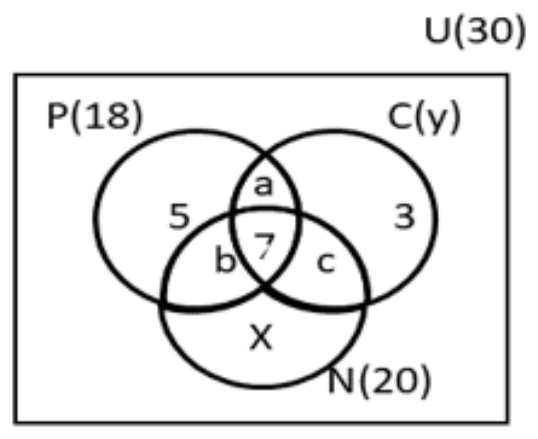
 not Akayuure or Manukre. 7 preferred Akayuure and Odonti but not Manukre. With the aid of a Venn diagram, determine the number of voters that were in favour of all three candidates. Assume that every member of the SRC voted for at least one candidate. Determine the candidate that went unopposed if a rule of 50% majority was used in such a decision.
- Find the values of a, b, c, x and y.
Teaching and Learning Resources:
- ICT tools and resources
- Worksheets
- Scientific calculator
- Technological tools, apps, etc.
- SHS Additional Mathematics Curriculum
Assessment (2.1.1.AS.2). The document marks these depth-of-knowledge levels for this indicator: Level 1 Recall; Level 2 Skills of conceptual understanding; Level 3 Strategic reasoning; Level 4 Extended critical thinking and reasoning.