SHS3 History · Semester 1, Week 1
Sources and Methods of Reconstructing History
Lesson notes
Learning Objectives
Indicator: 3.1.2.LI.1 - Corroborate historical sources and draw conclusions.
By the end of the lesson, learners can:
- Define corroboration and contextualisation in their own words and distinguish between the two concepts.
- Compare evidence from at least three different historical sources on the same event and identify points of agreement and disagreement.
- Explain why corroboration is necessary for establishing the authenticity and reliability of historical sources.
- Use a Read Like a Historian chart to evaluate the credibility of different sources on a given historical event.
- Draw a reasoned conclusion about a historical event based on corroborated evidence from multiple sources.
Sign in with your phone number to read the full note and download the GES plan - free.
Sign in with phone numberCurriculum details
- Strand
- Historical Inquiry and Writing (Strand 1)
- Sub-strand
- Sources and Methods of Reconstructing History (1.2)
- Content standard
- 3.1.2.CS.1 - Demonstrate the application of skills in interpreting and reconstructing the past 3.1.2.LO.1 Employ relevant historical skills to reconstruct history and show how the skills can provide better opportunities for the development of society.
- Indicator
- 3.1.2.LI.1 - Corroborate historical sources and draw conclusions.
- Suggested placement
-
Semester 1, Week 1
(Week 1 of the year)
Our suggestion, laid out in curriculum order across three terms of twelve weeks. NaCCA does not fix the week, so follow your school's scheme of learning.
- Curriculum reference
- NaCCA curriculum document, p. 99
Exemplars (from the NaCCA curriculum)
Enquiry Routes: What is contextualisation in History? What is corroboration in History? How does contextualisation and corroboration in history help to establish the authenticity of historical sources? Why is it necessary to contextualise and corroborate historical sources?
Problem-Based Learning:
- Using graffiti walls, learners write examples of primary and secondary sources.
- Using a case study, learners collect pieces of evidence on any historical event (eg, migration account, independence struggle, the name 'Ghana', etc.)
- In pairs, learners discuss what other pieces of evidence say about the historical event. HINT: Let learners who cannot speak use sign to demonstrate the things they cannot say or mention.
Project-Based Learning:
- Learners create a chart that shows the different versions of the historical account. (READ LIKE A HISTORIAN CHART)
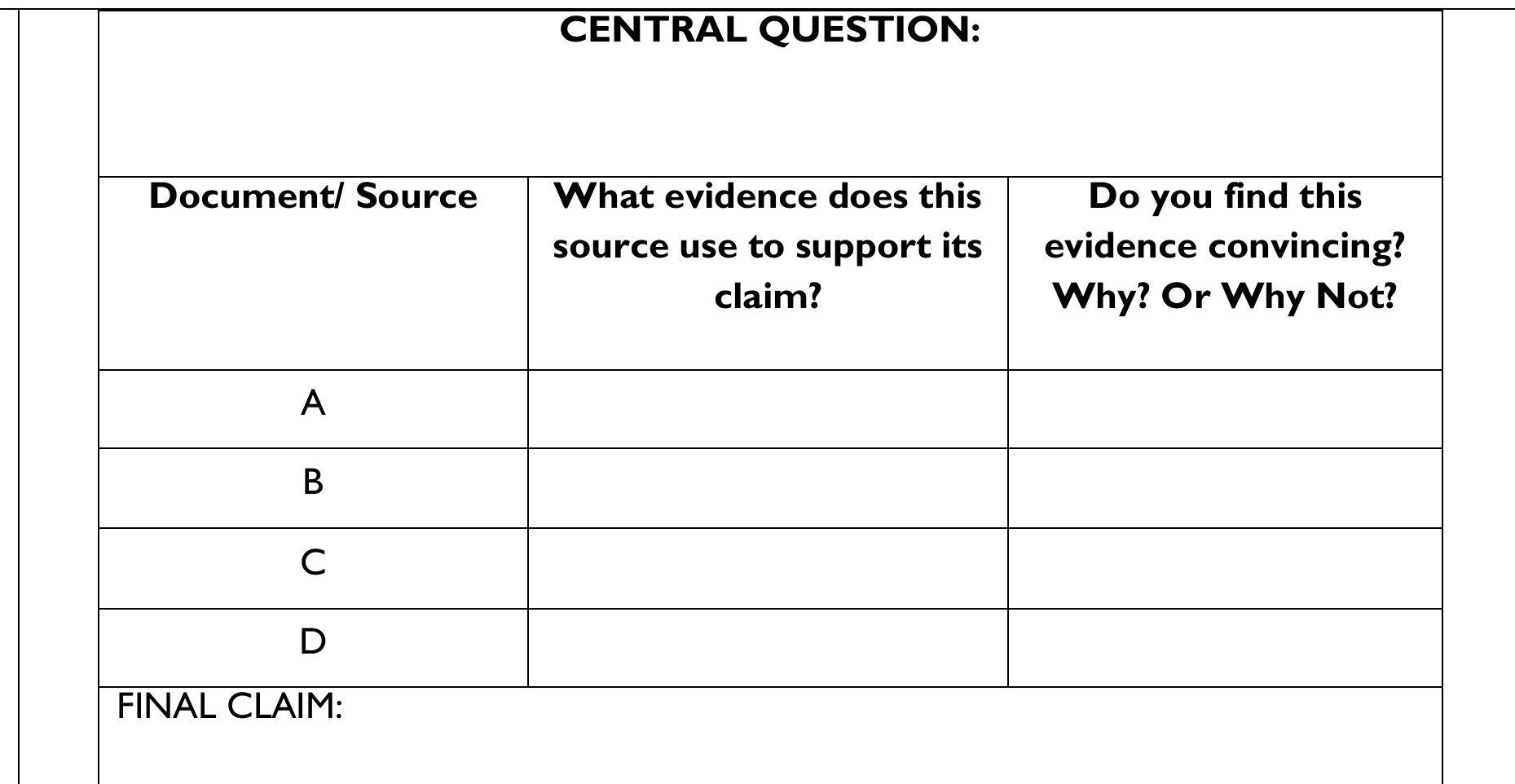
 CENTRAL QUESTION:
Document/ Source What evidence does this Do you find this source use to support its evidence convincing? claim? Why? Or Why Not?
A
B
C
D FINAL CLAIM:
- Learners make a final claim/report based on evidence from the different sources
Talk For Learning: In mixed-ability groups, learners discuss what you do if you find information from two pieces of evidence contradicting each other.
Teaching and Learning Resources:
- Primary and secondary source accounts on major historical events in Ghana. E.g., migration accounts, the (founder's') founding of Ghana, the coining of the name Ghana.
- Sample of historical texts
- Sample of survey and questionnaire
- Old photographs
- A resource person
- A chart showing the 5Ws and how they are establishing contextualisation in history.
- Stationery
- Interview guides
- Voice/audio recorders
Assessment (3.1.2.AS.1). The document marks these depth-of-knowledge levels for this indicator: Level 3 Strategic reasoning; Level 4 Extended critical thinking and reasoning.