SHS1 History · Semester 1, Week 2
Nature and Scope of History
Lesson notes
Learning Objectives
Indicator: 1.1.1.LI.2 - Analyse the nature and scope of History as an academic discipline.
By the end of the lesson, learners can:
- Identify at least four unique features of History as an academic discipline, distinguishing it from other subjects like Geography or Economics.
- Explain how History connects the past to the present using at least two concrete examples from Ghanaian society.
- Categorise historical events into at least three branches of History (such as Political, Social, Economic, or Cultural History) with accurate examples.
- Use chronological terminologies (decade, century, millennium, BCE, CE) correctly to place historical events on a timeline.
- Justify the importance of periodisation and chronology in historical studies, giving reasons why historians organise time into periods.
Sign in with your phone number to read the full note and download the GES plan - free.
Sign in with phone numberCurriculum details
- Strand
- Historical Inquiry and Writing (Strand 1)
- Sub-strand
- Nature and Scope of History (1.1)
- Content standard
- 1.1.1.CS.1 - Demonstrate understanding of the origins, meanings, and nature of history as a discipline. 1.1.1.LO.1 Use appropriate historical sources from the environment to communicate effectively the origins, nature and scope of history while demystifying common misconceptions associated with the study of history. 1.1.1.LO.2 Use relevant sources from the environment to communicate meaningfully the role of history in society.
- Indicator
- 1.1.1.LI.2 - Analyse the nature and scope of History as an academic discipline.
- Suggested placement
-
Semester 1, Week 2
(Week 2 of the year)
Our suggestion, laid out in curriculum order across three terms of twelve weeks. NaCCA does not fix the week, so follow your school's scheme of learning.
- Curriculum reference
- NaCCA curriculum document, p. 28
Exemplars (from the NaCCA curriculum)
Enquiry Routes: What is History? What are the unique features of History? How does History connect the past to the present? What are the branches of History?
Problem-Based Learning:
- Learners brainstorm the unique features of History as a discipline. Example:
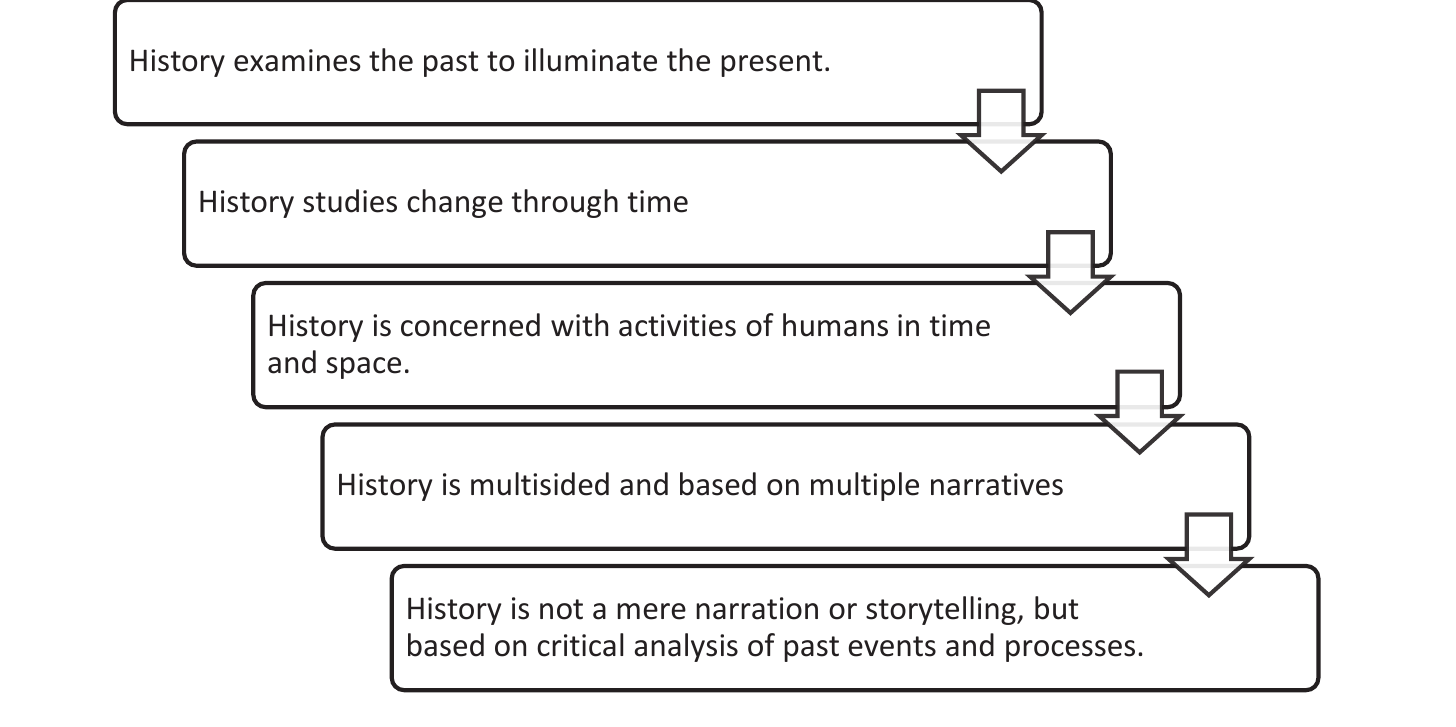
- In mixed-ability groups, learners prepare an oral presentation on the unique features of History. HINT: Encourage Approaching Proficiency learners to volunteer and share their ideas.
Project-Based Learning:
- Learners prepare a chart that explains the varied branches of History such as Political, Social, Economic, Diplomatic, Gender, Women, Cultural, Environmental, Transnational and Global Histories.
- Learners examine periodisation or dating systems in History as a key element of historical studies.
- Learners use the concept of the Number Line to explain chronological terminologies such as (CE and BCE or BC and AD), decade, century, millennium, etc.
- Learners use the internet or standard books to find out the major periods in Ghanaian history and place them in a timeline.
Teaching and Learning Resources:
- Personal/other diaries
- old photographs
- Archival documents/materials
- Newspaper cuttings/Old Newspapers
- Magazines
- Museum pieces
- Archaeological finds (material culture)
- A chronological chart showing significant historical events.
- Internet access
- A chronological timeline
- Archival documents
- Art Forms
- Cultural Materials
- Epic poems
- Myths
- Old Letters
- Memoirs/ biographies
- Presidential speeches
- Parliamentary debates/ Hansard
- Computers/ laptops, LCD projector/screen, video/ audio player
- Questionnaires
- Audio/tape recorder
- Documentary on misconceptions associated with the study of history.
- Autobiographical/ biographical narratives of/by students.
- A chart showing the REC criteria for determining historical significance.
- Resource persons
Assessment (1.1.1.AS.2). The document marks these depth-of-knowledge levels for this indicator: Level 2 Skills of conceptual understanding; Level 3 Strategic reasoning.