SHS3 Additional Mathematics · Semester 2, Week 5
Principle of Calculus
Full lesson notes coming
Notes for this lesson are being prepared. The curriculum details below are complete and ready to use for your planning.
Curriculum details
- Strand
- Calculus (Strand 3)
- Sub-strand
- Principle of Calculus (3.1)
- Content standard
- 3.3.1.CS.1 - Demonstrate conceptual understanding of the rules and techniques of integration to select and apply them. appropriately to a function. 3.3.1.LO.1 Identify and apply the integration rules to evaluate integrals.
- Indicator
- 3.3.1.LI.4 - Solve problems involving integrals with no exact antiderivative (Trapezium rule).
- Suggested placement
-
Semester 2, Week 5
(Week 25 of the year)
Our suggestion, laid out in curriculum order across three terms of twelve weeks. NaCCA does not fix the week, so follow your school's scheme of learning.
- Source document note
-
The official curriculum document has a fault in this entry, so the curriculum text above is transcribed exactly as printed:
- exemplars - p.514: adjacent duplicated CambriaMath characters were collapsed, but this PDF also maps some equation glyphs to the wrong letter or operator; verify every mathematical expression in this row against the rendered page
- exemplars - p.516: a stacked fraction, matrix, vector or other two-dimensional construct is flattened by the text layer; all visible parts require comparison with the rendered page
- Curriculum reference
- NaCCA curriculum document, p. 514
Exemplars (from the NaCCA curriculum)
Talk for Learning, Think-pair-share, Experiential Learning; and Group Work/Collaborative Learning.
Activity 1: Using the Trapezium rule Learners brainstorm by way of think-pair-share/square and debate on existence of the trapezium rule and why the need for it.
Theorem Let 𝑓(𝑥) be a continuous function on the interval[𝑎, 𝑏]. Now divide the intervals [𝑎, 𝑏] into 𝑛 equal subintervals with each of width, '*& ∆𝑥 = % , ∆𝑥 𝑖 𝑡ℎ𝑒 𝑠 𝑠 𝑎 '𝑛' 𝑖 𝑡ℎ𝑒 𝑛 𝑜 𝑝 ' 𝑇 % ≈ î 𝑓(𝑥) 𝑑 & ∆0 𝑇 % = ) [𝑓(𝑥 ( ) + 2𝑓(𝑥 ! ) + 2𝑓(𝑥 ) ) + ⋯ + 𝑓(𝑥 %*! ) + 𝑓(𝑥 % )]
Activity 2: Deriving Trapezium rule Learners work collaboratively on hands-on activity (learning by doing) to establish the trapezium rule for a given definite integral.
Example 1
- Find the area under the curve, 𝑦 = 𝑥 ) using the trapezoidal rule where 𝑛 = 5 and x ranges from 0 to 10
Solution:
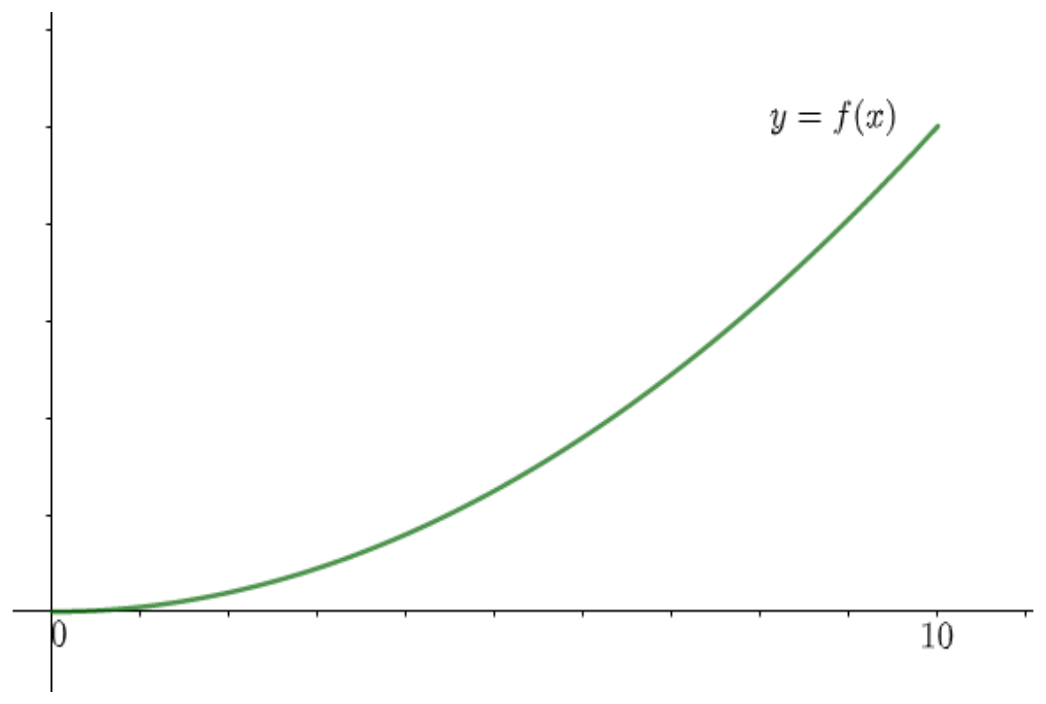
!(*( ∆𝑥 𝑥 =2 .

𝑇 . = ) [(0) ) + 2(2) ) + 2(4) ) + 2(6) ) + 2(8) ) + (10) ) ] )
= 340 𝑢 𝑠
- The table below shows the rate at which water flows through a pipe into a strange tank. This rate is measured every 10 minutes. Estimate the amount of water that will accumulate in the first hour using the trapezoidal rule.
Time Rate (min) (gal/min) 0 3.8 10 4.5 20 6.2 30 7.0 40 7.5 50 6.9 60 6.2
Solution: /(*( ∆𝑥 = % = 10, 𝑛 = 6 !( 𝑇 / = ) [3.8 + 2(4.5) + 2(6.2) + 2(7.0) + 2(7.5) + 2(6.9) + 6.2]
= 371 𝑔
Question: In medical imaging, such as CT (computerized tomography) and MRI (magnetic resonance imaging) processes at Cape Coast hospital, numerous measurements are taken and processed by a computer to construct a three-dimensional image of the tissue the physician wishes to study. Suppose that an MRI scan indicates that the cross-sectional areas of adjacent slices of a tumor are given by the values in the table.
𝑥 𝐴(𝑥)(𝑐) ) 0 0.0 0.0 0.1 0.2 0.4 0.3 0.3 0.4 0.6 0.5 0.9 0.6 1.2 0.7 0.8 0.8 0.6 0.9 0.2 1.0 0.1
Estimate the volume of the tumor using trapezium rule.
Teaching and Learning Resources:
- Reading resource colour pens
- Notebook
- Graph sheets
- Mathematical sets,
- Technological tools.
- Curriculum
- Card boards
Assessment (3.3.1.AS.4). The document marks these depth-of-knowledge levels for this indicator: Level 3 Strategic reasoning; Level 4 Extended critical thinking and reasoning.