SHS3 Additional Mathematics · Semester 1, Week 7
Applications of Algebra
Full lesson notes coming
Notes for this lesson are being prepared. The curriculum details below are complete and ready to use for your planning.
Curriculum details
- Strand
- Modelling with Algebra (Strand 1)
- Sub-strand
- Applications of Algebra (1.2)
- Content standard
- 3.1.2.CS.2 - Demonstrate the ability to use and apply knowledge of matrices in linear transformations and apply a linear transformation to solve problems in context. 3.1.2.LO.1 Construct compound statements and truth tables using connectives. 3.1.2.LO.2 Apply linear transformation in: finding images of points and object points. finding reflections and rotations of points and plane figures.
- Indicator
- 3.1.2.LI.4 - Apply linear transformation in finding translation, reflections, rotations and enlargement of points and plane figures.
- Suggested placement
-
Semester 1, Week 7
(Week 7 of the year)
Our suggestion, laid out in curriculum order across three terms of twelve weeks. NaCCA does not fix the week, so follow your school's scheme of learning.
- Source document note
-
The official curriculum document has a fault in this entry, so the curriculum text above is transcribed exactly as printed:
- exemplars - p.458: adjacent duplicated CambriaMath characters were collapsed, but this PDF also maps some equation glyphs to the wrong letter or operator; verify every mathematical expression in this row against the rendered page
- exemplars - p.458: a stacked fraction, matrix, vector or other two-dimensional construct is flattened by the text layer; all visible parts require comparison with the rendered page
- Curriculum reference
- NaCCA curriculum document, p. 458
Exemplars (from the NaCCA curriculum)
Think-pair-share, Talk for Learning, and Building on what others say.
Learning Experience: Learners in convenient groups discuss the properties and use them to perform translation of points.
Activity 1 Translation and its properties Learners in groups discuss the concept of translation and its properties. Note: Under translation, every point of the plane moves the same distance in the same direction; for all points 𝑃(𝑥 𝑦 ), 𝑂𝑃 ! = 𝑂 + 𝑇, where 𝑇 is the translation vector.
𝑥 𝑎 If 𝑂 = i 𝑦j and 𝑇 = i j, then: 𝑏 𝑥 𝑎 𝑎 + 𝑥 𝑂𝑃 = i 𝑦j + i j = i ! 𝑏 + 𝑦 j 𝑏
𝑰 = 𝑶𝒃𝒋𝒆𝒄 + 𝑻 𝒗
Properties of Translation
- It requires a translation vector, T.
- All points 𝑃 map unto their images 𝑃 ! so that 𝑃 − 𝑃 ! = 𝑇.
- The vector gives the magnitude and direction of the translation.
- There is no invariant point.
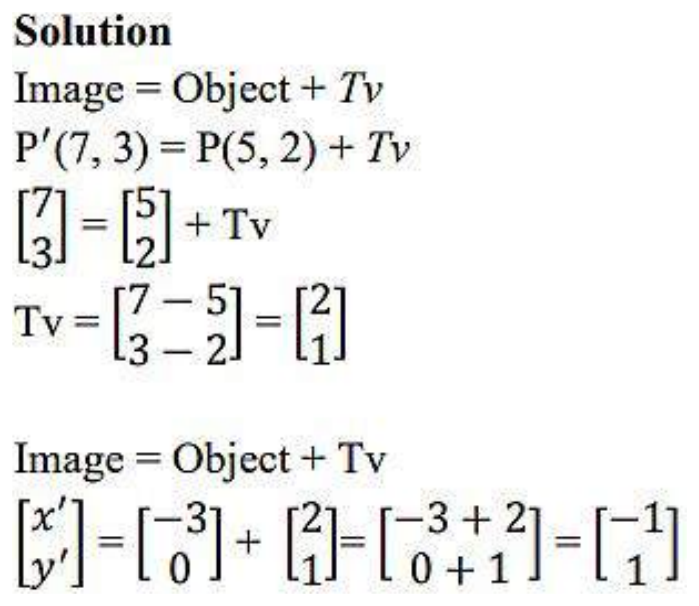
Example 1: In a translation in the plane, the image of 𝑃 ! (5, 2) is (7, 3). Find the image of 𝑄(−3, 0) under the translation.
Activity 1 Reflection and its properties Learners in groups discuss the concept of reflection and its properties.
Notes: Reflection Here, an image is produced by reflecting an object or point on either the x-axis or the y-axis. Thus, we have: 1. Reflection in the x-axis (or line y = 0). 2. Reflection in the y-axis (or line x = 0). 3. Reflection in a given line.
Reflection in the x-axis (or line y = 0).
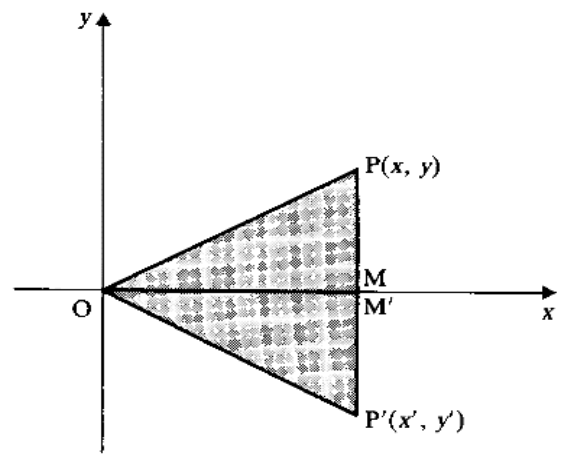
𝑥 - = 𝑥 𝑦 - = −𝑦 𝑥 𝑥' 1 0 £ ¤=i j i 𝑦j 𝑦' 0 −1
This is represented by the matrix [1 0 0 − 1 ]
Image = [1 0 0 − 1 ] × object.
Example 1: Find the image of point 𝐴(−2, 5) on the x-axis.
Solution: 𝐴(−2, 5) 1 0 Reflection in the x-axis is represented by the matrix É Ê. 0 −1 1 0 −2 𝐴 - = É ÊÉ Ê 0 −1 5
1(−2) + 0(5) −2 + 0 −2 𝐴 - = ö ÷=É Ê=É Ê 0(−2) − 1(5) 0 + −5 −5
𝐴' = (−2, −5)
Activity 2 Reflection in the y-axis (line 𝒙 = 𝟎). −1 0 This is represented by the matrix É Ê 0 1
−1 0 𝐼 = É Ê × 𝑜. 0 1
Find the image of point 𝐵(−2, 5) on the y-axis.
Solution: B (-2, 5) −1 0 Reflection in the y-axis is represented by the matrix É Ê 0 1 −1 0 −2 𝐵' = É ÊÉ Ê 0 1 5
−1(−2) + 0(5) 2 + 0 2 𝐵' = ö ÷=É Ê=É Ê 0(−2) + 1(5) 0+5 5
𝐵' = (2, 5)
Activity 2 Reflection in the line 𝒚 = 𝒙 or 𝒚- 𝒙 = 𝟎 0 1 This is represented by the matrix É Ê 1 0
0 1 𝐼 = É Ê × 𝑜. 1 0
Example: Find the image of point C (5, 7) under reflection in the line y = x.
Solution: C(5, 7) 0 1 Reflection in the y = x is represented by the matrix É Ê. 1 0 0 1 5 𝐶' = É ÊÉ Ê 1 0 7 0(5) + 1(7) 0+7 7 𝐶' = ö ÷=É Ê=É Ê 1(5) + 0(7) 5+0 5 𝐶 - = (7, 5)
Activity 3 Reflection in the line 𝒚 = −𝒙 or 𝒚 + 𝒙 = 𝟎 0 −1 This is represented by the matrix É Ê −1 0
0 −1 𝐼 = É Ê × 𝑜. −1 0
Example 1: Find the image of point D (6, 11) under reflection in the line 𝑦 = −𝑥.
Solution: D(6, 11) 0 −1 Reflection in the 𝑦 = −𝑥 is represented by the matrix É Ê. −1 0
0 −1 6 𝐷' = É ÊÉ Ê −1 0 11
0(6) − 1(11) 0 − 11 −11 𝐷' = ö ÷=É Ê=É Ê −1(6) + 0(11) −6 + 0 −6
𝐷' = (−11, −6).
Activity 4 Rotation: Learners in groups discuss the properties of rotation and perform some activities in rotation.
Notes: Rotation is the turning of an object or point about or around a fixed point (where the fixed point could be the origin). Rotation can be clockwise or anticlockwise through 90 0 , 180 0 , 270 0 and other angles, represented by θ.
Properties of Rotation
- There is a single invariant point, 𝑂, of the rotation.
- All other points 𝑃 map onto their images 𝑃' so that 𝑃 = 𝑃'𝑂, ∠𝑃' = 𝜃
- The angle 𝜃 gives the magnitude of the rotation, the sign convention being positive for clockwise and negative for anticlockwise.
- The angle between any line and its image, for example, 𝑃 and 𝑃'𝑄', is equal to 𝜃.
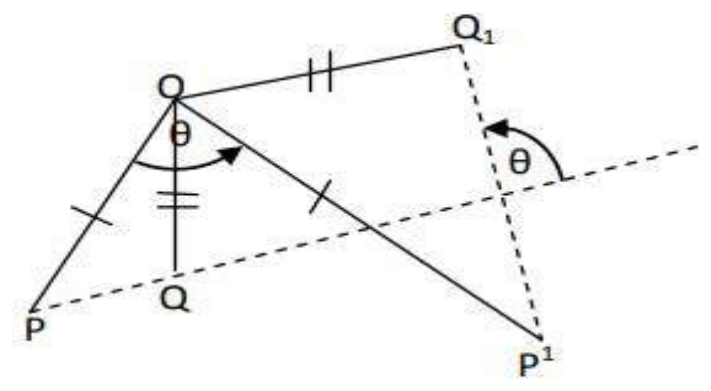
Example 1 Rotation through an angle θ, anticlockwise about the origin cos(𝜃) − sin(𝜃) This is represented by the matrix identity: £ ¤. sin(𝜃 ) cos(𝜃 )
cos(𝜃) − sin(𝜃) Given that 𝑅(𝜃) = £ ¤ find 𝑅(45°). sin(𝜃 ) cos(𝜃)
Solution cos(𝜃) − sin(𝜃) 𝑅(𝜃) = £ ¤ sin(𝜃) cos(𝜃 )
cos(45°) − sin(45°) 𝑅(45°) = £ ¤ sin(45°) cos(45°)
√) √) − ) 𝑅(45°) = Ò ) Ó √) √) ) )
Example 2: Anticlockwise Rotation through an Angle 90°or Clockwise Rotation through 270°about 0 −1 the origin. This is represented by the matrix i j. 1 0
Find the image of 𝑃(−4, 9) under anticlockwise rotation through 90° about the origin.
Solution: 𝑃(−4, 9) under anticlockwise rotation through 90°about the origin is given by: 0 −1 −4 𝑃' = É ÊÉ Ê 1 0 9
0(−4) − 1(9) 0−9 −9 𝑃' = ö ÷=É Ê=É Ê 1(−4) + 0(9) −4 + 0 −4
𝑃' = (−9, −4).
Example 3: Anticlockwise Rotation through 180° or Clockwise Rotation through 180° about the origin. This is −1 0 represented by the matrix identity i j. 0 −1
Find the image of 𝑄(7, 10) under anticlockwise rotation through 180° about the origin.
Solution: Q(7, 10) under anticlockwise rotation through 180° about the origin is given by: −1 0 7 𝑄' = É ÊÉ Ê 0 −1 10
−1(7) + 0(10) −7 + 0 −7 𝑄' = ö ÷=É Ê=É Ê 0 7 − 1 10 ( ) ( ) 0 − 10 −10
𝑄'' = (−7, −10).
Example 4: Anti-clockwise Rotation through 270° or Clockwise Rotation through 90° about the origin.
0 1 This is represented by the matrix identity i j. −1 0
Find the image of 𝑅(−6, 4) under anticlockwise rotation through 270° about the origin.
Solution: 𝑅(−6, 4) under anticlockwise rotation through 270° about the origin:
0 1 −6 𝑅' = É ÊÉ Ê −1 0 4
0(−6) + 1(4) 0+4 4 𝑅' = ö ÷=É Ê=É Ê −1(−6) + 0(4) 6+0 6
𝑅' = (4, 6).
Activity 5: Enlargement Learners in groups discuss the properties of rotation and perform some activities in rotation.
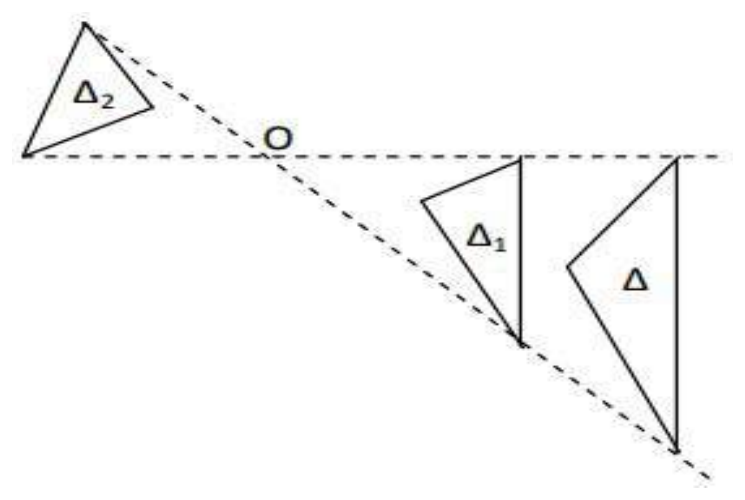
Enlargement: Enlargement is the process of making an object bigger than its original size. This is made possible by the use of a scale factor, k. In some cases, the object is made smaller than its original size in a process called reduction or dilatation. Enlargement from the origin, with scale factor k, is represented by the matrix identity. 𝑘 0 i j. 0 𝑘
Properties of Enlargement
- There is a single invariant point, the centre of enlargement, 𝑂.
- All other points 𝑃 map onto their images: 𝑃' so that 𝑂' = 𝑘, where 𝑘 is the scale factor of enlargement.
- Under enlargement, any figure is mapped onto a similar figure.
- If |𝑘| > 1, the image is larger than the original figure, but if |𝑘| < 1, it is smaller. To avoid the concept of an enlargement producing a smaller figure, the term dilatation is often used.
- If 𝑘 < 0, 𝑂 lies between 𝑃 and 𝑃' and the image figure is inverted.
- A scale factor of −1 is equal to a rotation about the centre 𝑂 of 180°.
- With a scale factor, 𝑘, similar figures have lengths in the ratio 𝑘:1 and areas in the ratio 𝑘:1.
Activity 6: Isometrics Learners in groups perform some activities on isometrics.
Note: Under isometrics, any figure maps onto a congruent figure. Translation and rotation produce directly congruent figures; reflection is inversely congruent.
Activity 7 Inverse of a Linear Transformation Learners in groups discuss the concept of inverse and solve some problems on it.
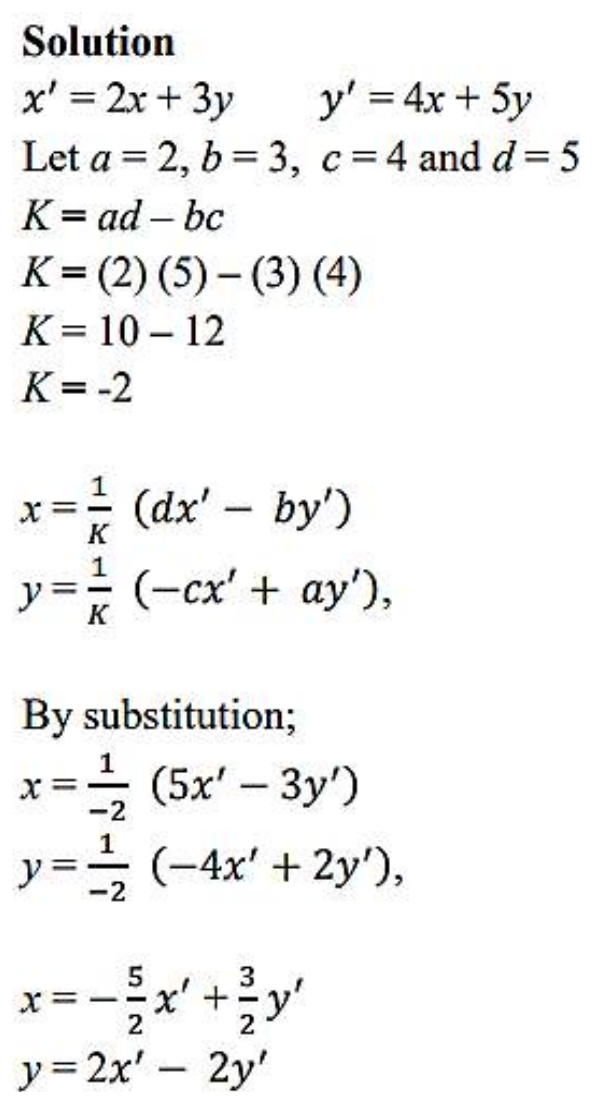
The inverse transformation of a linear transformation: ! 𝑥' = 𝑎 + 𝑏 𝑦' = 𝑐 + 𝑑 is 𝑥 = l (𝑑𝑥 - − 𝑏𝑦 - )
𝑦 = l (−𝑐𝑥 - + 𝑎𝑦 - ) !
provided 𝑘 = 𝑎- 𝑏 ≠ 0, the inverse is also linear.
Example 1 Inverse of the linear transformation Find the inverse of the linear transformation 𝑥' = 2𝑥 + 3𝑦; 𝑦' = 4𝑥 + 5𝑦
Teaching and Learning Resources:
- SHS Curriculum, Graph boards, mathematical set, ICT tools
Assessment (3.1.2.AS.4). The document marks these depth-of-knowledge levels for this indicator: Level 2 Skills of conceptual understanding; Level 3 Strategic reasoning.