SHS3 Additional Mathematics · Semester 1, Week 1
Applications of Algebra
Full lesson notes coming
Notes for this lesson are being prepared. The curriculum details below are complete and ready to use for your planning.
Curriculum details
- Strand
- Modelling with Algebra (Strand 1)
- Sub-strand
- Applications of Algebra (1.2)
- Content standard
- 3.1.2.CS.1 - Appreciate the concepts of logic and apply the concept to draw valid conclusions and deductions from arguments. 3.1.2.LO.1 Construct compound statements and truth tables using connectives. 3.1.2.LO.2 Apply linear transformation in: finding images of points and object points. finding reflections and rotations of points and plane figures.
- Indicator
- 3.1.2.LI.1 - Form statements including negation statements and comment on them.
- Suggested placement
-
Semester 1, Week 1
(Week 1 of the year)
Our suggestion, laid out in curriculum order across three terms of twelve weeks. NaCCA does not fix the week, so follow your school's scheme of learning.
- Curriculum reference
- NaCCA curriculum document, p. 437
Exemplars (from the NaCCA curriculum)
Talk for Learning, Think-Pair-Share, building on what others say.
Learning Experience: Learners, in pairs, discuss statements and the associations in those statements.
Activity 1: Mathematical statements Learners in groups bring out statements for the group to comment whether they are indeed statements and also whether those statements are true or false. A mathematical statement is a sentence which is either true or false. It may contain words and symbols.
Example
- Accra is the capital of Ghana.
- There are three raining seasons in a year in the whole of Ghana.
- Are there factories in every district of Ghana?
Comments: From the example above, sentences a and b are statements, but sentence b is not true. Sentence c, however, is not a statement.
Notation of Statements: In mathematics, statements are denoted by letters such as P, Q and R.
Example P: 7 + 9 = 15, simply means P is the statement 7 + 9 = 15. P is obviously a false statement because 7 + 9 ≠15.
Activity 2: Negation of a Statement Learners in squares discuss and construct negation of a statement and share with the group for comments.
Notes: The negation uses the word no, not. For a statement p, its negation is ~p. The negation of a given statement is the denial of a given statement.
Example 1: Let us take a simple example of the negation of a statement: P: Accra is the capital of Ghana. ~P: Accra is NOT the capital of Ghana.
Example 2: P: The earth is round in shape. ~P: The earth is NOT round in shape.
Activity 3: Learners discuss the difference between the opposite of a statement and the denial of a statement. Learners to come to the conclusion that the negation of a statement is a denial, not the opposite of a given statement.
Example 1 Kofi Yesu is tall. Kofi Yesu is short. (opposite, therefore not a negation statement). Kofi Yesu is not tall. (negation statement).
Activity 4: Statements and Venn Diagrams Learners in convenient groups discuss the representation of statements in Venn diagrams.
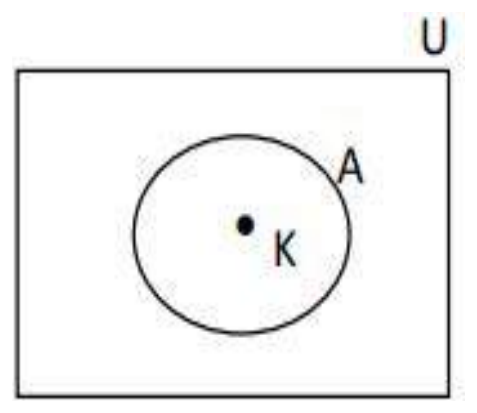
Note: Similar to sets, statements can be represented in Venn diagrams. Example: Identify the following from the given statements: 1. Universal set. 2. Subsets. 3. Complement.
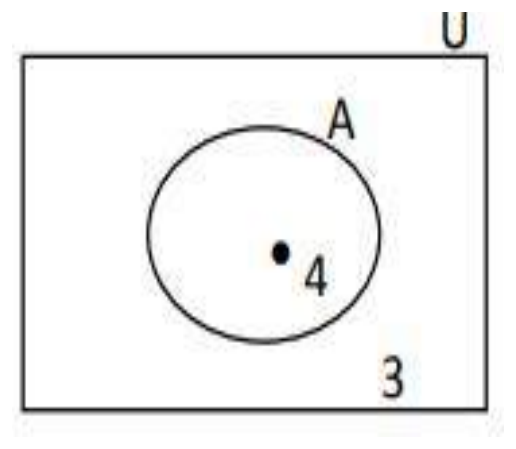
Example 1: Represent each of the following statements on a Venn diagram: 1. P: Kofi is a good boy. 2. Q: 4 is a factor of 100, but 3 is not.
Solution U = {boys} A = {Good boys} k = Kofi k {Good boys}
ii. U = {Integers} A = {factors of 100} 4 ∈ factors of 100} A 1 = {3}
Activity 4: Compound statements Learners in squares discuss and construct compound statements and share them with the group for comments.
Teaching and Learning Resources:
- SHS Curriculum, Graph boards, mathematical set, ICT tools
Assessment (3.1.2.AS.1). The document marks these depth-of-knowledge levels for this indicator: Level 2 Skills of conceptual understanding; Level 3 Strategic reasoning.