SHS2 Additional Mathematics · Semester 2, Week 11
Principles of Calculus
Lesson notes
Learning Objectives
Indicator: 2.3.1.LI.2 - Partition intervals for a given step size or number of sub-intervals and find area under curves through graphics.
By the end of the lesson, learners can:
- Partition a given interval [a, b] into a specified number of sub-intervals, N, and state the step size, h = (b − a) / N, for any given function.
- Construct rectangles under a curve using left endpoints and compute the sum of their areas for a given step size.
- Draw accurate graphs on graph sheets showing the curve and the rectangles for at least two different step sizes.
- Compare the approximating sum of rectangular areas with the exact area under the curve and explain how the number of sub-intervals affects the approximation.
- Justify why increasing the number of sub-intervals (reducing the step size) produces a better approximation to the true area.
Sign in with your phone number to read the full note and download the GES plan - free.
Sign in with phone numberCurriculum details
- Strand
- Calculus (Strand 3)
- Sub-strand
- Principles of Calculus (3.1)
- Content standard
- 2.3.1.CS.2 - Demonstrate a conceptual understanding of the connection between integration and limits and integration as a reverse process of differentiation. 2.3.1.LO.1 Determine the appropriate rule and use it to find the derivative of a function. 2.3.1.LO.2 Estimate the area under a curve using the trapezoid rule.
- Indicator
- 2.3.1.LI.2 - Partition intervals for a given step size or number of sub-intervals and find area under curves through graphics.
- Suggested placement
-
Semester 2, Week 11
(Week 31 of the year)
Our suggestion, laid out in curriculum order across three terms of twelve weeks. NaCCA does not fix the week, so follow your school's scheme of learning.
- Source document note
-
The official curriculum document has a fault in this entry, so the curriculum text above is transcribed exactly as printed:
- exemplars - p.390: adjacent duplicated CambriaMath characters were collapsed, but this PDF also maps some equation glyphs to the wrong letter or operator; verify every mathematical expression in this row against the rendered page
- Curriculum reference
- NaCCA curriculum document, p. 390
Exemplars (from the NaCCA curriculum)
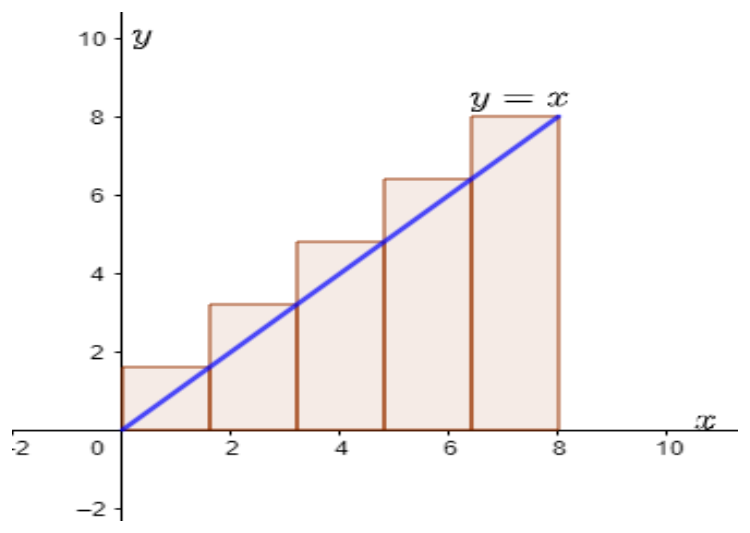
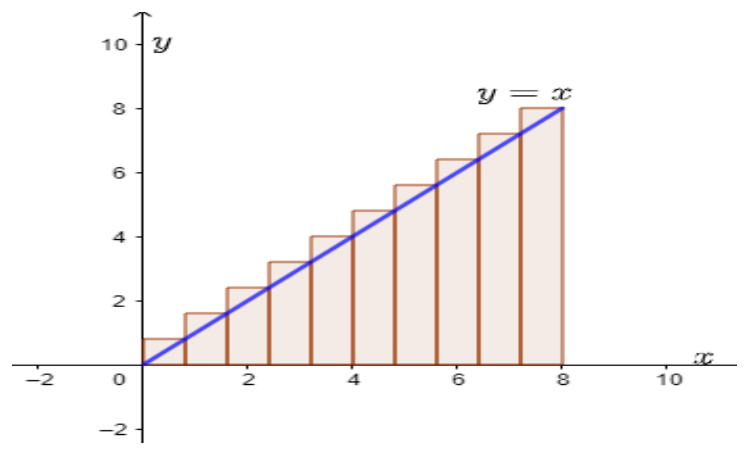
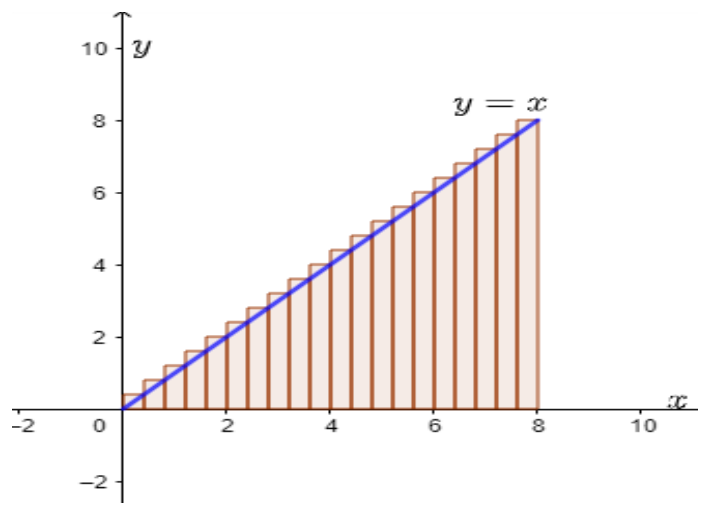
Activity 1: Area under a curve In small groups, learners construct a specified number of subintervals for an interval of a given function and find the sum areas of the rectangles. Within each group, Learners share their results with those in other groups. Example: Investigate the area under the curve, 𝑦 = 𝑥 for 𝑥 ∊ [0,8] when the number of intervals N is 5, 10 and 20. Try to approximate the area of the rectangles constructed under subintervals.
N=5, step size h=1.6
N=10, h=0.8
N=20, h=0.16
Note that since the area of the rectangles is 𝐴 = ℎ ∗ ∑ %Y4! 𝑓(𝑎 + 𝑗ℎ)
Learners are to explore and compare the effect of step size of the sum of areas under the rectangle and the actual area: ! = ) 𝑏 × ℎ𝑒ℎ𝑡 ! = ) × 8 × 8 = 32
Teaching and Learning Resources:
- Reading resource colour pens
- Notebook
- Graph sheets
- Mathematical sets
- Technological tools
Assessment (2.3.1.AS.2). The document marks no depth-of-knowledge level for this indicator.