SHS2 Additional Mathematics · Semester 2, Week 4
Measurement of Triangles
Lesson notes
Learning Objectives
Indicator: 2.2.2.LI.2 - Derive the sine and cosine rules and apply them to solve problems.
By the end of the lesson, learners can:
- Use the area formula for a triangle to derive the sine rule in the form a/sin A = b/sin B = c/sin C.
- Use the Pythagorean theorem on an altitude drawn inside a triangle to derive the cosine rule in the form a² = b² + c² - 2bc cos A.
- Identify which rule to apply based on the information given about a triangle (two angles and a side, two sides and a non-included angle, two sides and the included angle, or three sides).
- Apply the sine rule to find unknown sides and angles in triangles, including obtuse-angle cases where the ambiguous case must be considered.
- Apply the cosine rule to find unknown sides and angles, and use both rules together to solve multi-step problems involving bearings and distances.
Sign in with your phone number to read the full note and download the GES plan - free.
Sign in with phone numberCurriculum details
- Strand
- Geometric Reasoning and Measurement (Strand 2)
- Sub-strand
- Measurement of Triangles (2.2)
- Content standard
- 2.2.2.CS.1 - Demonstrate understanding of trigonometric identities and apply algebraic techniques to verify identities and solve Trigonometric problems on them. 2.2.2.LO.1 Find trigonometric values using compound, multiple and half angles and prove the sine and cosine rule. 2.2.2.LO.2 Verify whether or not a given trigonometric equation is an identity, and solve trigonometric equations.
- Indicator
- 2.2.2.LI.2 - Derive the sine and cosine rules and apply them to solve problems.
- Suggested placement
-
Semester 2, Week 4
(Week 24 of the year)
Our suggestion, laid out in curriculum order across three terms of twelve weeks. NaCCA does not fix the week, so follow your school's scheme of learning.
- Source document note
-
The official curriculum document has a fault in this entry, so the curriculum text above is transcribed exactly as printed:
- exemplars - p.367: adjacent duplicated CambriaMath characters were collapsed, but this PDF also maps some equation glyphs to the wrong letter or operator; verify every mathematical expression in this row against the rendered page
- exemplars - p.369: a stacked fraction, matrix, vector or other two-dimensional construct is flattened by the text layer; all visible parts require comparison with the rendered page
- Curriculum reference
- NaCCA curriculum document, p. 367
Exemplars (from the NaCCA curriculum)
Project-based Learning, Collaborative Learning, Talk for Learning
Learning Experience: Learners in mixed-ability groups research how to derive the sine and cosine rules and share their findings in class.
Activity 1: The sine and cosine rules Learners in their mixed-ability groups research on half angles, and the group leaders share their findings on sine and cosine rules with the class. Sine rule:
& ' ; = OL%T = OL%S or OL%R
OL%R OL%T OL%S = ' = ; , and &
- Cosine rule 𝑎 ) = 𝑏 ) + 𝑐 ) − 2𝑏(𝐴) ' ! $; ! *& ! or 𝑐 𝑐 (𝐴) = )';
Conditions The sine rule is used if: Two angles and one side. Two sides and an angle opposite one of these sides. The cosine rule is used if: Two sides and an included angle. The lengths of the three sides.
Activity 2: Application of sine and cosine rules Learners apply sine and cosine rules to solve problems. Learners in their mixed-ability groups solve questions on sine and cosine rules and present their solutions to the class.
Example 1: In the following
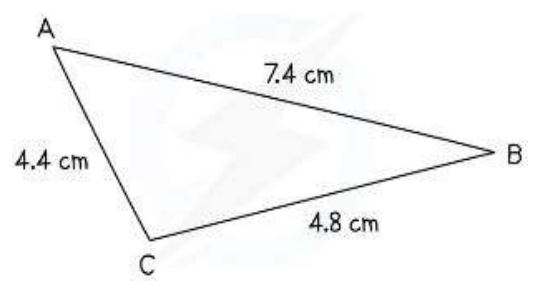
Find the size of angle ABC. Given that angle ACB is obtuse, use the Sine rule and your answer from (1) to find the size of angle ABC.
Solution: To find angle 𝐵 𝑏 ) = 𝑎 ) + 𝑐 ) − 2𝑎(𝐵) 4.4 ) = 4.8 ) + 7.8 ) − 2(4.8)(7.8)𝑐 4.8 ) + 7.8 ) − 4.4 ) 𝑐 = 2(4.8)(7.8) Angle 𝐵 ≈ 34.7° To find angle 𝐶 𝑠 𝑠 = 𝑏 𝑐 𝑠34.7 𝑠 = 4.4 7.4 Angle 𝐶 ≈ 107°
Example 2: A yacht starts from a point A and sails on a bearing of 038° for 3000 𝑚. It then alters its course to a bearing of 318°◦, and after sailing for 3300m it reaches a point B. 1. Find the distance AB correct to the nearest meter.
2. Find the bearing of B from A correct to the nearest degree.
Solution
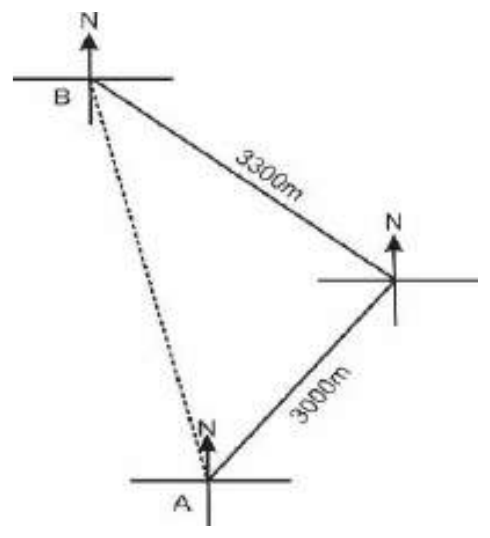
1. Angle 𝐶 = 180° − (38 + 42)] = 100° Let the distance of 𝐴 = 𝑐, 𝐴 = 𝑏 and 𝐵 = 𝑎 ∴ 𝑐 ) = 𝑎 ) + 𝑏 ) − 2𝑎 = 3300 + 3000 ) − 2(3300)(3000) 𝑐 𝑐 100 ) 𝑐 = 4830𝑚 2. To find the bearing of B from A, ""(( ,1"( = OL%!(( OL%R 𝐴 = 42.8° ∴ 𝑇ℎ𝑒 𝑏 𝑜 𝐵 𝑓 𝐴 = [360 − (42.3 − 38°)] = 355.7°
Teaching and Learning Resources:
- Graph paper
- Ruler
- Scientific calculator
- Protractor
- Computer
Assessment (2.2.2.AS.2). The document marks these depth-of-knowledge levels for this indicator: Level 2 Skills of conceptual understanding.