SHS2 Additional Mathematics · Semester 1, Week 19
Spatial Sense
Lesson notes
Learning Objectives
Indicator: 2.2.1.LI.2 - Apply knowledge of the distance between two points and the Pythagoras theorem to describe a circle in the algebraic form.
By the end of the lesson, learners can:
- Derive the standard form of the equation of a circle, (x - h)² + (y - k)² = r², by applying the distance formula between the centre (h, k) and a point (x, y) on the circumference.
- Write the standard equation of a circle given its centre and radius, including the special case where the centre is at the origin (0, 0).
- Expand the standard form of a circle’s equation to derive the general form x² + y² + 2gx + 2fy + c = 0, and identify the relationships between h, k, r and g, f, c.
- Determine the centre and radius of a circle from its general equation using the completing the square method.
- Model practical situations involving circular motion or boundaries by forming and solving circle equations in Ghanaian contexts.
Sign in with your phone number to read the full note and download the GES plan - free.
Sign in with phone numberCurriculum details
- Strand
- Geometric Reasoning and Measurement (Strand 2)
- Sub-strand
- Spatial Sense (2.1)
- Content standard
- 2.2.1.CS.1 - Demonstrate understanding of loci and their applications. 2.2.1.LO.1 Deduce the equation of a circle and find its centre and radius. 2.2.1.LO.2 Determine the equation of a locus under a given condition.
- Indicator
- 2.2.1.LI.2 - Apply knowledge of the distance between two points and the Pythagoras theorem to describe a circle in the algebraic form.
- Suggested placement
-
Semester 1, Week 19
(Week 19 of the year)
Our suggestion, laid out in curriculum order across three terms of twelve weeks. NaCCA does not fix the week, so follow your school's scheme of learning.
- Source document note
-
The official curriculum document has a fault in this entry, so the curriculum text above is transcribed exactly as printed:
- exemplars - p.332: adjacent duplicated CambriaMath characters were collapsed, but this PDF also maps some equation glyphs to the wrong letter or operator; verify every mathematical expression in this row against the rendered page
- Curriculum reference
- NaCCA curriculum document, p. 332
Exemplars (from the NaCCA curriculum)
Experiential Learning, Collaborative Learning, Talk for Learning
Learning Experience: Learners in a mixed-ability group apply the idea of distance between two points and its equation to derive the equation of a circle.
Activity 1: Learners in a mixed-ability group discuss the equation derived through construction with ICT tools like GeoGebra. Learners in groups brainstorm the equation derived. Learners in mixed-ability groups brainstorm on how the equation of the circle can be derived.
Activity 2: Learners in a mixed-ability group discuss how to derive the standard form of the equation of a circle. Learners in a mixed-ability group construct a circle and label the centre as 𝑂(ℎ, 𝑘) and any point 𝑃(𝑥, 𝑦)on the circumference of the circle.
- Learners then apply their understanding of distance between two points to state the equation of distance between 𝑂 and 𝑃, which is the radius of the circle.
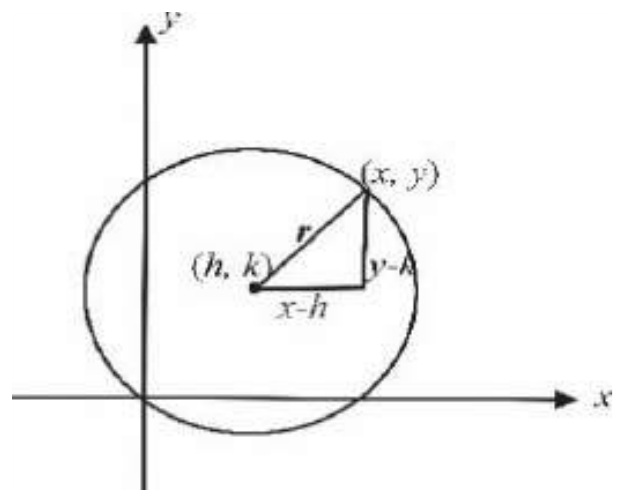
- Learners in their groups derive the equation 𝑂 and 𝑃 as 𝑟 = w(𝑥 − ℎ) ) − (𝑦 − 𝑘) )
- Learners in their groups simplify this expression as 𝑟 ) = (𝑥 − ℎ) ) − (𝑦 − 𝑘) )
- Learners compare the equation derived from the distance between 𝑂 and the equation of the circle derived by GeoGebra to establish that the two equations are the same.
- Learners in their mixed-ability groups recognise the equation of a circle in standard form as 𝑟 ) = (𝑥 − ℎ) ) − (𝑦 − 𝑘) ) where (h, k) is the centre and (x, y) is a point on the circumference.
Activity 3: Learners in a mixed-ability group discuss how to deduce the equation of a circle with a centre at the origin.
- Learners in their groups investigate the behaviour of the equation of a circle if the centre is at the origin 𝑂(0,0).
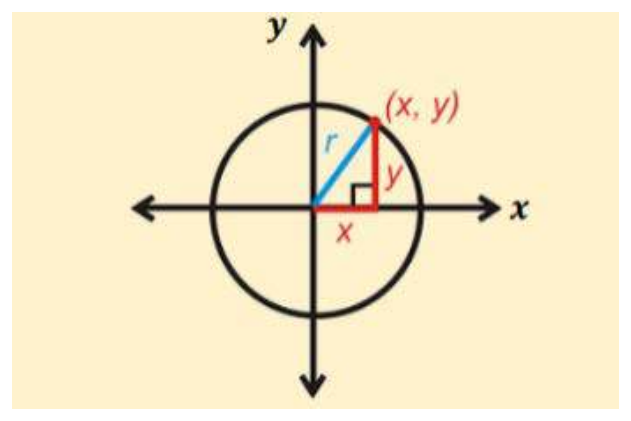
E.g., At (0,0), we have 𝑟 ) = (𝑥 − ℎ) ) − (𝑦 − 𝑘) ) 𝑟 ) = (𝑥 − 0) ) − (𝑦 − 0) ) Therefore, the equation of the circle turns to 𝑟 ) = 𝑥 ) + 𝑦 ) .
Activity 4: Learners in their mixed-ability group model practical problems for other groups to derive the equation of a circle.
Example 1: A goat is tethered by a rope of length 2 meters away from a peg. If the peg is at the point (3, 2). Find the equation to describe the area the goat can go round the peg.
Example 2: Write the standard form of the equation of a circle with centre (2,4) and radius of 10.
Solution: (𝑥 − 2) ) + (𝑦 − 4) ) = 10 )
Activity 5: Learners in their mixed-ability group derive the general equation of a circle. Learners in their groups expand the standard form of the equation of a circle to derive the general equation of a circle. That is, expanding 𝑟 ) = (𝑥 − ℎ) ) − (𝑦 − 𝑘) ) to obtain 𝑥 ) + 𝑦 ) − 2ℎ𝑥 − 2𝑘 + ℎ ) + 𝑘 ) − 𝑟 ) = 0 Hence, the general equation of the circle is 𝑥 ) + 𝑦 ) + 2𝑔 + 2𝑓 + 𝑐 = 0, Where g replaces −ℎ with 𝑓 replaces −𝑘 and 𝑐 = ℎ ) + 𝑘 ) − 𝑟 ) since ℎ, 𝑘 𝑎 𝑟 are numbers.
Example 1: Write the general equation of a circle with a centre (2,4) and a radius of 10.
Solution: 𝑥 ) + 𝑦 ) − 4𝑥 − 8𝑦 − 80 = 0
Activity 6: Learners create and solve practical problems.
Example: Learners establish that the general equation of a circle is 𝑥 ) + 𝑦 ) + 2𝑔 + 2𝑓 + 𝑐 = 0 with centre (−𝑔, −𝑓) and radius 𝑟 ) = 𝑔 ) + 𝑓 ) − 𝑐 Learners in their mixed-ability groups create and solve practical problems for other groups to derive the equation of a circle.
Example 1: The point (4,6) is on a circle whose centre is (1,2). Write a standard equation of the circle.
Solution: 𝑟 = w(4 − 1) ) + (6 − 2) ) 𝑟 = 5
Using 𝑟 = 5 and centre (1,2), the equation of the circle is (𝑥 − 1) ) + (𝑦 − 2) ) = 5 )
Example 2: Find the centre and the radius of the circle with the equation 𝑥 ) + 𝑦 ) − 14𝑥 + 16𝑦 − 12 = 0
Learners apply their knowledge in completing the square or any other method to solve the question.
Solution: Using completing the square method: 𝑥 ) + 𝑦 ) − 14𝑥 + 16𝑦 − 12 = 0 𝑥 ) − 14𝑥 + 𝑦 ) + 16𝑦 − 12 = 0 (𝑥 − 7) ) − 7 ) + (𝑦 + 8) ) − 8 ) − 12 = 0 (𝑥 − 7) ) + (𝑦 + 8) ) = 125 Therefore, the centre is (7, −8), and the radius is 𝑟 ) = 125 = 5√5
Alternative method: 2𝑔 = −14, ∴ 𝑔 = −7 2𝑓 = 16, ∴ 𝑓 = 8 Since the centre of the circle is (−𝑔, −𝑓), the centre of this circle is (7, −8) The radius of the circle is found by 𝑟 ) = 𝑔 ) + 𝑓 ) − 𝑐 𝑟 = 7 ) + (−8) ) + 12 ) 𝑟 = √125
Teaching and Learning Resources:
- Worksheets
- Scientific Calculator
- Technological tools, apps, etc.
- SHS Additional Mathematics Curriculum
Assessment (2.2.1.AS.2). The document marks these depth-of-knowledge levels for this indicator: Level 2 Skills of conceptual understanding.