SHS2 Additional Mathematics · Semester 1, Week 17
Application of Algebra
Lesson notes
Learning Objectives
Indicator: 2.1.1.LI.4 - Find the inverse of a matrix using linear transformation.
By the end of the lesson, learners can:
- Determine the determinant of a 2 x 2 matrix and state whether the matrix is singular or non-singular.
- Find the adjoint (adjugate) of a 2 x 2 matrix by interchanging the leading diagonal entries and changing the signs of the off-diagonal entries.
- Use the formula A⁻¹ = (1/det(A)) × adj(A) to compute the inverse of a non-singular 2 x 2 matrix.
- Verify that A × A⁻¹ = A⁻¹ × A = I, the identity matrix, for a given 2 x 2 matrix.
- Apply the inverse of a 2 x 2 matrix to solve a system of two linear equations and interpret matrix inverses as inverse linear transformations.
Sign in with your phone number to read the full note and download the GES plan - free.
Sign in with phone numberCurriculum details
- Strand
- Modelling with Algebra (Strand 1)
- Sub-strand
- Application of Algebra (1.1)
- Content standard
- 2.1.1.CS.4 - Demonstrate the ability to carry out matrix operations, determine the inverse of a linear transformation and represent real life situations in matrix forms. 2.1.1.LO.1 Investigate De Morgan's law on sets algebraically and graphically, formulate and solve real life problems up to three sets. 2.1.1.LO.2 Model sequence recursively and explicitly, and establish the relationship between the two forms, as well as solve real life problems involving linear and exponential sequences and series. 2.1.1.LO.3 Apply indices and logarithms to solve real life problems, including logarithms with different bases, and sketch and interpret logarithmic functions. 2.1.1.LO.4 Formulate and derive appropriate strategies to solve quadratic inequalities. 2.1.1.LO.5 Graph systems of given inequality and identify the region that provides the feasible solution and apply it to real life situations. 2.1.1.LO.6 Determine the set of values for which a rational function is defined and resolve rational functions into partial fractions. 2.1.1.LO.7 Multiply matrices, determine the inverse of a 2 x 2 matrix, find the determinant up to a 3 x 3 matrix and represent matrices in linear transformations.
- Indicator
- 2.1.1.LI.4 - Find the inverse of a matrix using linear transformation.
- Suggested placement
-
Semester 1, Week 17
(Week 17 of the year)
Our suggestion, laid out in curriculum order across three terms of twelve weeks. NaCCA does not fix the week, so follow your school's scheme of learning.
- Source document note
-
The official curriculum document has a fault in this entry, so the curriculum text above is transcribed exactly as printed:
- exemplars - p.322: adjacent duplicated CambriaMath characters were collapsed, but this PDF also maps some equation glyphs to the wrong letter or operator; verify every mathematical expression in this row against the rendered page
- exemplars - p.323: a stacked fraction, matrix, vector or other two-dimensional construct is flattened by the text layer; all visible parts require comparison with the rendered page
- Curriculum reference
- NaCCA curriculum document, p. 322
Exemplars (from the NaCCA curriculum)
Collaborative Learning, Experiential Learning, Problem-based Learning, Project-based Learning and Talk for Learning
Activity: Inverse of a matrix
Collaborative Learning, Experiential Learning, Whole class discussion, Talk for Learning Approaches and Problem-based Learning.
Work with a partner: One pair identifies and creates a square matrix while the other pair identifies the minors and co-factors matrix. Then, the pair work together to determine the adjoint matrix. Learners change roles and summarise their findings.
Example
- Establish that the adjoint of a matrix (also called the adjugate of a matrix) is defined as the transpose of the cofactor matrix of that particular matrix. For a matrix A, the adjoint is denoted as 𝑎 (𝐴).
𝑎 !! 𝑎 !) 𝑎 !" 𝑎 𝑎 )) 𝑎 )" , then the matrix formed by the cofactors of the elements is Thus, if 𝐴 = Ÿ )! 𝑎 "! 𝑎 ") 𝑎 "" 𝐴 !! 𝐴 !) 𝐴 !" Ÿ 𝐴 )! 𝐴 )) 𝐴 )" 𝐴 "! 𝐴 ") 𝐴 "" 𝐴 !! −𝐴 !) 𝐴 !" and the adjoint of 𝐴, a𝑑(𝐴) = Ÿ −𝐴 )! 𝐴 )) −𝐴 )" where 𝐴 "! −𝐴 ") 𝐴 "" 𝑎 22 𝑎 23 𝑎 21 𝑎 23 𝑎 21 𝑎 22 𝐴 !! = Ý 𝑎 Ý, 𝐴 !) = Ý 𝑎 Ý, 𝐴 !" = Ý 𝑎 Ý, 𝑎 𝑎 31 𝑎 32 32 33 31 33 𝑎 12 𝑎 13 𝑎 11 𝑎 13 𝑎 11 𝑎 12 𝐴 )! = Ý 𝑎 Ý, 𝐴 )) = Ý 𝑎 Ý, 𝐴 )" = Ý 𝑎 Ý, 𝑎 𝑎 31 𝑎 32 32 33 31 33 𝑎 12 𝑎 13 𝑎 11 𝑎 13 𝑎 𝑎 Ý, 𝐴 "" = Ý 𝑎 11 𝑎 12 Ý 𝐴 "! = Ý 𝑎 Ý, 𝐴 ") = Ý 𝑎 𝑎 𝑎 22 23 21 23 21 22
- Find the adjoint matrix of the matrix.
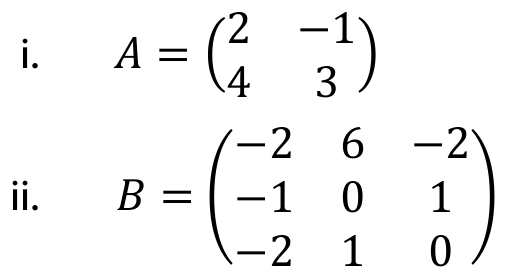
 2 −1 i. 𝐴 = i j 4 3 −2 6 −2 ii. 𝐵 = Ÿ −1 0 1 −2 1 0
- Verify that 1. for any square matrix 𝐴, then 𝐴(𝑎 𝐴) = (𝑎 𝐴)𝐴 = |𝐴|𝐼 where 𝐼 is the identity matrix of the same order. 2. If A is a non-singular matrix of order n, then |𝑎| = |𝐴| %*! 3. If A and B are two square matrices of order n, then (𝑎 (𝐴) = (𝑎 𝐵)(𝑎 𝐵) 4. For any square matrix A, (𝑎 𝐴) G = 𝑎 𝐴 G . 5. The adjoint of an identity matrix is the identity matrix. 6. The adjoint of a symmetric matrix is a symmetric matrix.
Work with a partner: learners explore with several pairs of matrices to establish that if 𝐴 *! = 𝐼 = 𝐴 *! 𝐴, then 𝐴 *! is called the multiplicative inverse of A.
Example 1. Verify which pair of matrices are inverses of each other. 2 3 5 −3 i j and i j i. 3 5 −3 2 2 −1 3 1 ii. i j and i j 4 3 −4 2 3 −5 4 5 i j and i j iii. −2 4 2 3
2. What can you say about (i) and (ii)
- Learners establish that the necessary and sufficient condition for a square matrix A to have an inverse is that 𝐴 ≠ 0 (That is, A is non-singular). ! 𝑑 −𝑏 𝑑 −𝑏
- Learners establish that If 𝐴 = (𝑎 𝑏 𝑐 𝑑 ) then 𝐴 *! = &<*'; i j. Where i j is the −𝑐 𝑎 −𝑐 𝑎 adjoint matrix of A (𝑎(𝐴)), and 𝑎 − 𝑏 is the determinant of A.
Note: that the inverse of a matrix can be easily found using the calculator. Simply raise the matrix to the power of -1.
Work with a partner: Learners explore several matrices to establish that; If 𝐴 = 𝐵, where A, X and B are matrices, then 𝐴 *! 𝐵 = 𝑋 1. 2. If 𝑋 = 𝐵, where A, X and B are matrices, then 𝐵 *! = 𝑋
Teaching and Learning Resources:
- Worksheets
- Scientific Calculator
- Technological tools, apps, etc.
Assessment (2.1.1.AS.4). The document marks these depth-of-knowledge levels for this indicator: Level 2 Skills of conceptual understanding.