SHS2 Additional Mathematics · Semester 1, Week 11
Application of Algebra
Full lesson notes coming
Notes for this lesson are being prepared. The curriculum details below are complete and ready to use for your planning.
Curriculum details
- Strand
- Modelling with Algebra (Strand 1)
- Sub-strand
- Application of Algebra (1.1)
- Content standard
- 2.1.1.CS.3 - Demonstrate understanding of the laws and properties of indices and apply the ideas to solve problems. 2.1.1.LO.1 Investigate De Morgan's law on sets algebraically and graphically, formulate and solve real life problems up to three sets. 2.1.1.LO.2 Model sequence recursively and explicitly, and establish the relationship between the two forms, as well as solve real life problems involving linear and exponential sequences and series. 2.1.1.LO.3 Apply indices and logarithms to solve real life problems, including logarithms with different bases, and sketch and interpret logarithmic functions. 2.1.1.LO.4 Formulate and derive appropriate strategies to solve quadratic inequalities. 2.1.1.LO.5 Graph systems of given inequality and identify the region that provides the feasible solution and apply it to real life situations. 2.1.1.LO.6 Determine the set of values for which a rational function is defined and resolve rational functions into partial fractions. 2.1.1.LO.7 Multiply matrices, determine the inverse of a 2 x 2 matrix, find the determinant up to a 3 x 3 matrix and represent matrices in linear transformations.
- Indicator
- 2.1.1.LI.9 - Solve real life problems involving linear inequalities.
- Suggested placement
-
Semester 1, Week 11
(Week 11 of the year)
Our suggestion, laid out in curriculum order across three terms of twelve weeks. NaCCA does not fix the week, so follow your school's scheme of learning.
- Source document note
-
The official curriculum document has a fault in this entry, so the curriculum text above is transcribed exactly as printed:
- exemplars - p.304: adjacent duplicated CambriaMath characters were collapsed, but this PDF also maps some equation glyphs to the wrong letter or operator; verify every mathematical expression in this row against the rendered page
- exemplars - p.305: a stacked fraction, matrix, vector or other two-dimensional construct is flattened by the text layer; all visible parts require comparison with the rendered page
- Curriculum reference
- NaCCA curriculum document, p. 304
Exemplars (from the NaCCA curriculum)
Collaborative Learning, Experiential Learning, Problem-based Learning, Project-Based Learning and Talk for Learning
Activity: Real-life applications of linear programming.
Collaborative Learning, Problem-based Learning, Experiential Learning, and Talk for Learning Approaches: Learners work together (from whole class discourse, to small convenient groups, then pair work as well as individual work) to create and solve real life problems involving the application of linear programming.
Example 1 A company that produces football jerseys makes two sets of jerseys for Accra Hearts of Oak: the traditional rainbow jerseys for home matches and the white jerseys with rainbow for away matches. To produce each jersey, two types of material - nylon and cotton - are used.
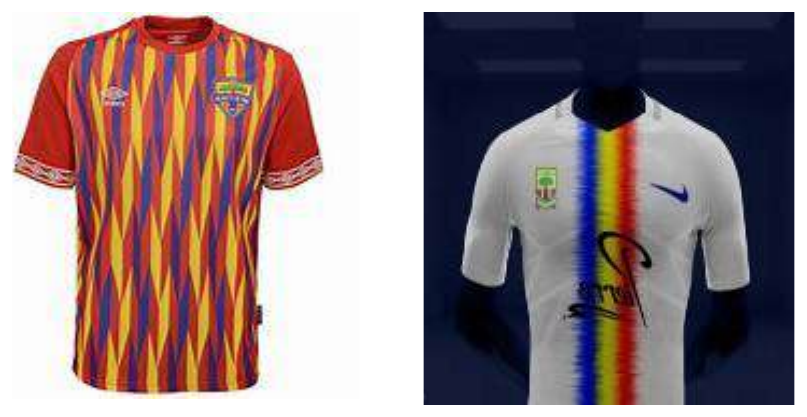
The company has 450 units of nylon in stock and 300 units of cotton. The traditional rainbow jersey requires 6 units of nylon and 3 units of cotton. The white 'away' jersey requires 5 units of nylon and 5 units of cotton. Each white 'away' jersey that is made realises a profit of GHC 12.00 for the company, whereas each rainbow jersey realises a profit of GHC15.00. For the nylon and cotton that the company currently has in stock, how many jerseys should the company make to maximise their profit?
Solution Let 'x' represent the number of blue flags. Let 'y' represent the number of green flags
Units required per rainbow jersey Units required per white jersey Units Available
Nylon, 6 5 450 Cotton 3 5 300 Profit per jersey 𝐺₵ 12.00 𝐺₵ 15.00
The number of rainbow jerseys and/or white jerseys that are produced must be either zero or greater than zero. Therefore, the constraint 𝑖 𝑥 ≥ 0 and 𝑦 ≥ 0, respectively. The total number of units of nylon and/or cotton required to make both types of jerseys cannot exceed 450. Therefore, the constraint is 6𝑥 + 5𝑦 ≤ 450 and 3𝑥 + 5𝑦 ≤ 300 respectively. The equation to identify the profit. 𝑃 = 12𝑥 + 15𝑦
Graphically, we have:
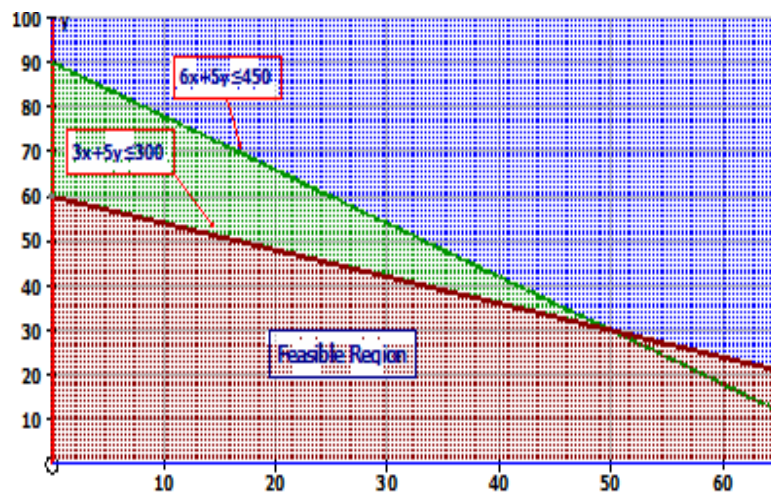
By determining the exact point of intersection between the constraints at (50, 30), the x-intercept of the feasible region (75, 0). The y-intercept is (0, 60) and using the profit equation, for each vertex of the feasible region, the maximum profit occurred at the vertex (50, 30). This means with the supplies in stock, the company should make 50 rainbow jerseys and 30 white jerseys.
Example 2 A cocoa processing factory can provide its customers with chocolate, cocoa paste and cocoa butter by processing either of two cocoa bean varieties - Forastero or Criollo. The cocoa beans arrive at the company in railroad trucks. Each railroad truck of Forastero cocoa beans can be processed into 3 tons of chocolate, 3 tons of paste and I ton of butter. Each railroad truck of Criollo cocoa beans can process 1 ton of chocolate, 4 tons of paste and 3 tons of butter. The factory received an order for 7 tons of chocolate, 19 tons of cocoa paste and 8 tons of cocoa butter. The cost to purchase and process a carload of Forastero beans is GHC7000.00 while the cost for Criollo beans is GHC6000.00 If the company wants to fill the order at a minimum cost, how many carloads of each variety must be bought?
Teaching and Learning Resources:
- Graph paper
- Ruler
- A scientific calculator
Assessment (2.1.1.AS.9). The document marks these depth-of-knowledge levels for this indicator: Level 3 Strategic reasoning.