SHS2 Additional Mathematics · Semester 1, Week 11
Application of Algebra
Full lesson notes coming
Notes for this lesson are being prepared. The curriculum details below are complete and ready to use for your planning.
Curriculum details
- Strand
- Modelling with Algebra (Strand 1)
- Sub-strand
- Application of Algebra (1.1)
- Content standard
- 2.1.1.CS.3 - Demonstrate understanding of the laws and properties of indices and apply the ideas to solve problems. 2.1.1.LO.1 Investigate De Morgan's law on sets algebraically and graphically, formulate and solve real life problems up to three sets. 2.1.1.LO.2 Model sequence recursively and explicitly, and establish the relationship between the two forms, as well as solve real life problems involving linear and exponential sequences and series. 2.1.1.LO.3 Apply indices and logarithms to solve real life problems, including logarithms with different bases, and sketch and interpret logarithmic functions. 2.1.1.LO.4 Formulate and derive appropriate strategies to solve quadratic inequalities. 2.1.1.LO.5 Graph systems of given inequality and identify the region that provides the feasible solution and apply it to real life situations. 2.1.1.LO.6 Determine the set of values for which a rational function is defined and resolve rational functions into partial fractions. 2.1.1.LO.7 Multiply matrices, determine the inverse of a 2 x 2 matrix, find the determinant up to a 3 x 3 matrix and represent matrices in linear transformations.
- Indicator
- 2.1.1.LI.8 - Determine the maximum/minimum values within the given constraints.
- Suggested placement
-
Semester 1, Week 11
(Week 11 of the year)
Our suggestion, laid out in curriculum order across three terms of twelve weeks. NaCCA does not fix the week, so follow your school's scheme of learning.
- Source document note
-
The official curriculum document has a fault in this entry, so the curriculum text above is transcribed exactly as printed:
- exemplars - p.302: adjacent duplicated CambriaMath characters were collapsed, but this PDF also maps some equation glyphs to the wrong letter or operator; verify every mathematical expression in this row against the rendered page
- Curriculum reference
- NaCCA curriculum document, p. 302
Exemplars (from the NaCCA curriculum)
Collaborative Learning, Experiential Learning, Problem-based Learning, Project-Based Learning and Talk for Learning
Activity: Feasible regions of systems of linear inequalities.
Project-based Learning: Collaborative Learning, Problem-based Learning, Experiential Learning and Talk for Learning Approaches: Learners work together (from whole class discussions to working in small convenient groups, then pair work) to explore by analytical methods and by hand and use of appropriate ICT tools (e.g., GeoGebra) the solutions for systems of linear and quadratic equations and inequalities to establish maximum and or minimum values within the given constraints.
Example
- Evaluate the expression 𝑙 = 3𝑥 + 4𝑦 for the given feasible region to determine the point at which '𝑙' has a maximum value and the point at which '𝑙' has a minimum value.
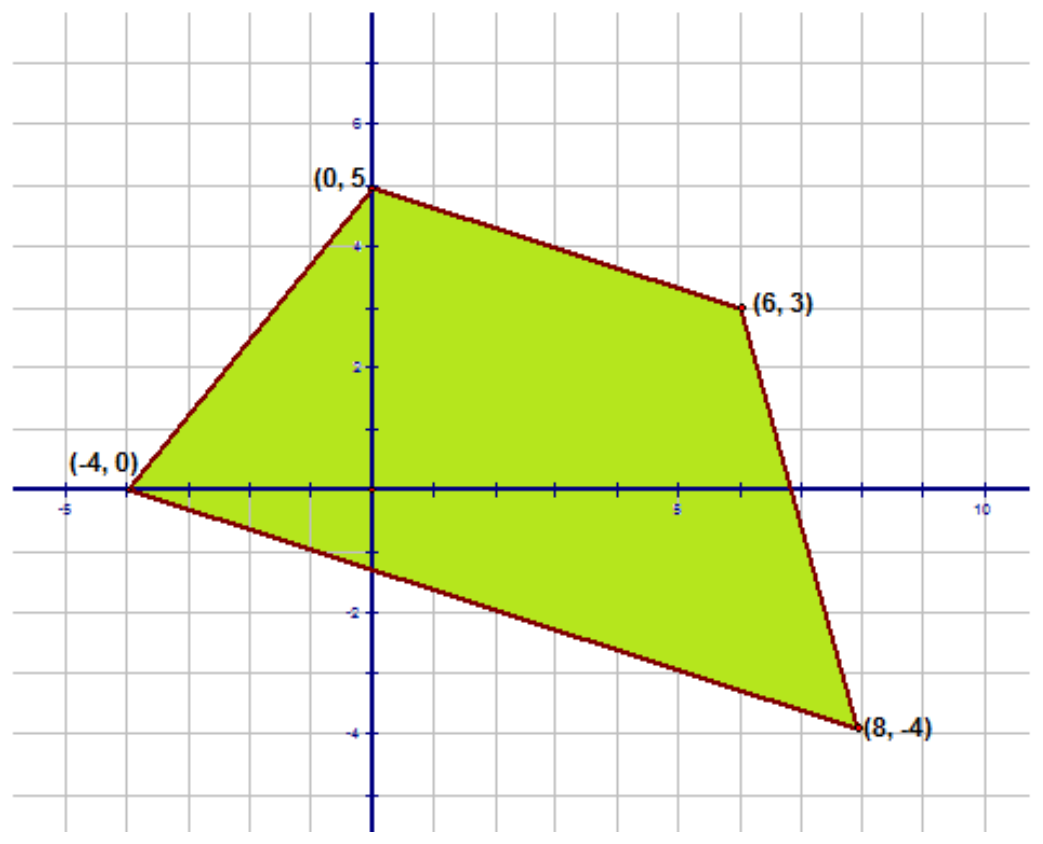
Solution At (−4,0) 𝑙 = 3𝑥 + 4𝑦 → 𝑙 = 3(−4) + 4(0) → 𝑙 = −12 + 0 → 𝑙 = −12 Therefore 3𝑥 + 4𝑦 = −12 At (0,5): 𝑙 = 3𝑥 + 4𝑦 → 𝑙 = 3(0) + 4(5) → 𝑙 = 0 + 20 → 𝑙 = 20 Therefore 3𝑥 + 4𝑦 = 20 At (6,3): 𝑙 = 3𝑥 + 4𝑦 → 𝑙 = 3(6) + 4(3) 𝑙 = 18 + 12 → 𝑙 = 30; Therefore 3𝑥 + 4𝑦 = 30 At (8,−4): 𝑙 = 3𝑥 + 4𝑦 → 𝑙 = 3(8) + 4(−4) → 𝑙 = 24 − 16 → 𝑙 = 8 Therefore 3𝑥 + 4𝑦 = 8 The maximum value of 'l' occurred at the vertex (6, 3). The minimum value of 'l' occurred at the vertex (- 4, 0)
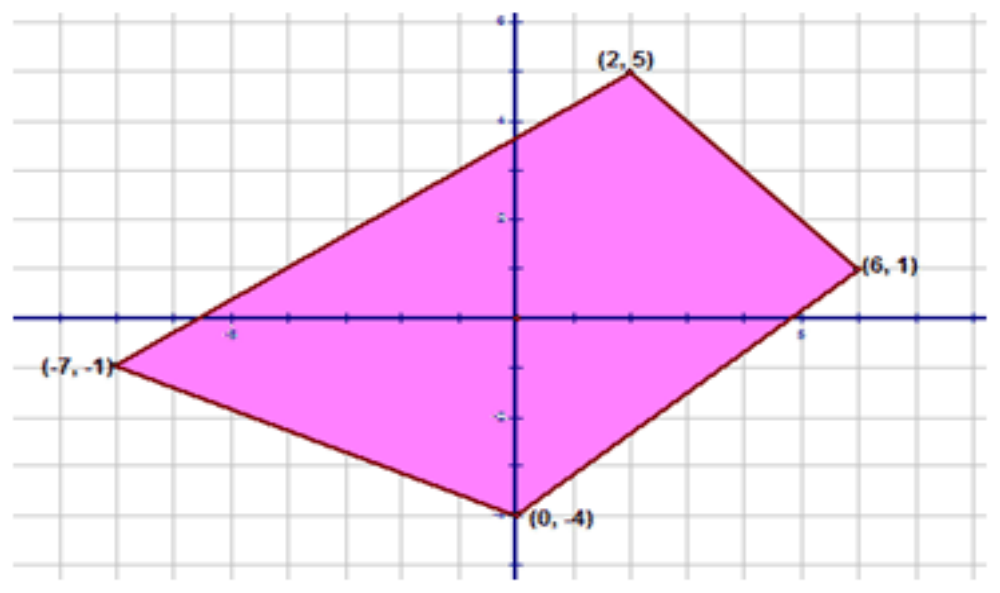
- For the following graphed region and the expression 𝑧 = 5𝑥 + 7𝑦 − 1, find a point where 'z' has a maximum value and a point where 'z' has a minimum value.
Teaching and Learning Resources:
- Graph paper
- Ruler
- A scientific calculator
Assessment (2.1.1.AS.8). The document marks these depth-of-knowledge levels for this indicator: Level 2 Skills of conceptual understanding; Level 4 Extended critical thinking and reasoning.