SHS2 Additional Mathematics · Semester 1, Week 7
Application of Algebra
Lesson notes
Learning Objectives
Indicator: 2.1.1.LI.4 - Describe the processes of solving quadratic equations by graphical method, factorisation, and inspection for quadratic functions, including functions of the form (𝑥) = 49) where possible.
By the end of the lesson, learners can:
- Solve quadratic equations of the form ax² + bx + c = 0 by factorisation, showing all steps and stating the roots clearly.
- Solve quadratic equations by inspection for simple cases, including equations of the form x² = 49 and (x + 3)² = 25.
- Use the graphical method to find approximate roots of a quadratic equation by reading the x-intercepts of the graph of the corresponding function.
- Describe and compare the three methods (graphical, factorisation, and inspection), stating when each method is most appropriate.
- Apply factorisation and inspection methods to solve word problems involving quadratic equations in real-life situations.
Sign in with your phone number to read the full note and download the GES plan - free.
Sign in with phone numberCurriculum details
- Strand
- Modelling with Algebra (Strand 1)
- Sub-strand
- Application of Algebra (1.1)
- Content standard
- 2.1.1.CS.3 - Demonstrate understanding of the laws and properties of indices and apply the ideas to solve problems. 2.1.1.LO.1 Investigate De Morgan's law on sets algebraically and graphically, formulate and solve real life problems up to three sets. 2.1.1.LO.2 Model sequence recursively and explicitly, and establish the relationship between the two forms, as well as solve real life problems involving linear and exponential sequences and series. 2.1.1.LO.3 Apply indices and logarithms to solve real life problems, including logarithms with different bases, and sketch and interpret logarithmic functions. 2.1.1.LO.4 Formulate and derive appropriate strategies to solve quadratic inequalities. 2.1.1.LO.5 Graph systems of given inequality and identify the region that provides the feasible solution and apply it to real life situations. 2.1.1.LO.6 Determine the set of values for which a rational function is defined and resolve rational functions into partial fractions. 2.1.1.LO.7 Multiply matrices, determine the inverse of a 2 x 2 matrix, find the determinant up to a 3 x 3 matrix and represent matrices in linear transformations.
- Indicator
- 2.1.1.LI.4 - Describe the processes of solving quadratic equations by graphical method, factorisation, and inspection for quadratic functions, including functions of the form (𝑥 ) = 49) where possible.
- Suggested placement
-
Semester 1, Week 7
(Week 7 of the year)
Our suggestion, laid out in curriculum order across three terms of twelve weeks. NaCCA does not fix the week, so follow your school's scheme of learning.
- Source document note
-
The official curriculum document has a fault in this entry, so the curriculum text above is transcribed exactly as printed:
- exemplars - p.293: adjacent duplicated CambriaMath characters were collapsed, but this PDF also maps some equation glyphs to the wrong letter or operator; verify every mathematical expression in this row against the rendered page
- exemplars - p.294: a stacked fraction, matrix, vector or other two-dimensional construct is flattened by the text layer; all visible parts require comparison with the rendered page
- Curriculum reference
- NaCCA curriculum document, p. 293
Exemplars (from the NaCCA curriculum)
Collaborative Learning: Learners to work in convenient groups (ability, mixed-ability, mixed gender, etc.) to solve problems and present answers.
Talk for Learning Approaches: Learners brainstorm through think-pair-share, debates and discussions to explain the features of quadratic inequalities.
Project-based Learning: Engage learners to come up with graphs of quadratic inequalities indicating when and what to choose as members of a solution set.
Experiential Learning: Engage learners in hands-on activity (learning by doing) by manipulating symbols, using excel spreadsheets and other ICT tools such as GeoGebra to sketch and determine points on a graph.
Problem-based learning: learners inquire into what happens when the equality sign of an equation changes to an inequality.
Activity 1: Recall quadratic solutions to functions.
Use Talk for Learning Approaches, Problem-based Approaches, Project-based Learning, Experiential and Collaborative Learning approaches to review concepts about quadratic functions.
Example Learners revise features of quadratic functions, including their graphs, turning points, nature of roots, inverse, minimum and maximum values, increasing and decreasing values, domains and range using algebraic reasoning and graphical processes. i.e., Learners working in groups/pairs establish that for the quadratic equation, 𝑎 ) + 𝑏 + 𝑐 = 0: −𝑏 ± √𝑏 ) − 4𝑎 𝑥 = 2𝑎
Learners understand and use the expression 𝑏 ) − 4𝑎 and any other methods to determine the nature of the roots of the function. Learners use completing squares, graphs, and other methods to write functions in the form 𝐴(𝑥 ± 𝐵) ) ± 𝐶 = 0 or 𝐴(𝑥 ± 𝐵) ) = 𝐶, where A, B and C are constants, and C is the maximum and minimum values of the function, and the maximum and minimum occur at 𝑥 ± 𝐵 = 0 or 𝑥 ± 𝐵
Activity 2: Apply knowledge of solutions to quadratic functions to solve quadratic inequalities.
Use Talk for Learning Approaches, Problem-based Approaches, Project-based Learning, Experiential and collaborative learning approaches to graph quadratic inequalities in two variables and solve quadratic inequalities in one variable.
Learners work in groups/pairs, research how to solve quadratic inequalities, and make presentations to the class in the plenary. Learners work in pairs to solve quadratic inequalities by way of using:
- graphs and illustrations (number line or coordinate plane); and
- algebraic reasoning.
Example
- Solve 𝑥 ) − 3𝑥 − 4 < 0 algebraically. Solution
So, the solution is −1 < 𝑥 < 4.
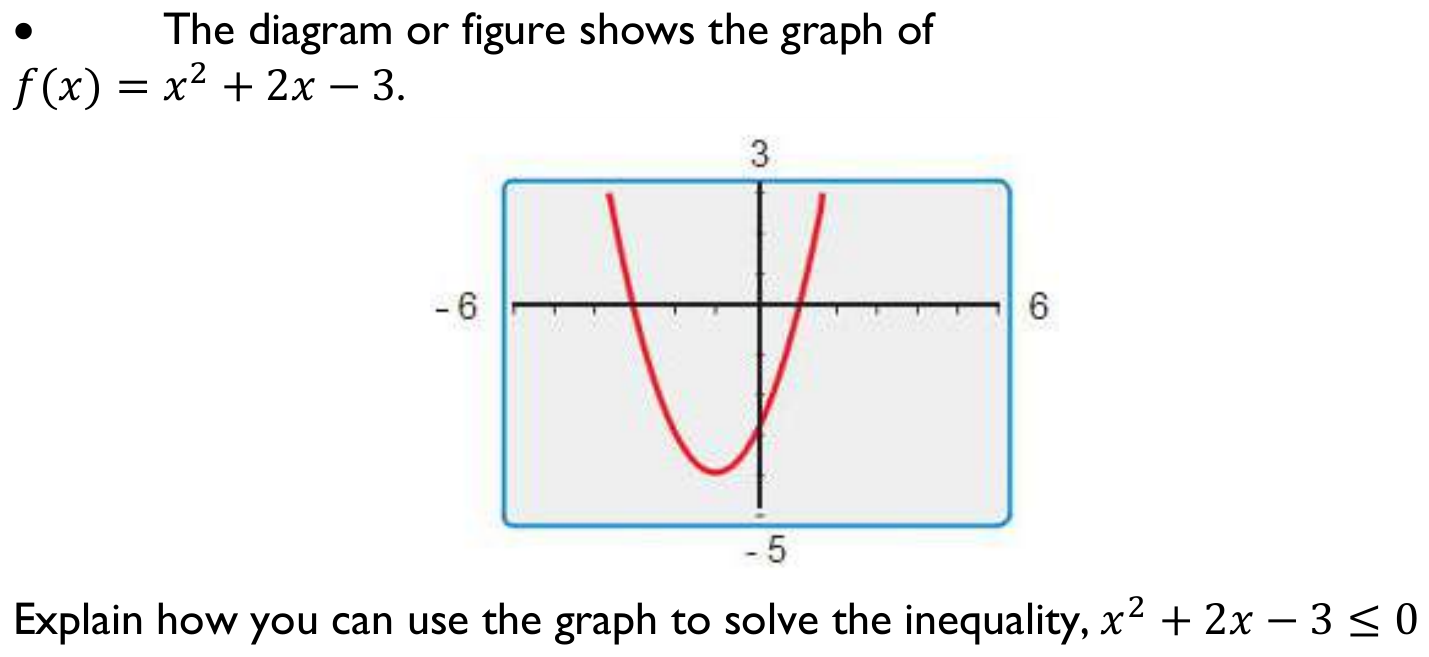
- The diagram or figure shows the graph of 𝑓(𝑥) = 𝑥 ) + 2𝑥 − 3.
Explain how you can use the graph to solve the inequality, 𝑥 ) + 2𝑥 − 3 ≤ 0
Teaching and Learning Resources:
- Graph paper
- Ruler
- A scientific calculator
Assessment (2.1.1.AS.4). The document marks these depth-of-knowledge levels for this indicator: Level 1 Recall; Level 2 Skills of conceptual understanding; Level 4 Extended critical thinking and reasoning.