SHS1 Additional Mathematics · Semester 2, Week 9
Principles of Calculus
Full lesson notes coming
Notes for this lesson are being prepared. The curriculum details below are complete and ready to use for your planning.
Curriculum details
- Strand
- Calculus (Strand 3)
- Sub-strand
- Principles of Calculus (3.1)
- Content standard
- 1.3.1.CS.1 - Demonstrate understanding of the limit of a function, investigate the behaviour of a function near a value in its domain and establish the derivative of a function. 1.3.1.LO.1 Describe graphically and algebraically the behaviour of the function about an input value and determine its derivative.
- Indicator
- 1.3.1.LI.4 - Use the limits of a function to find its derivative.
- Suggested placement
-
Semester 2, Week 9
(Week 29 of the year)
Our suggestion, laid out in curriculum order across three terms of twelve weeks. NaCCA does not fix the week, so follow your school's scheme of learning.
- Source document note
-
The official curriculum document has a fault in this entry, so the curriculum text above is transcribed exactly as printed:
- exemplars - p.194: adjacent duplicated CambriaMath characters were collapsed, but this PDF also maps some equation glyphs to the wrong letter or operator; verify every mathematical expression in this row against the rendered page
- exemplars - p.195: a stacked fraction, matrix, vector or other two-dimensional construct is flattened by the text layer; all visible parts require comparison with the rendered page
- Curriculum reference
- NaCCA curriculum document, p. 194
Exemplars (from the NaCCA curriculum)
Collaborative learning, Experiential Learning, and initiate Talk for Learning.
Learning Experience: Learners working in mixed-ability groups investigate how the limit of a function relates to its derivative.
Activity 1: Learners working in mixed-ability groups investigate both algebraically and graphically how the limits of a function relate to its derivative.
Example: Imagine that a training film is taken of a runner. The film shows elapsed time and distance markers that allow us to measure the distance s(t) the athlete has run in any given time 𝑡. However, the speed of the runner will vary from one instant of time to another. How can the runner's speed 𝑣(𝑡) at a given instant of time t be calculated? 𝑠(𝑢) − 𝑠(𝑡) 𝑢 − 𝑡
For u close to t, this will give a good approximation to 𝑣(𝑡) because the runner's speed does not change much in the small-time interval [𝑡, 𝑢]. If we press this point further, then we intuitively arrive at the concept of instantaneous velocity at t: 𝑠(𝑢) − 𝑠(𝑡) 𝑣(𝑡) = 𝑙 X→G 𝑢 − 𝑡
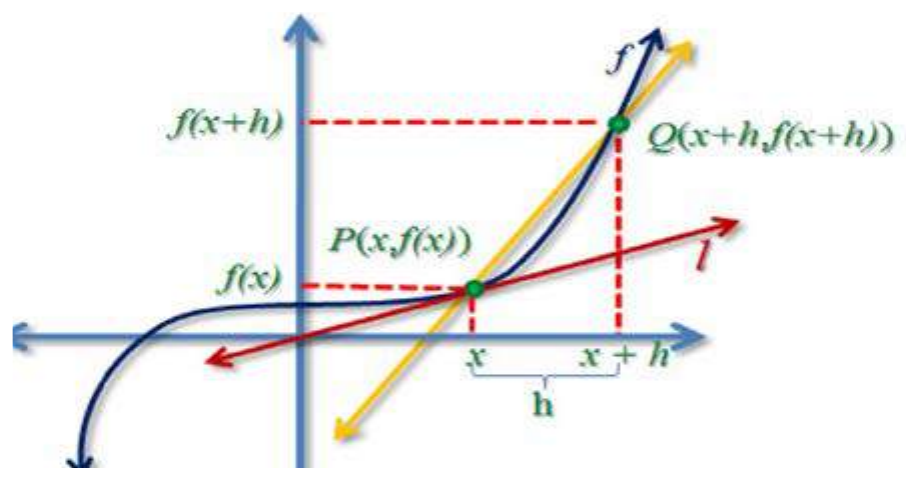
 The number u cannot actually be equal to t because that results in the meaningless fraction 0/0. The key is first to understand exactly what is meant by the limits in these equations and then to learn methods for computing them.)
Fig 3
Activity 2: Learners are tasked in groups to brainstorm on Fig 3 to establish the link between limits and derivative of a function given by
𝑑 𝑓(𝑥 + ℎ) − 𝑓(𝑥) = 𝑑 ℎ
NB:
- There are different notations used for the derivative of a function. For example, the derivative for a <A <I(0) function y = f(x) could be written as 𝑓'(𝑥), or <0 . <0
- The slope of the tangent line is also referred to as the instantaneous rate of change of F at x. Using limits to find a derivative of 𝑦 = 𝑓(𝑥):
- Find 𝑓(𝑥 + ℎ).
- I(0$W)*I(0) Write the difference quotient, . W
- Simplify the difference quotient.
- Find the limit as ℎ → 0.
Example 1: Learners are to discuss how to find the derivative of the functions𝑓, 𝑔 and 𝑝 using the first principle:
- 𝑡(𝑥) = 2𝑥 )
- 𝑔(𝑥) = 6𝑥 + 4
- 𝑝(𝑥) = 3𝑥 ) − 6𝑥 + 7
Solution: (i) 𝑡(𝑥) = 2𝑥 ) . Let ℎ be a very small change which approaches 0 At point 𝑥 + ℎ, 𝑡(𝑥 + ℎ) = 2(𝑥 + ℎ) ) = 2(𝑥 ) + ℎ ) + 2ℎ𝑥) = 2𝑥 ) + 2ℎ ) + 4ℎ𝑥 The link between the limit of a function and the derivative of a function 𝑦 = 𝑡(𝑥) is given by =)0 ! $)W ! $,W0>*()0 ! ) =)W ! $,W0> <A G(0$W)*G(0) = = 𝑙 = 𝑙 =𝑙 (2ℎ + 4𝑥) = 4𝑥 <0 W W→( W W→( W W→(
Example 2: (Continuous function that is not differentiable) - Learners are to work in groups and use limits to find the derivative of 𝑓(𝑥) = |𝑥|, Solution: 𝑓(𝑥) = |𝑥| is the distance from the origin 𝑓(𝑥) = 𝑥 𝑓 𝑥 ≥ 0 and 𝑓(𝑥) = −𝑥 𝑓 𝑥 < 0 then 𝑓(𝑥 + ℎ) = |𝑥 + ℎ| means 𝑓(𝑥 + ℎ) = 𝑥 + ℎ 𝑓 𝑥 + ℎ ≥ 0 and 𝑓(𝑥 + ℎ) = −(𝑥 + ℎ) 𝑓 𝑥 + ℎ < 0 so for x>0 𝑓(𝑥 + ℎ) − 𝑓(𝑥) 𝑥 + ℎ − 𝑥 = 𝑙 + =1 ℎ ℎ W→(
𝑓(𝑥 + ℎ) − 𝑓(𝑥) −(𝑥 + ℎ) − (−𝑥) = 𝑙 . ℎ W→( ℎ
- (0$W)*(*0) 𝑙 = −1 W W→( . Since the slope of the left side equals -1 and the slope of the right side equals +1, they disagree; hence, the function is not differentiable at x = 0. Illustration:
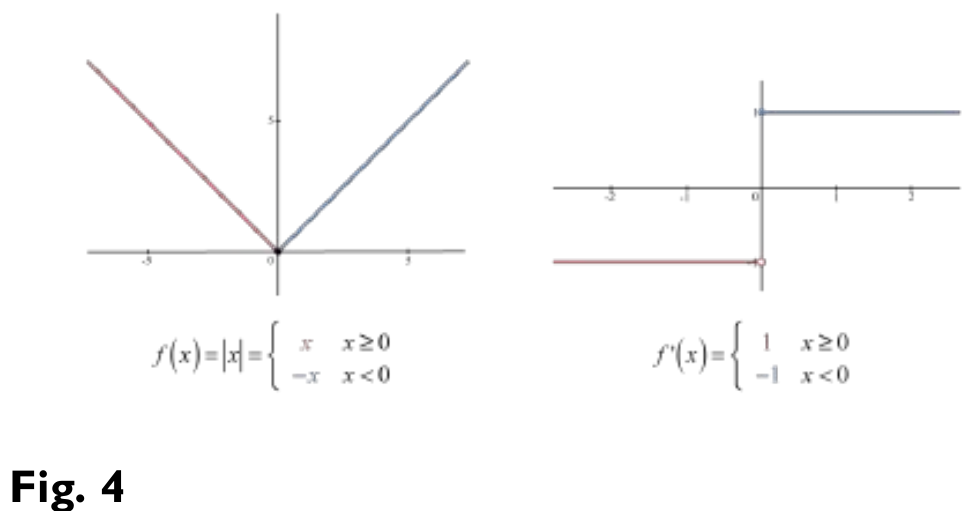
Fig. 4
NB:
- Learners are confronted with the conceptual understanding of why to connect the limits of a function to its derivative. Example 2 reinforces the need to connect limits to the derivatives.
- All differentiable functions are continuous. However, not all continuous functions are differentiable; hence, differentiability is stronger than continuity. Example 3: Identify the values of x if the graph in Fig 5 is not differentiable.
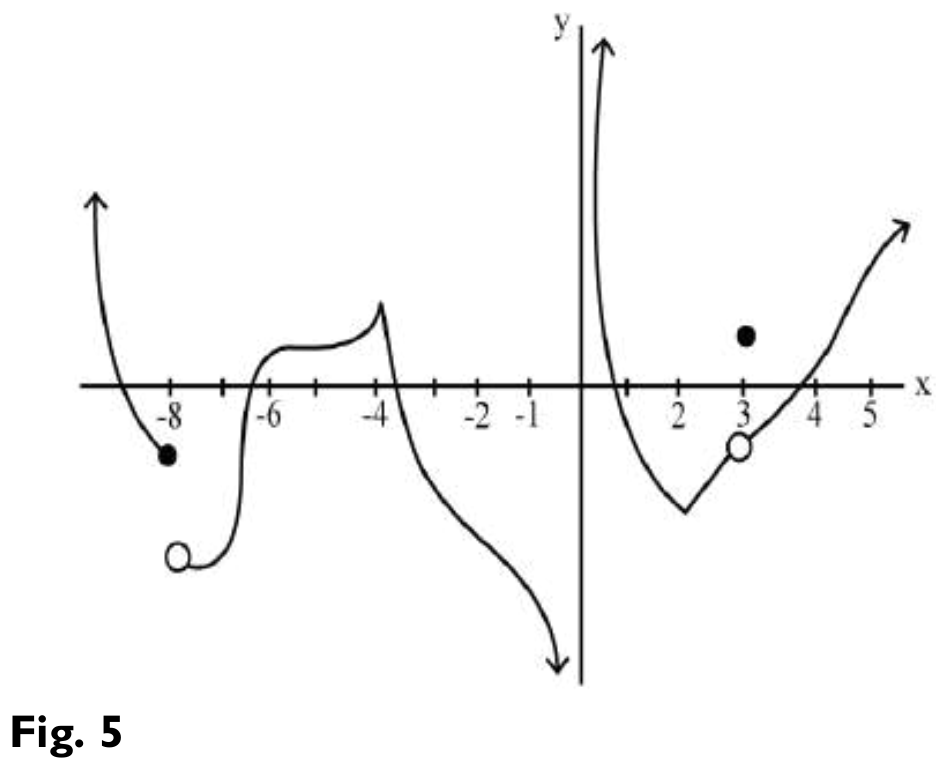
Fig. 5
Solution Values for x=-8, 0 and 3 are not differentiable and are discontinued, and values x=-4 and 2 are also not differentiable; however, they are continuous. Activity 4 (Generalization) Learners are to work in mixed-ability groups to establish the general formula for the function 𝑓(𝑥) = 𝑥 % where 𝑛 is a natural number.
Recall that 𝑓(𝑥 + ℎ) = (𝑥 + ℎ) % . From the binomial expansion, we have %(%*!) %*) ) 𝑓(𝑥 + ℎ) = 𝑥 % + 𝑛𝑥 %*! ℎ + 𝑥 ℎ ... ... ... ... . . +ℎ % )! %(%*!) 𝑓(𝑥 + ℎ) − 𝑓(𝑥) = 𝑛𝑥 %*! ℎ + 𝑥 %*) ℎ ) ... ... ... ... . . +ℎ % )! 𝑑 𝑓(𝑥 + ℎ) − 𝑓(𝑥) = = 𝑛𝑥 %*! 𝑑 ℎ
Example 1 Find the derivative of the following;
- 𝑡(𝑥) = 2𝑥 )
- 𝑔(𝑥) = 6𝑥 + 4
- 𝑝(𝑥) = 3𝑥 ) − 6𝑥 + 7
- 𝑓(𝑥) = −𝑥 " + 4𝑥 ) + 9𝑥
- ℎ(𝑥) = 3𝑥 *) − 4𝑥 *" + 7
- ℎ(𝑡) = 5𝑡 *) + 𝑡 /
- 𝑓(𝑥) = √𝑥
Solution
- <G(0) = 4𝑥 <0 <J(0)
- =6 <0 <+(0)
- = 6𝑥 − 6 <0
Derivative of sin and cosine Theorem: (Trigonometry) < 𝑠 𝑠 (𝑥) = 𝑐 (𝑥) and <0 𝑐 𝑐 (𝑥) = −𝑠 (𝑥) < <0
Proof 𝑑 𝑠 𝑠 (𝑥 + ℎ) − 𝑠 (𝑥) 𝑠 𝑠 (𝑥) = 𝑑 ℎ OL%OL% (0);PO;PO (W) $OL%OL% (W) ;PO (0) *OL% (0) = W OL%OL% (0)[;PO;PO (W)*!] $OL%OL% (W) ;PO (0) = W 𝑠 𝑠 (𝑥)[𝑐 𝑐 (ℎ) − 1] 𝑠 𝑠 (ℎ) 𝑐 (𝑥) + ℎ ℎ
𝑐 (ℎ) − 1 𝑠 𝑠 (ℎ) 𝑐 (𝑥) 𝑠 (𝑥) + ℎ ℎ
;PO (W)*! OL%(W) Note that = 0 and =1 W W < Hence 𝑠 𝑠 (𝑥) = 𝑐 (𝑥) <0 Similarly, learners should work in pairs to establish 𝑑 𝑐 𝑐 (𝑥) = −𝑠 (𝑥) 𝑑
Teaching and Learning Resources:
- GeoGebra
- PhET
- Technology tools
- Mathematical sets
- Calculators
- Learners textbooks
- Graph sheets
Assessment (1.3.1.AS.4). The document marks these depth-of-knowledge levels for this indicator: Level 2 Skills of conceptual understanding; Level 3 Strategic reasoning.