SHS1 Additional Mathematics · Semester 2, Week 8
Principles of Calculus
Lesson notes
Learning Objectives
Indicator: 1.3.1.LI.1 - Describe and interpret the meaning of the limit of a function through graphical and algebraic approaches.
By the end of the lesson, learners can:
- State in their own words what is meant by the limit of a function as x approaches a value, using the formal notation lim f(x) as x approaches a.
- Read values of limits from a graph by examining the behaviour of the function from both the left and the right of the input value.
- Construct a table of values for a given function near a specified input value and use the pattern to estimate the limit algebraically.
- Distinguish between the value of a function at a point and the value the function approaches near that point, explaining cases where these differ.
- Discuss real-life situations where quantities approach a limiting value, connecting the mathematical idea of a limit to everyday experience.
Sign in with your phone number to read the full note and download the GES plan - free.
Sign in with phone numberCurriculum details
- Strand
- Calculus (Strand 3)
- Sub-strand
- Principles of Calculus (3.1)
- Content standard
- 1.3.1.CS.1 - Demonstrate understanding of the limit of a function, investigate the behaviour of a function near a value in its domain and establish the derivative of a function. 1.3.1.LO.1 Describe graphically and algebraically the behaviour of the function about an input value and determine its derivative.
- Indicator
- 1.3.1.LI.1 - Describe and interpret the meaning of the limit of a function through graphical and algebraic approaches.
- Suggested placement
-
Semester 2, Week 8
(Week 28 of the year)
Our suggestion, laid out in curriculum order across three terms of twelve weeks. NaCCA does not fix the week, so follow your school's scheme of learning.
- Source document note
-
The official curriculum document has a fault in this entry, so the curriculum text above is transcribed exactly as printed:
- exemplars - p.182: adjacent duplicated CambriaMath characters were collapsed, but this PDF also maps some equation glyphs to the wrong letter or operator; verify every mathematical expression in this row against the rendered page
- Curriculum reference
- NaCCA curriculum document, p. 182
Exemplars (from the NaCCA curriculum)
Talk for Learning, Collaborative learning.
Learning Experience: Learners working in mixed-ability groups to consolidate and foster their understanding of concepts of limits in mathematics and in daily life using both algebraic and graphical means.
Activity 1: Learners should work in mixed-ability groups to demonstrate the concepts of limits in mathematics and in daily life using both algebraic and graphical means.
Example 1: Investigate and interpret the limit of 𝑔(𝑥) as 𝑥 approaches 2 (refer to Fig. 1)
Solution: 𝑇ℎ𝑒 𝑓 𝑔(𝑥) approaches 2 Note: You can approach 2 from the left or right.
Example 2: Given a function, 𝑓(𝑥) = 2𝑥
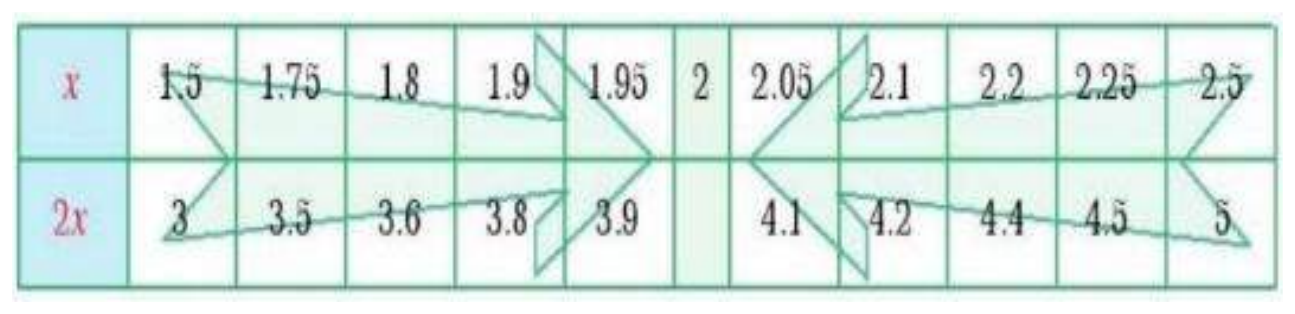
Display the table above to learners to investigate the value of the function as 𝑥 gets closer to 2.
Solution: 𝑓(𝑥) gets closer to 4 as 𝑥 approaches 2.
Activity 2: Learners are to work in groups with different tasks to investigate the behaviour of a function for different intervals for the input values and share their observations.
Example 1: Investigate the behaviour of 𝑔(𝑥) on the interval input values on the intervals (-6,-4), (- 3.5, 0) and (0,4).
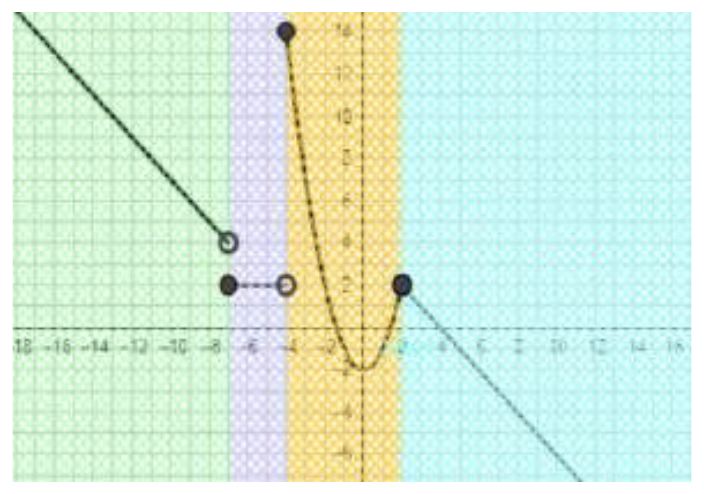
Fig. 1: Graph of a piecewise function 𝑔(𝑥) in Geogebra.
Activity 3: Think pair share within and across groups to investigate and discuss the value 𝑔(𝑥) approaches as x approaches the number -7 on the horizontal axis. (Refer to Fig. 1)
Note: The concept of limit is the basis for a solid understanding of calculus. For example, consider a circle C of radius r - its area A is πr ) and circumference C is 2πr. One can approximate the area and circumference of C by a region with an area and perimeter that we do know. One approach is to inscribe an equilateral triangle (a regular 3-gon) in C. We add sides, one at a time, to the inscribed figure to create inscribed polygons. The area and circumference of the inscribed figure get closer and closer to the area and circumference, respectively.
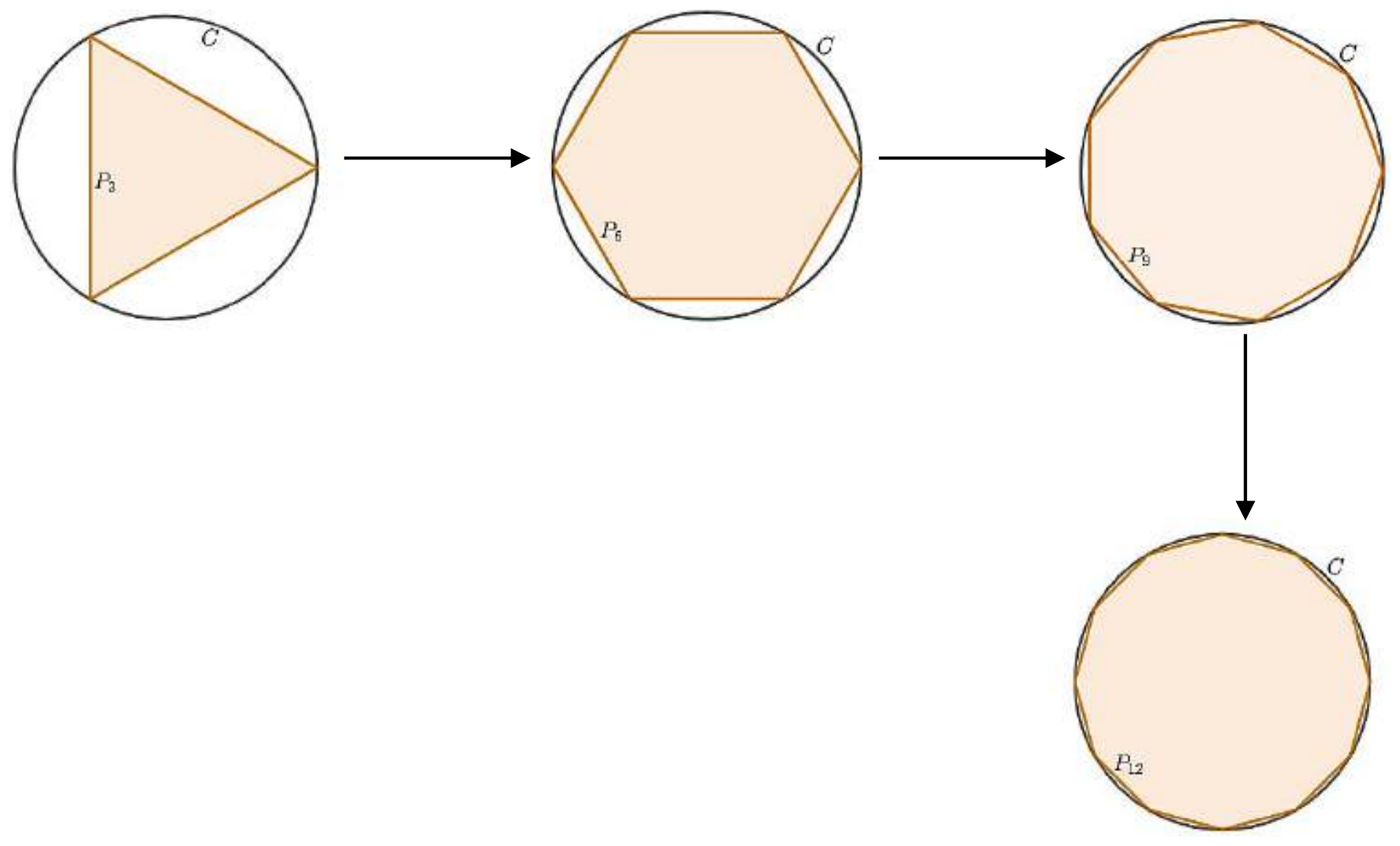
No matter how small the sides of a polygon become, the polygon will have many small equal lengths, even though the circle is round. This means as the number of sides n tends to infinity, the limit of the area, A ] , inside the polygon P ] equals the area A inside the circle and the limit of the perimeter C ] of P ] equals the circumference C of the circle. So we write this as 𝐴 = 𝐴 % 𝑎 𝐶 = 𝐶 %
Teaching and Learning Resources:
- GeoGebra
- PhET
- Technology tools
- Mathematical sets
- Calculators
- Learners textbooks
- Graph sheets
Assessment (1.3.1.AS.1). The document marks these depth-of-knowledge levels for this indicator: Level 1 Recall; Level 3 Strategic reasoning; Level 4 Extended critical thinking and reasoning.