SHS1 Additional Mathematics · Semester 1, Week 18
Applications of Algebra
Lesson notes
Learning Objectives
Indicator: 1.1.2.LI.1 - Recognise a matrix (including types of matrices) and state its order.
By the end of the lesson, learners can:
- Define a matrix as a rectangular arrangement of numbers, symbols or objects arranged in rows and columns, and identify examples of matrices in their school and home environment.
- State the order (dimension) of a given matrix as m × n, where m is the number of rows and n is the number of columns.
- Identify and describe the different types of matrices, including row matrices, column matrices, square matrices, zero matrices and identity matrices.
- Use the notation aᵢⱼ to locate and name the element in the i-th row and j-th column of a matrix.
- Recognise when two matrices are equal and use the condition of equality to find unknown values in simple matrix equations.
Sign in with your phone number to read the full note and download the GES plan - free.
Sign in with phone numberCurriculum details
- Strand
- Modelling with Algebra (Strand 1)
- Sub-strand
- Applications of Algebra (1.2)
- Content standard
- 1.1.2.CS.2 - Demonstrate knowledge and understanding of algebraic processes and reasoning in relation to matrix operations. 1.1.2.LO.1 Examine, analyse, determine and predict other terms in a pattern/sequence. 1.1.2.LO.2 Distinguish among various types of relations, find the domain and range of, and evaluate functions. 1.1.2.LO.3 Show that a function is injective (into) and/or surjective (onto). Find the inverse, describe the relationship between two variables and establish composite functions. 1.1.2.LO.4 Graph linear and quadratic functions and determine the intercepts. 1.1.2.LO.5 Find graphical and algebraic solutions to a system of three linear equations in three variables and apply them to solve real life problems. 1.1.2.LO.6 Perform algebraic manipulations on polynomial functions and graph polynomial functions. 1.1.2.LO.7 Find the domain, range, and zero of a rational function and state when it is undefined. 1.1.2.LO.8 Identify and describe the order of a matrix, the identity matrix and the zero matrix; find the determinant and perform basic arithmetic operations on 2 by 2 matrices (addition and subtraction).
- Indicator
- 1.1.2.LI.1 - Recognise a matrix (including types of matrices) and state its order.
- Suggested placement
-
Semester 1, Week 18
(Week 18 of the year)
Our suggestion, laid out in curriculum order across three terms of twelve weeks. NaCCA does not fix the week, so follow your school's scheme of learning.
- Source document note
-
The official curriculum document has a fault in this entry, so the curriculum text above is transcribed exactly as printed:
- exemplars - p.122: adjacent duplicated CambriaMath characters were collapsed, but this PDF also maps some equation glyphs to the wrong letter or operator; verify every mathematical expression in this row against the rendered page
- exemplars - p.123: a stacked fraction, matrix, vector or other two-dimensional construct is flattened by the text layer; all visible parts require comparison with the rendered page
- Curriculum reference
- NaCCA curriculum document, p. 122
Exemplars (from the NaCCA curriculum)
Collaborative Learning: Learners will work in convenient groups (ability, mixed-ability, mixed gender, etc.) to solve problems and present answers related to matrices and linear transformation.
Talk for Learning Approaches: Learners will brainstorm through think-pair-share and debate and discuss the types and features of matrices.
Project-based Learning: Learners will collaboratively embark on a project to come up with a matrix that is relevant and applicable to real life and make presentations.
Experiential Learning: Learners will collaboratively engage in hands-on activity (learning by doing) to resolve and manipulate data into a matrix and calculate determinants.
Problem-based Learning: Learners will collaboratively inquire into the importance of matrices in real life.
Activity 1: Discuss matrices in the natural environment and create matrices using objects, symbols or numerals.
Collaborative Learning, Experiential Learning, and Talk for Learning Approaches: Learners work in groups/pairs to Identify and describe features of matrices. Learners examine and recognise a matrix as an arrangement of objects or numbers into rows and columns.
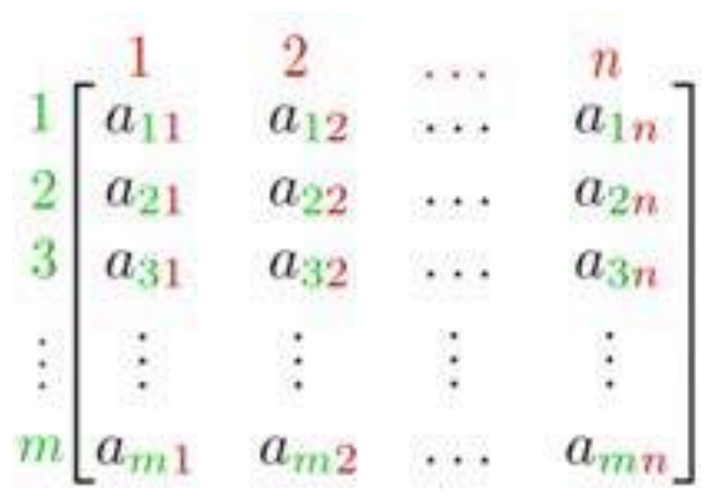
Example: In an 𝑚 𝑥 𝑛 matrix, the m rows are horizontal, and the n columns are vertical. Each element of a matrix is denoted by a variable with subscripts. For example, 𝑎 )" represents the element at the second row and third column of the matrix.
Example 1: The sitting arrangement in a classroom Example 2: Provision items in a shop. Example 3: A pack of bottled water. Example 4: Suppose that we wish to express the information of possession of pens and pencils by Afiba and his two friends, Enyonam and Yaw, which is as follows: Afiba has 20 pens and 7 pencils, Enyonam has 15 pens and, 5 pencils, and Yaw has 12 pens and 3 pencils. Now, this could be arranged in tabular form as follows:
Pens Pencils Afiba 2 7 Enyonam 1 5 Yaw 3 2
and this can be expressed as, 2 7 2 7 𝐴 = Ÿ 1 5 or 𝐴 = ¡ 1 5 ¢ 3 2 3 2
Problem-Based Learning: Learners research the relevance of learning about matrices in mathematics and make presentations.
Activity 2: Order of a matrix, equality of a matrix, identity matrix and zero matrix.
Collaborative Learning, Experiential Learning, and Talk for Learning Approaches: Learners recognise the order of a matrix as 𝑚 𝑥 𝑛, where 𝑚 represents the number of rows and 𝑛 the number of columns.
Example 1: 7 8 𝐵 = ¡ 9 10 ¢ 11 12 For matrix B, the order is 3 × 2
Learners discuss and solve problems related to the order of a matrix, the unit matrix, and matrix equality.
Example: Given that, 3𝑦 + 1 7 10 3𝑦 − 𝑥 £ ¤=i j 2𝑦 + 𝑥 3 8 3 find the values of 𝑥 and 𝑦.
Teaching and Learning Resources:
- Worksheets
- Scientific Calculator
- Technological tools, apps, etc.
- SHS Additional Mathematics Curriculum
Assessment (1.1.2.AS.1). The document marks these depth-of-knowledge levels for this indicator: Level 1 Recall; Level 2 Skills of conceptual understanding; Level 3 Strategic reasoning.