SHS1 Additional Mathematics · Semester 1, Week 10
Applications of Algebra
Lesson notes
Learning Objectives
Indicator: 1.1.2.LI.6 - Find the inverse of simple functions.
By the end of the lesson, learners can:
- State the definition of an inverse function and explain why only bijective functions have inverses.
- Find the inverse of a simple linear function algebraically, using both the “make x the subject” method and the “swap x and y” method.
- Determine whether a given function is invertible by applying the horizontal line test to its graph.
- Verify that two functions are inverses of each other by composing them and confirming the result equals x.
- Sketch the graph of a function and its inverse on the same axes, recognising that they are reflections over the line y = x.
Sign in with your phone number to read the full note and download the GES plan - free.
Sign in with phone numberCurriculum details
- Strand
- Modelling with Algebra (Strand 1)
- Sub-strand
- Applications of Algebra (1.2)
- Content standard
- 1.1.2.CS.1 - Demonstrate knowledge and understanding of applying algebraic processes and reasoning involving sequence, functions, and linear programming. 1.1.2.LO.1 Examine, analyse, determine and predict other terms in a pattern/sequence. 1.1.2.LO.2 Distinguish among various types of relations, find the domain and range of, and evaluate functions. 1.1.2.LO.3 Show that a function is injective (into) and/or surjective (onto). Find the inverse, describe the relationship between two variables and establish composite functions. 1.1.2.LO.4 Graph linear and quadratic functions and determine the intercepts. 1.1.2.LO.5 Find graphical and algebraic solutions to a system of three linear equations in three variables and apply them to solve real life problems. 1.1.2.LO.6 Perform algebraic manipulations on polynomial functions and graph polynomial functions. 1.1.2.LO.7 Find the domain, range, and zero of a rational function and state when it is undefined. 1.1.2.LO.8 Identify and describe the order of a matrix, the identity matrix and the zero matrix; find the determinant and perform basic arithmetic operations on 2 by 2 matrices (addition and subtraction).
- Indicator
- 1.1.2.LI.6 - Find the inverse of simple functions.
- Suggested placement
-
Semester 1, Week 10
(Week 10 of the year)
Our suggestion, laid out in curriculum order across three terms of twelve weeks. NaCCA does not fix the week, so follow your school's scheme of learning.
- Source document note
-
The official curriculum document has a fault in this entry, so the curriculum text above is transcribed exactly as printed:
- exemplars - p.104: adjacent duplicated CambriaMath characters were collapsed, but this PDF also maps some equation glyphs to the wrong letter or operator; verify every mathematical expression in this row against the rendered page
- exemplars - p.104: a stacked fraction, matrix, vector or other two-dimensional construct is flattened by the text layer; all visible parts require comparison with the rendered page
- Curriculum reference
- NaCCA curriculum document, p. 104
Exemplars (from the NaCCA curriculum)
Collaborative Learning, Experiential Learning and Problem-based Learning: Learners Recognise bijective functions and determine the inverse of such functions (learners must find the inverse function by using graphic illustrations and through algebraic means).
Activity 1: Inverse of a function Note: A bijection function is also known as an invertible function because they have an inverse function property. The inverse of bijection 𝑓 denoted as 𝑓 *! is a function which assigns to 𝑏, a unique element 𝑎, such that 𝑓(𝑎) = 𝑏. Hence 𝑓 *! (𝑏) = 𝑎
Example 1: Find the inverse of 𝑓(𝑥) = 2𝑥 - 1 By definition, the inverse of a function is that function that takes values of the dependent variable (in this example, 𝑦) as arguments and yield values for the independent variable (in this case, 𝑥). Based on this definition, we would seek a function with 𝑥 as the subject and 𝑦 as the independent variable
If we let 𝑓(𝑥) = 𝑦, i.e., 𝑦 = 2𝑥 − 1, we can just make 𝑥 the subject thus: A$! 𝑥 = ) We need a function in terms of 𝑥 hence we write it as 𝑓 *! (𝑥) = 0$! )
Alternatively, we could switch the 𝑥 values and the 𝑦 values of the given function, then solve for the new "𝑦." Next, replace the new "𝑦" with 𝑓 *! (𝑥).
Solution: Let 𝑓(𝑥) = 𝑦 = 2𝑥 - 1 𝑥 = 2𝑦 - 1 ⇒ 2𝑦 = 𝑥 + 1 0$! 𝑦 = ) 0$! ∴ 𝑓 *! (𝑥) = )
Activity 1: Investigate the graphs of a function and its inverse
Collaborative Learning, Experiential Learning and Problem-based Learning: Learners determine the domain and range of inverse functions presented in graphical and algebraic forms.
The inverse of a function is visually represented as the original function reflected over the line 𝑦 = 𝑥 and passes the vertical line test and the horizontal line test.
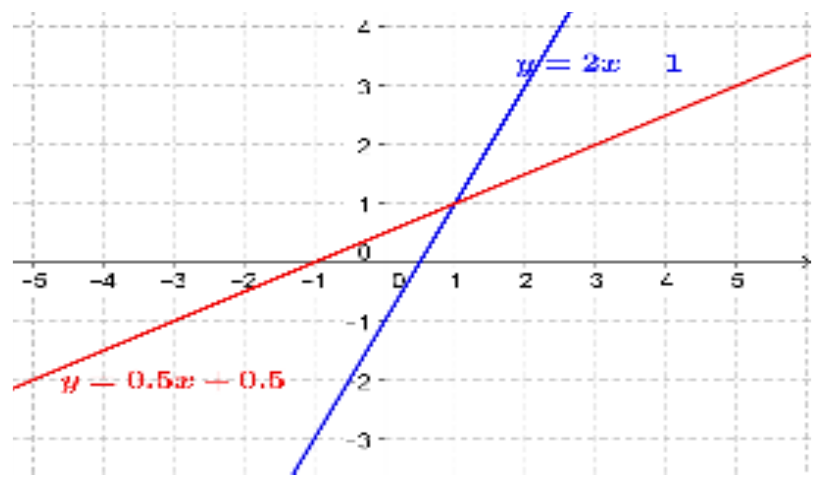
0$! The graph shows a function 𝑓(𝑥) = 2𝑥 − 1 and it inverse 𝑓 *! (𝑥) = )
Teaching and Learning Resources:
- Cut out shapes of different colours and orientation
- Maths Technology learning apps, tools and devices
- Chalkboard illustrations
- Worksheets
- Cut-out geometrical shapes of different colours and orientation
Assessment (1.1.2.AS.6). The document marks these depth-of-knowledge levels for this indicator: Level 2 Skills of conceptual understanding; Level 3 Strategic reasoning.