SHS1 Additional Mathematics · Semester 1, Week 9
Applications of Algebra
Full lesson notes coming
Notes for this lesson are being prepared. The curriculum details below are complete and ready to use for your planning.
Curriculum details
- Strand
- Modelling with Algebra (Strand 1)
- Sub-strand
- Applications of Algebra (1.2)
- Content standard
- 1.1.2.CS.1 - Demonstrate knowledge and understanding of applying algebraic processes and reasoning involving sequence, functions, and linear programming. 1.1.2.LO.1 Examine, analyse, determine and predict other terms in a pattern/sequence. 1.1.2.LO.2 Distinguish among various types of relations, find the domain and range of, and evaluate functions. 1.1.2.LO.3 Show that a function is injective (into) and/or surjective (onto). Find the inverse, describe the relationship between two variables and establish composite functions. 1.1.2.LO.4 Graph linear and quadratic functions and determine the intercepts. 1.1.2.LO.5 Find graphical and algebraic solutions to a system of three linear equations in three variables and apply them to solve real life problems. 1.1.2.LO.6 Perform algebraic manipulations on polynomial functions and graph polynomial functions. 1.1.2.LO.7 Find the domain, range, and zero of a rational function and state when it is undefined. 1.1.2.LO.8 Identify and describe the order of a matrix, the identity matrix and the zero matrix; find the determinant and perform basic arithmetic operations on 2 by 2 matrices (addition and subtraction).
- Indicator
- 1.1.2.LI.3 - Identify Relations and Functions and describe their differences.
- Suggested placement
-
Semester 1, Week 9
(Week 9 of the year)
Our suggestion, laid out in curriculum order across three terms of twelve weeks. NaCCA does not fix the week, so follow your school's scheme of learning.
- Source document note
-
The official curriculum document has a fault in this entry, so the curriculum text above is transcribed exactly as printed:
- exemplars - p.96: adjacent duplicated CambriaMath characters were collapsed, but this PDF also maps some equation glyphs to the wrong letter or operator; verify every mathematical expression in this row against the rendered page
- Curriculum reference
- NaCCA curriculum document, p. 96
Exemplars (from the NaCCA curriculum)
Collaborative Learning: Learners will be working in convenient groups (ability, mixed-ability, mixed gender etc.) to solve problems and present answers related to functions and relations.
Talk for Learning Approaches: Learners will brainstorm through think-pair-square and debate and discuss the types and features of functions and relations.
Experiential Learning: Learners will collaboratively engage in hands-on activity (learning by doing) to create functions.
Problem-based Learning: Learners will collaboratively undertake research inquiry functions in real life.
Activity 1: Recognising relations and functions in mathematics.
Talk for Learning: Learners discuss the historical antecedent of functions, tracing it from Rene Descartes in 1637 through Gottfried Wilhelm Leibniz, Leonhard Euler, Nicolas Bourbáki, John Tate
etc. Learners discuss the importance of functions as the building blocks for designing machines, predicting natural disasters, curing diseases, understanding world economies, keeping aeroplanes in the air, etc.
Learners work in groups to answer the question, "What is your understanding of a function?" Each group should agree upon and present one meaning on a poster and discuss the concept of function in terms of a function's definition, type, and general properties.
Example 1: Learners discuss within groups which of the relations listed below are examples of functions and justify their answers to the class.
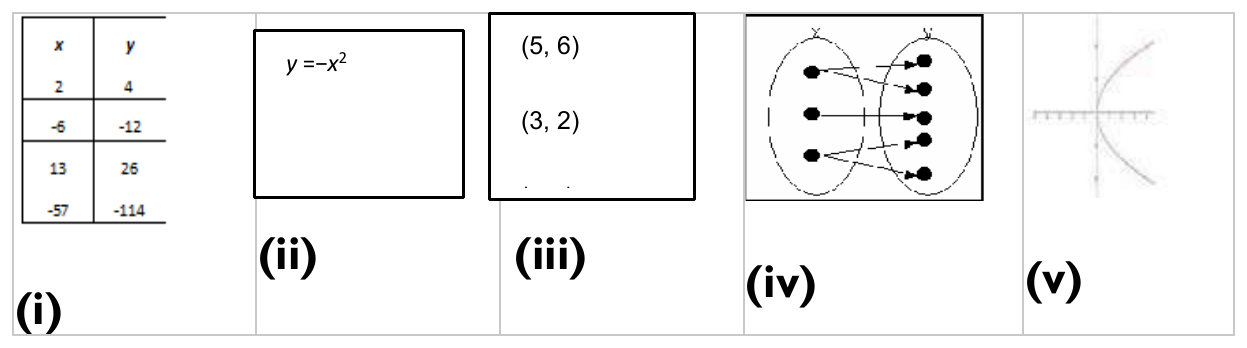
 (5, 6) y =−x 2 (3, 2)
(5, 1) (ii) (iii) (v) (iv) (i)
Example 2: Groups investigate the following problems and make presentations to the class justifying which can be classified as functions. Let A = (a, b, c}, B = {4, 5, 6}, and f = {(a, 6), (b, 4), (c, 6)}. Is f a function from A to B? Why? Let A = {1, 2, 3}, B = {c, d, e}, and g = {(1, d), (2, c), (1, e)}. Is g a function from A to B? Why? Let M be the set of all museums, N the set of all countries, and 𝐿 = {(𝑚, 𝑛) ∈ 𝑀 × 𝑁 the museum m is in the country n}. Is L a function from M to N?
Learners reflect on their informal work in trying to describe what a function is and formalize the definition of function, taking notice of the use of the symbols in the definition.
Note: Three examples of how a function might be defined are:
Given two sets 𝐴 and 𝐵, the set 𝐴 × 𝐵 consists of all ordered pairs (𝑎, 𝑏) where 𝑎 ∈ 𝐴, 𝑏 ∈ 𝐵. A subset of 𝐴 × 𝐵 is called a relation. Thus:
- A function from 𝐴 to 𝐵 is a pairing of elements in A with elements in 𝐵 in such a way that each element in 𝐴 is paired with exactly one element in 𝐵.
- A function 𝑓 from 𝐴 to 𝐵 is a rule or relation between 𝐴 and 𝐵 that assigns each element 𝑎 ∈ 𝐴 to a unique element 𝑏 ∈ 𝐵.
- A function 𝑓 from 𝐴 to 𝐵 is a subset of the Cartesian product 𝐴 × 𝐵 = {(𝑎, 𝑏) |𝑎 𝐴, 𝑏 𝐵} such that 𝑏 is unique for each 𝑎 ∈ 𝐴}.
Activity 2: Use of mapping diagrams to establish various types of relations and establish connections between relations and functions.
Learners working in convenient groups observe different graphical representations and explanations for relations and draw conclusions.
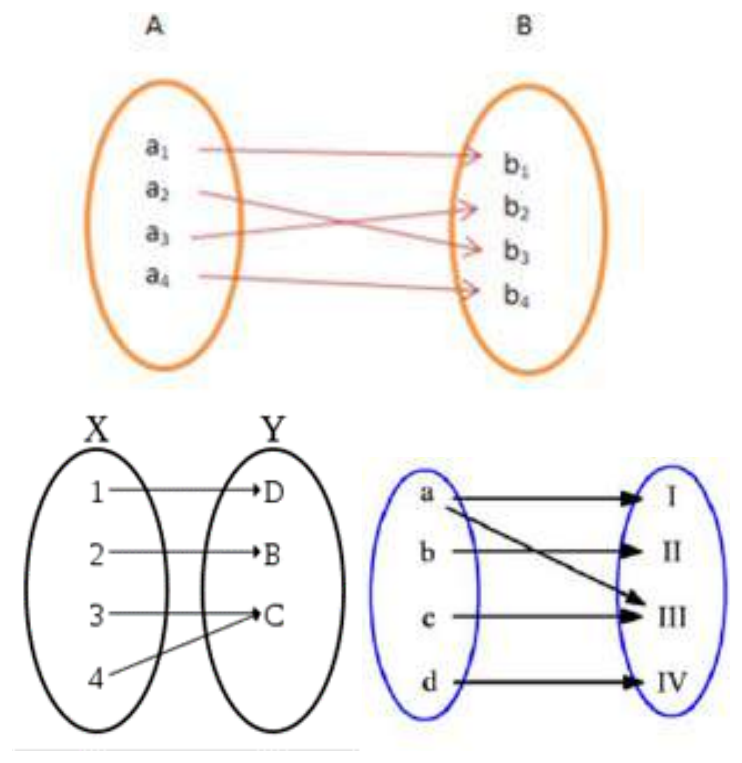
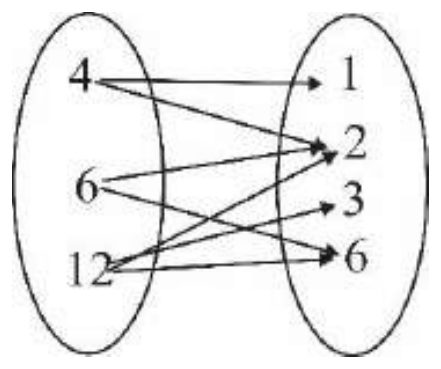
Conclusion: All functions are relations, BUT not all relations are functions. A function is a type of relation that assigns ONE output to each input.
Problem-based/Research Work: Have learners investigate the various types of functions (absolute functions, identity function, quadratic, cubic functions etc.) study the nature of their graphs and make presentations on them.
Teaching and Learning Resources:
- Cut out shapes of different colours and orientation
- Maths Technology learning apps, tools and devices
- Chalkboard illustrations
- Worksheets
- Cut-out geometrical shapes of different colours and orientation
Assessment (1.1.2.AS.3). The document marks these depth-of-knowledge levels for this indicator: Level 1 Recall; Level 3 Strategic reasoning; Level 4 Extended critical thinking and reasoning.