SHS1 English Language · Semester 1, Week 13
Grammar
Lesson notes
Learning Objectives
Indicator: 1.3.1.LI.1 - Use nouns accurately in speech and writing.
By the end of the lesson, learners can:
- Identify nouns in spoken and written passages and name their type or form (common, proper, concrete, abstract, count, non-count, collective).
- Form the plural of regular and irregular nouns correctly in sentences.
- Use the genitive forms of nouns (apostrophe ‘s, the bare apostrophe, and the “of” form) accurately in speech and writing.
- Classify nouns from a selected passage into their various types with minimal support.
- Compose short paragraphs that correctly include at least four different noun types and at least one example of each genitive form.
Sign in with your phone number to read the full note and download the GES plan - free.
Sign in with phone numberCurriculum details
- Strand
- Grammar Usage (Strand 3)
- Sub-strand
- Grammar (3.1)
- Content standard
- 1.3.1.CS.1 - Demonstrate knowledge, understanding and use of grammatical forms in speech and writing. 1.3.1.LO.1 Apply knowledge of word classes and their functions in communication. 1.3.1.LO.2 Distinguish between and use the parts and elements that make up a sentence. 1.3.1.LO.3 Distinguish between and use compound and complex sentences. 1.3.1.LO.4 Distinguish between and use dependent and independent clauses. 1.3.1.LO.5 Compose texts using phrase types.
- Indicator
- 1.3.1.LI.1 - Use nouns accurately in speech and writing.
- Suggested placement
-
Semester 1, Week 13
(Week 13 of the year)
Our suggestion, laid out in curriculum order across three terms of twelve weeks. NaCCA does not fix the week, so follow your school's scheme of learning.
- Source document note
-
The official curriculum document has a fault in this entry, so the curriculum text above is transcribed exactly as printed:
- strand name - p.53: this document swaps the names GRAMMAR and GRAMMAR USAGE between the strand and its first sub-strand from page to page - printed p.46 heads "Strand 3. GRAMMAR USAGE / Sub-Strand 1. GRAMMAR", printed p.62 "Strand 3. GRAMMAR / Sub-Strand 2. VOCABULARY", printed p.124 "Strand 3. GRAMMAR / Sub-Strand 1. GRAMMAR USAGE" and printed p.134 "Strand 3.GRAMMAR USAGE" with no space. The scope-and-sequence on printed p.21 calls the strand Grammar and the sub-strand Grammar Usage. Each heading is transcribed as its own page prints it
- indicator text - p.53: the code 1.3.1.LI.1 names 2 different indicators in this year. This document restarts learning-indicator numbering at LI.1 under every content standard, so a code identifies an indicator only together with its content standard - here 1.3.1.CS.1
- Curriculum reference
- NaCCA curriculum document, p. 53
Exemplars (from the NaCCA curriculum)
Brainstorming: Learners work in mixed ability groups ensuring collaboration and respecting one another's views to identify nouns in context and use them in speech and writing.
Task-Based Learning: Learners in mixed ability groups brainstorm the concept of nouns, encouraging one another to define and give examples taking into consideration their cultural backgrounds.
Think-Pair-Share: Learners use previous examples given in the brainstorming session to identify noun forms as they think in pairs and share ideas, supporting the involvement of all.
Group Work:
Learners in mixed ability groups collaboratively classify nouns from selected passages into noun types/forms.
Forms/Types of Nouns:
- Common Nouns E.g.: chair, book etc.
- Proper Nouns E.g.: Adwoa, Musa, Ghana, Lake Volta, Canada etc.
- Concrete Nouns E.g. Window, projector, computer, bottle etc.
- Abstract Nouns E.g. Love, kindness, honesty etc.
- Count Nouns E.g. Pen-Pens, book-books, boy-boys, girl-girls etc.
- Non-Count Nouns E.g. Water, oil, sugar etc.
- Collective Nouns E.g. Children, family, police, clergy etc.
Note: Teacher guides learners to identify regular and irregular nouns. E.g.
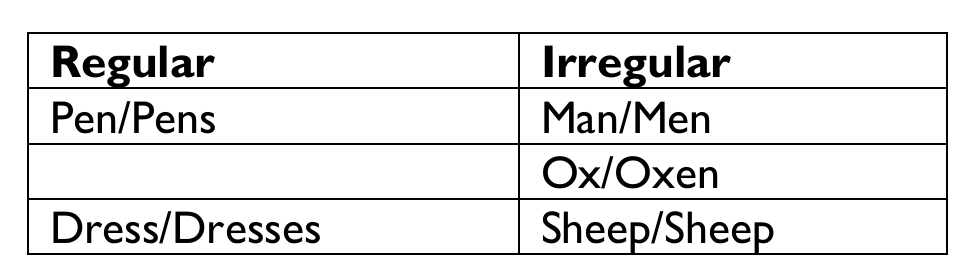
Regular
Irregular
Pen/Pens
Man/Men
Ox/Oxen
Dress/Dresses
Sheep/Sheep
I have one ox - I have two oxen
Genitive Forms of Nouns
Games:
- Learners in gender groupings use games to form genitives of nouns appropriately in speech and writing.
Examples:
i.
Building on What Others Say (chain game) ... 's' genitive:
ii.
Adding 's' to regular nouns to show possession. E.g.:
a) Akwasi's bag
b) Fuseina's new bag
c) Dzifanu's bowl
iii.
Adding 's' to the genitive case in regular plural nouns. E.g.:
a) The boys' dormitory
b) The girls' house
iv.
Adding 's' to the apostrophe/Adding the apostrophe to nouns ending in 's'. Eg:
a) Abass' book
b) Rawlings'
c) James's bag
d) Akos' new bag
v.
Adding 'of' to the noun phrase. E.g.:
a) The title of the poem
Conversation Drills: Using conversation drills, learners (in pairs, groups, whole class, dialogues etc) use the 's' genitive and the 'of' form in sentences.
KWL (What I know-What I want to know- What I have Learnt): Learners play the KWL game in their mixed ability pairs to identify and use plural noun forms in selected passages/texts ensuring collaboration and respect for one another's views.
Example: Learner A: K - river + s = rivers
W - Examples of nouns that neither adds 's' nor change their form = people, sheep
L - I have learnt that not all nouns form plural by adding 's'
Teaching and Learning Resources:
- Word/Sentence cards
- Word Walls
- Real objects and pictures
- Selected passages
- Teacher made passages
- Technology tools such as computer, mobile phones, projector, radio, TV, films and narratives etc.
- Passages that reveal various forms of nouns.
- Varieties of narrative texts that reveal various types of pronouns.
- Pictures
- Real objects.
- Varieties of narrative texts that reveal use of adjectives in context.
- Videos with dialogue
- Role-play
- Varieties of narrative texts and Passages
Assessment (1.3.1.AS.1). The document marks these depth-of-knowledge levels for this indicator: Level 1 Recall; Level 2 Skills of conceptual understanding; Level 3 Strategic reasoning.
the