SHS3 Mathematics · Semester 1, Week 19
Spatial Sense
Full lesson notes coming
Notes for this lesson are being prepared. The curriculum details below are complete and ready to use for your planning.
Curriculum details
- Strand
- Geometry Around Us (Strand 3)
- Sub-strand
- Spatial Sense (3.1)
- Content standard
- 3.3.1.CS.1 - Demonstrate a conceptual understanding of spatial sense with respect to circles and their theorems and apply its properties to solve everyday life problems. 3.3.1.LO.1 Draw circles for given radii and use the circle theorems; identify the tangent as perpendicular to the radius at the point of contact and verify that tangents drawn from an external point to the same circle are equal when measured from their point of contact.
- Indicator
- 3.3.1.LI.4 - Verify that tangents drawn from an external point to the same circle are equal when measured from their point of contact.
- Suggested placement
-
Semester 1, Week 19
(Week 19 of the year)
Our suggestion, laid out in curriculum order across three terms of twelve weeks. NaCCA does not fix the week, so follow your school's scheme of learning.
- Curriculum reference
- NaCCA curriculum document, p. 341
Exemplars (from the NaCCA curriculum)
Group discussions: In convenient groups, learners discuss the concept and prove that tangents drawn from an external point to the same circle are equal when measured from their point of contact. Use technology Literacy Skills, combined problem-solving competency, and critical thinking skills to enable creative and innovative techniques about circle theorems to verify tangents drawn from an external point to the same circle and equal when measured from their point of contact.
Examples Theorem: Suppose that two tangents are drawn to a circle S from an exterior point P. Let the points of contact be A and B, as shown:
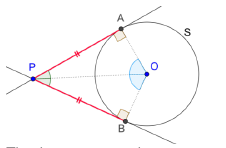
The theorem states that:
- The lengths of these two tangents will be equal, that is, PA = PB.
- They will also subtend equal angles at the centre, that is, ∠POA=∠POB
- The angle between them will be bisected by the line joining the exterior point and the centre, that is, ∠APO=∠BPO
Proof: All three parts will be proved if we show that ΔPAO is congruent to ΔPBO Comparing the two triangles, we see that: 1. OA = OB (radii of the same circle) 2. OP = OP (common) 3. ∠OAP=∠OBP=90 0 Thus, by the RHS criterion, ΔPAO is congruent to ΔPBO, and the truth of all three assertions follows.
Group discussions: In convenient groups, learners solve examples. Example 1: Consider the following figure, where BC and BD are tangents to the circle:
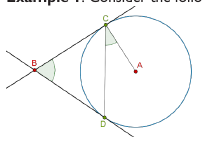
What is the relation between ∠DBC and ∠DCA?
Solution: Since BC is tangent to the circle at C, we note that ∠BCA=90 0 Thus, ∠BCD=∠BDC=90 0 −∠DCA. Applying the angle sum property in ΔBCD we have: ∠DBC+∠BCD+∠BDC=180 0

 ∠DBC+(900−∠DCA)+(90 0 −∠DCA)=180 0 ∠DBC−2∠DCA=0 0 ∠DBC=2∠DCA This is the required relation.
Example 2: Consider a chord AB of length 9 cm in a circle of radius 5 cm. Tangents at A and B intersect at C, as shown below:
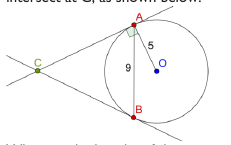
What are the lengths of these tangents, that is, of CA and CB?
Solution: Join OC and let it intersect AB at D:
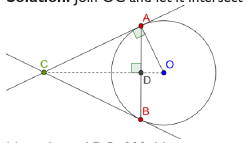
Note that ∠ADC=900. Now, compare ΔOAC with ΔODA: 1. ∠OAC=∠ODA=900 2. ∠DOA=∠COA(common)
Thus, the two triangles are similar by the AA similarity criterion. This means that OD:OA = AD:AC (make sure that you understand this). We know that OA = 5 cm, and AD is half of AB, which is 9 cm, so AD is 9/2 cm. We do not know the value of OD, but it can easily be calculated using the Pythagoras Theorem: OD2=OA2−AD2=52−(9/2)2=19/4 OD=√(19/4)=√(4.75)cm We plug this value into the similarity relation OD:OA = AD:AC to get: AC=(OA×AD)/OD=(5×9/2)/√(4.75)=10.3cm This is the (approximate) length of the two tangents CA and CB.
Teaching and Learning Resources:
- * Mathematical sets. Graph sheet. * Technology tools such as computers, mobile phones, etc. * Computer software applications like GeoGebra.
Assessment (3.3.1.AS.4). The document marks these depth-of-knowledge levels for this indicator: Level 3 Strategic reasoning.