SHS3 Mathematics · Semester 1, Week 16
Spatial Sense
Full lesson notes coming
Notes for this lesson are being prepared. The curriculum details below are complete and ready to use for your planning.
Curriculum details
- Strand
- Geometry Around Us (Strand 3)
- Sub-strand
- Spatial Sense (3.1)
- Content standard
- 3.3.1.CS.1 - Demonstrate a conceptual understanding of spatial sense with respect to circles and their theorems and apply its properties to solve everyday life problems. 3.3.1.LO.1 Draw circles for given radii and use the circle theorems; identify the tangent as perpendicular to the radius at the point of contact and verify that tangents drawn from an external point to the same circle are equal when measured from their point of contact.
- Indicator
- 3.3.1.LI.1 - Identify parts of a circle and draw circles for given radii and through points.
- Suggested placement
-
Semester 1, Week 16
(Week 16 of the year)
Our suggestion, laid out in curriculum order across three terms of twelve weeks. NaCCA does not fix the week, so follow your school's scheme of learning.
- Curriculum reference
- NaCCA curriculum document, p. 327
Exemplars (from the NaCCA curriculum)
Group discussions: In small groups, task students to engage in discussions to recall the definition of circles and their properties. Provide opportunities for students to reflect on positive and negative choices in their discussions and the consequences of each choice.
Example: A circle is a two-dimensional figure formed by a set of points that are at a constant or at a fixed distance (radius) from a fixed point (centre) on the plane.
Parts of a Circle
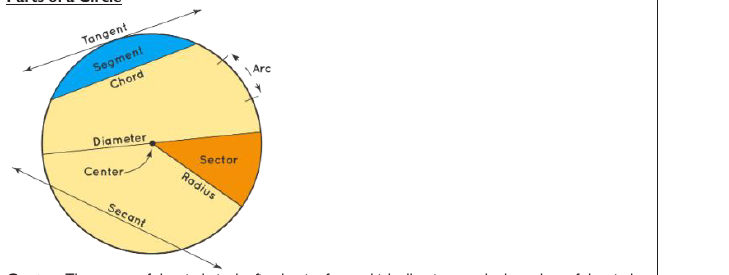
Centre: The centre of the circle is the fixed point from which all points on the boundary of the circle are equidistant, often noted on diagrams as 'O'.
Radius: The distance from the centre of a circle to the outside. The radius of the circle is half the diameter of the circle. The plural of radius is radii.
Diameter: The distance across the circle going through the centre. The diameter is twice the radius.
Circumference: The distance once around the circle.
Arc: A part of the circumference.
Major arc - A major arc is greater than half the circumference. Minor arc - A minor arc is less than half the circumference.
Chord: A line segment going from one point of the circumference to another but does not go through the centre.
Secant: A line that goes through the circle at two points.
Tangent: A straight line that touches the circle at a single point only.
Sector: A section of the circle created by two radii. Major sector - A major sector has a central angle which is more than 180 0 . Minor sector - A minor sector has a central angle which is less than 180 0 .
Semi-circle: Half of a circle. It could be considered a sector where the circle has been split by the diameter.
Quadrant: A quarter of a circle created by two perpendicular radii.
Segment: A section of the circle created by a chord.
Major segment - a segment where the arc is greater than half the circumference.
Minor segment - a segment where the arc is less than half the circumference.
Think-pair-share activities: In pairs, engage learners to draw circles given various radii.
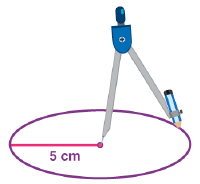
How to Draw a Circle of a Given Radius? To draw a circle whose radius is given, we require a ruler and compasses. Given that the radius is 5 cm, the steps to be followed are:
- Step 1: Place the pointer of the compass at the initial point of the ruler (0 cm) and extend the other end of the pencil measuring 5 cm from the initial point (i.e., 5 cm)
- Step 2: Mark a point O on a piece of paper. This point is supposed to be the centre of the circle that you are about to construct.
- Step 3: Place the pointer of the compass at point O.
- Step 4: Turn the compass slowly through 360 degrees to draw a circle
Think-pair-share activities: In pairs, engage learners to draw circles through points.
Example: Drawing a circle through three points.
Infinitely, many lines can pass through a single point in the plane. However, exactly one line can pass through two separate places in the plane. That is, a line can only be determined by two unique points. What occurs when circles are involved? How many points must be present for a circle to be identified as such?
It should be clear that an endless number of circles can travel past a single point.
There are infinitely many circles that can pass through two points.
Let's now examine how to create a special circle that passes through three distinctive non-collinear locations. Three of these points-A, B, and C-are depicted in the following figure:
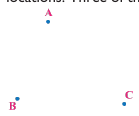
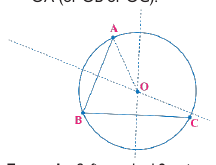
All three spots must be equidistant from the circle's centre. This means that in order for OA = OB = OC, we must find the point in the plane designated as O.
Remember that O must be located on the perpendicular bisector of the segment connecting the two fixed points that it is equally far from. Consequently, we move forward as follows:
1. Join the points A and B and draw a perpendicular bisector P1 of AB. Any point on P1 will be equidistant from A and B:
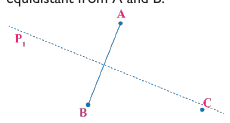
2. Join B and C and draw a perpendicular bisector P 2 of BC. Any point on P 2 will be equidistant from B and C:
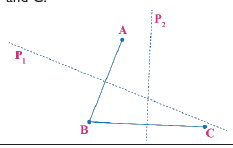
3. Indicate the point of intersection of P1 and P2 as O. This point O is equidistant from all of A, B, and C. 4. Let this be the centre of the circle.
5. We draw a circle with O as the centre, using the compass with the radius as the measure of length OA (or OB or OC).
Example: Safia marked 2 points on a sheet of paper. She is trying to figure out the number of circles that could be constructed that will pass through the given two points. Can you help her?
Solution: If there are two points, we can consider them as the endpoints of the diameter to start with. For the next circle that we try to draw, we let the distance between the two points as the chord to that circle.
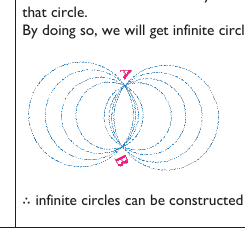
 By doing so, we will get infinite circles passing through the given two points.
∴ infinite circles can be constructed if two points are given.
Teaching and Learning Resources:
- * Mathematical sets. Graph sheet. * Technology tools such as computers, mobile phones, etc. * Computer software applications like GeoGebra.
Assessment (3.3.1.AS.1). The document marks these depth-of-knowledge levels for this indicator: Level 3 Strategic reasoning.