SHS2 Mathematics · Semester 2, Week 7
Measurement
Lesson notes
Learning Objectives
Indicator: 2.3.2.LI.1 - Determine the inverse of trigonometric ratios (graphs excluded) and talk about their applications in the fields of astronomy, engineering, physics, geometry and navigation.
By the end of the lesson, learners can:
- State the meaning of inverse trigonometric ratios (sin⁻¹, cos⁻¹, tan⁻¹) and explain the relationship between a trigonometric ratio and its inverse.
- Determine the values of inverse trigonometric ratios for standard angles (0, π/6, π/4, π/3, π/2) using the unit circle and special triangles.
- Evaluate expressions involving combinations of inverse trigonometric ratios, such as sin⁻¹(1/2) + cos⁻¹(1/2).
- Identify and discuss at least three real-world applications of inverse trigonometric ratios in fields such as astronomy, engineering, navigation, physics, and geometry.
- Use a calculator or mathematical set tables to verify inverse trigonometric ratio values for non-standard angles.
Sign in with your phone number to read the full note and download the GES plan - free.
Sign in with phone numberCurriculum details
- Strand
- Geometry Around Us (Strand 3)
- Sub-strand
- Measurement (3.2)
- Content standard
- 2.3.2.CS.2 - Demonstrate an understanding of the inverse of trigonometric ratios and angles of elevation/depression, and apply the knowledge to calculate distances and heights. 2.3.2.LO.2 Determine the inverse of trigonometric ratios, calculate angles of elevation and depression in everyday life situations and apply the knowledge to calculate distances and heights.
- Indicator
- 2.3.2.LI.1 - Determine the inverse of trigonometric ratios (graphs excluded) and talk about their applications in the fields of astronomy, engineering, physics, geometry and navigation.
- Suggested placement
-
Semester 2, Week 7
(Week 27 of the year)
Our suggestion, laid out in curriculum order across three terms of twelve weeks. NaCCA does not fix the week, so follow your school's scheme of learning.
- Source document note
-
The official curriculum document has a fault in this entry, so the curriculum text above is transcribed exactly as printed:
- exemplars - p.246: this exemplar sets a two-dimensional construct - a stacked fraction, an index or a column vector - which the text layer flattens into separate lines, so the parts are present but their vertical arrangement is lost; read the page
- Curriculum reference
- NaCCA curriculum document, p. 244
Exemplars (from the NaCCA curriculum)
Group discussions: In convenient groups, task learners to discuss the inverse of trig. ratios. Learners should respect diverse views from friends in groups or class.
Example 1: Inverse Trigonometric Ratios Table
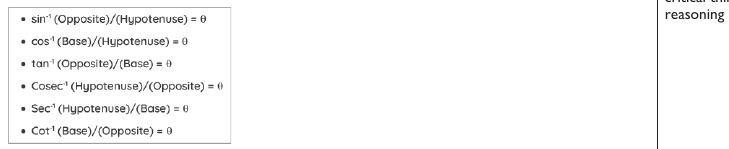
Example 2: The following table lists some examples of the sin−1 operation
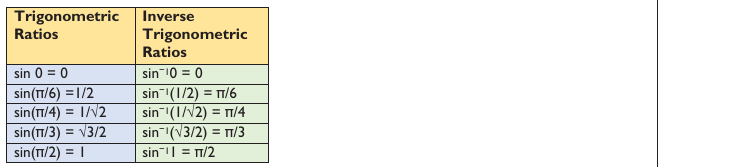
 Trigonometric Inverse Ratios Trigonometric Ratios sin 0 = 0 sin − 1 0 = 0 sin(π/6) =1/2 sin − 1 (1/2) = π/6 sin(π/4) = 1/√2 sin − 1 (1/√2) = π/4 sin(π/3) = √3/2 sin − 1 (√3/2) = π/3 sin(π/2) = 1 sin − 1 1 = π/2
Example 3: Here are some examples of the cos − 1 operation:
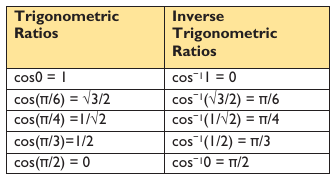
 Trigonometric Inverse Ratios Trigonometric Ratios
cos − 1 1 = 0 cos0 = 1 cos − 1 (√3/2) = π/6 cos(π/6) = √3/2 cos(π/4) =1/√2 cos − 1 (1/√2) = π/4
cos(π/3)=1/2 cos − 1 (1/2) = π/3
cos(π/2) = 0 cos − 1 0 = π/2
Example 4: Here are some examples of the tan−1 operation:
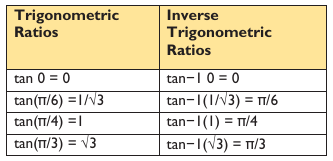
 Trigonometric Inverse Ratios Trigonometric Ratios
tan 0 = 0 tan−1 0 = 0 tan(π/6) =1/√3 tan−1(1/√3) = π/6 tan(π/4) =1 tan−1(1) = π/4 tan(π/3) = √3 tan−1(√3) = π/3
Example 5: Applications of Inverse trigonometric ratios are given below:
- Used to find the measure of the unknown angles of a right-angled triangle.
- Used in measuring the angle of depth or angle of inclination.
- Architects use it to calculate the angle of a bridge and the supports.
- Used by carpenters to create a desired cut angle.
Example 6: Find the value of sin − 1 (1/2) + cos − 1 (1/2) using the inverse trigonometric ratio formulas. Solution: We have: sin − 1 (1/2) + cos − 1 (1/2) = π/6+π/3 = π/2
Answer: The value of the given function is π/2.
Example 7: Find the value of Tan -1 (√3) - Cot -1 (-√3).
Solution: Tan -1 (√3) - Cot -1 (-√3) =Tan -1 (√3) - (π - Cot -1 (√3)) =Tan -1 (√3) - π + Cot -1 (√3) = π/3 - π + π/6 = π/2 - π = -π/2
Answer: Therefore, the answer is -π/2.
𝜋 1 Example 8: Find the value of Sin ( +Sin − 1 ( )). 3 2 Answer: 1
Teaching and Learning Resources:
- Mathematical sets.
- Technology tools such as computers, mobile phones, etc.
- Computer software applications like GeoGebra
Assessment (2.3.2.AS.1). The document marks these depth-of-knowledge levels for this indicator: Level 2 Skills of conceptual understanding; Level 3 Strategic reasoning.