SHS2 Mathematics · Semester 2, Week 5
Measurement
Lesson notes
Learning Objectives
Indicator: 2.3.2.LI.2 - Determine the properties (commutative, associative, distributive, etc.) of the operations on vectors through investigation with and without technology.
By the end of the lesson, learners can:
- State the commutative, associative, distributive, identity, and inverse properties of vector addition using vector notation and plain language.
- Verify the commutative and associative properties of vector addition using numerical examples in two-space, both by hand and with a graphing tool or app.
- Demonstrate that vector subtraction is neither commutative nor associative by testing counterexamples.
- Apply the distributive property of scalar multiplication over vector addition to simplify expressions involving vectors.
- Use the properties of vector operations to justify that two vector expressions are equal or not equal.
Sign in with your phone number to read the full note and download the GES plan - free.
Sign in with phone numberCurriculum details
- Strand
- Geometry Around Us (Strand 3)
- Sub-strand
- Measurement (3.2)
- Content standard
- 2.3.2.CS.1 - Demonstrate knowledge and understanding of measurement with respect to operations on bearings and vectors. 2.3.2.LO.1 Carry out addition, subtraction and scalar multiplication of vectors and investigate with and without technology some properties (e.g., commutative, associative, and distributive properties) of the operations.
- Indicator
- 2.3.2.LI.2 - Determine the properties (commutative, associative, distributive, etc.) of the operations on vectors through investigation with and without technology.
- Suggested placement
-
Semester 2, Week 5
(Week 25 of the year)
Our suggestion, laid out in curriculum order across three terms of twelve weeks. NaCCA does not fix the week, so follow your school's scheme of learning.
- Curriculum reference
- NaCCA curriculum document, p. 241
Exemplars (from the NaCCA curriculum)
Group discussions: In small groups or pairs, learners discuss and solve examples of the various properties of vector addition. Initiate discussions about the need for each and everyone to examine and dispel misconceptions/myths about gender as they relate to the learning of mathematics.
Example:
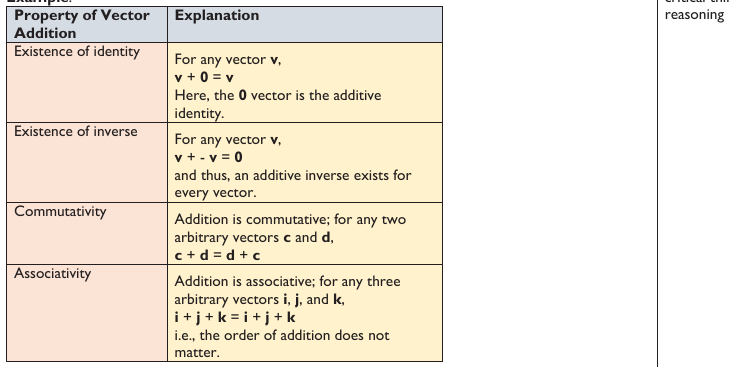
 Property of Vector Explanation Addition Existence of identity For any vector v, v + 0 = v Here, the 0 vector is the additive identity. Existence of inverse For any vector v, v + - v = 0 and thus, an additive inverse exists for every vector. Commutativity Addition is commutative; for any two arbitrary vectors c and d, c + d = d + c Associativity Addition is associative; for any three arbitrary vectors i, j, and k, i + j + k = i + j + k i.e., the order of addition does not matter.
Group discussions: In small groups or pairs, learners discuss and solve examples of the various properties of vector subtraction. Encourage learners to stay away from unwanted discrimination among themselves.
Example: Properties of Vector Subtraction Here are some important properties of vector subtraction.
- Any vector subtracted from itself results in a zero vector. i.e., a - a = 0, for any vector a.
- The subtraction of vectors is NOT commutative. i.e., a - b is not necessarily equal to b - a.
- The vector subtraction is NOT associative. i.e., (a - b) - c does not need to be equal to a - (b - c).
- (a - b) · (a + b) = |a| 2 - |b| 2 .
- (a - b) · (a - b) = |a - b| 2 = |a| 2 + |b| 2 - 2 a · b.
Teaching and Learning Resources:
- * Mathematical sets. * Technology tools such as computers, mobile phones, etc.
- * Computer software applications like
Assessment (2.3.2.AS.2). The document marks these depth-of-knowledge levels for this indicator: Level 1 Recall; Level 2 Skills of conceptual understanding; Level 3 Strategic reasoning.