SHS2 Mathematics · Semester 2, Week 2
Spatial Sense
Lesson notes
Learning Objectives
Indicator: 2.3.1.LI.3 - Identify shapes with rotational symmetry and show the image of an object (or point) after a rotation about the origin (or point).
By the end of the lesson, learners can:
- Define rotational symmetry and identify the order of rotational symmetry and angle of rotation for common plane shapes such as the square, rhombus, rectangle and equilateral triangle.
- State and apply the rotation rules for 90°, 180° and 270° rotations about the origin, both clockwise and anticlockwise.
- Determine the image of a given point (x, y) after a rotation about the origin using the appropriate rotation rule.
- Plot points on a Cartesian plane, rotate a given shape about the origin through 90°, 180° or 270°, and correctly label the image vertices.
- Recognise real-life objects and patterns in Ghana that exhibit rotational symmetry and describe their order and angle of rotation.
Sign in with your phone number to read the full note and download the GES plan - free.
Sign in with phone numberCurriculum details
- Strand
- Geometry Around Us (Strand 3)
- Sub-strand
- Spatial Sense (3.1)
- Content standard
- 2.3.1.CS.1 - Demonstrate a conceptual understanding of spatial sense regarding changes and invariance achieved by performing a combination of successive transformations (reflection, translation, rotation) in a 2D shape. 2.3.1.LO.1 Carry out a variety of transformations through translation, reflection, rotation and enlargement of plane shapes and identify scale drawing as an enlargement/reduction of a plane shape.
- Indicator
- 2.3.1.LI.3 - Identify shapes with rotational symmetry and show the image of an object (or point) after a rotation about the origin (or point).
- Suggested placement
-
Semester 2, Week 2
(Week 22 of the year)
Our suggestion, laid out in curriculum order across three terms of twelve weeks. NaCCA does not fix the week, so follow your school's scheme of learning.
- Curriculum reference
- NaCCA curriculum document, p. 221
Exemplars (from the NaCCA curriculum)
Think-pair share activities: Learners in pairs research and make presentations on the concept of rotational symmetry in Mathematics.
Example 1 An object is exactly similar to its original object when rotated in a particular direction. After turning a geometrical shape, the shape becomes identical to the origin, and this is known as rotational symmetry.
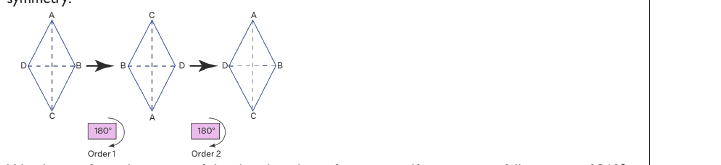
We observe from the images of the rhombus that it fits onto itself twice in one full rotation of 360°. Therefore, we can conclude that the order of rotational symmetry in a rhombus is 2, and the angle of rotation is 180°.
Example 2

The angle of rotation is 90°. This is because from the above figure, we see that the order of rotational symmetry of a square is 4 as it fits into itself 4 times in a complete 360° rotation.
Example 3: Show the rotational symmetry of an equilateral triangle.
Solution: An equilateral triangle has 3 sides of equal measure and each internal angle measuring 60° each.
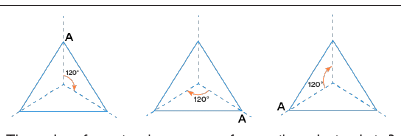
The order of rotational symmetry of an equilateral triangle is 3, and its angle of rotation is 120°. This is because the equilateral triangle exactly fits into itself 3 times at every angle of 120°.
Think-pair share activities: Learners in pairs research and make presentations on the rotation rules. Encourage learners to volunteer to lead their groups and endeavour to ensure fair treatment of all group members. And, as learners talk about rules of rotation, encourage discussions on the need to obey rules and the consequences of doing otherwise in everyday life.
Example 1: Rotation Rules We can use the following rules to find the image after 90°, 180°, 270° clockwise and counterclockwise rotation.
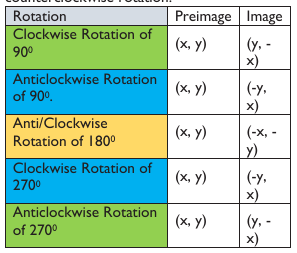
 Rotation Preimage Image Clockwise Rotation of (x, y) (y, - 90 0 x) Anticlockwise Rotation (x, y) (-y, of 90 0 . x) Anti/Clockwise (x, y) (-x, - Rotation of 180 0 y) Clockwise Rotation of (x, y) (-y, 270 0 x) Anticlockwise Rotation (x, y) (y, - of 270 0 x)
Example 2 a) Using a scale of 2cm to 2 units on both axes, draw two perpendicular axes, OX and OY, on a graph sheet. b) On this graph sheet, mark the x-axis from -4 to 10 and the y-axis from -6 to 12 c) Plot on the same graph sheet the points A (1, 4), B (4, 6) and C (5,
2). Join the points to form a triangle ABC. d) Draw the image of triangle ABC through 1800 anticlockwise rotation about the origin. e) Label the vertices of the new triangle DEF.
Solution: A rotation of 180° (either clockwise or counterclockwise) around the origin changes the position of a point (x, y) such that it becomes (-x, -y).
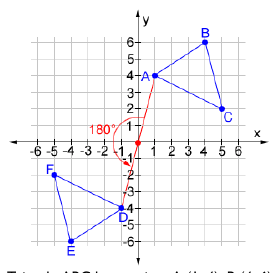
Triangle ABC has vertices A (1, 4), B (4, 6) and C (5, 2). It is rotated 180° counterclockwise to land on DEF, which has vertices D (-1, -4), E (-4, -6), and F(-5, -2).
Note: A clockwise rotation of 180° for triangle ABC also results in triangle DEF.
Teaching and Learning Resources:
- Mathematical sets. Graph sheet.
- Technology tools such as computers, mobile phones, etc.
- Computer software applications like
- GeoGebra.
- Compass
- clock face, etc.
Assessment (2.3.1.AS.3). The document marks these depth-of-knowledge levels for this indicator: Level 2 Skills of conceptual understanding; Level 3 Strategic reasoning.