SHS2 Mathematics · Semester 1, Week 20
Spatial Sense
Lesson notes
Learning Objectives
Indicator: 2.3.1.LI.1 - Identify and translate an object or point by a translating vector and describe the image.
By the end of the lesson, learners can:
- Define translation as a movement of every point of a shape by the same distance in the same direction, using the terms preimage and image correctly.
- Apply a given translation vector (x, y) to find the image of a point or the vertices of a shape by adding the vector components to each coordinate.
- State and use the four translation rules: moving left replaces x with x - k, moving right replaces x with x + k, moving up replaces y with y + k, and moving down replaces y with y - k.
- Illustrate a shape and its translated image on a coordinate plane, labelling the preimage with uppercase letters (e.g., ABC) and the image with prime notation (e.g., A’B’C’).
- Describe the translation that maps a preimage to a given image by finding the translation vector from the change in coordinates.
Sign in with your phone number to read the full note and download the GES plan - free.
Sign in with phone numberCurriculum details
- Strand
- Geometry Around Us (Strand 3)
- Sub-strand
- Spatial Sense (3.1)
- Content standard
- 2.3.1.CS.1 - Demonstrate a conceptual understanding of spatial sense regarding changes and invariance achieved by performing a combination of successive transformations (reflection, translation, rotation) in a 2D shape. 2.3.1.LO.1 Carry out a variety of transformations through translation, reflection, rotation and enlargement of plane shapes and identify scale drawing as an enlargement/reduction of a plane shape.
- Indicator
- 2.3.1.LI.1 - Identify and translate an object or point by a translating vector and describe the image.
- Suggested placement
-
Semester 1, Week 20
(Week 20 of the year)
Our suggestion, laid out in curriculum order across three terms of twelve weeks. NaCCA does not fix the week, so follow your school's scheme of learning.
- Curriculum reference
- NaCCA curriculum document, p. 211
Exemplars (from the NaCCA curriculum)
Think-pair share activities: Learners in pairs research and make presentations on the concept of translation in math. Learners must endeavour to respect diversity among themselves as they share diverse views, leading to tolerance.
Example: In Mathematics, a translation moves an object from one place to another. That is, it moves a shape left or right, up or down, and so every point on the object moves the same distance in the same direction. Shapes that are translated are congruent to each other. That is, they are of the same size as the original shape.
When you transform a shape, the new shape is called the image, and the original shape is called the preimage. You then label the vertices of the preimage using uppercase letters. For example, ABCD, QRST, MNOP, etc. and the image is labelled with uppercase letters with a "prime" next to each. For example, Q'R'S'T', and is pronounced "Q-prime, R-prime, S-prime, T-prime".
Example: In small groups, translate a given shape in a coordinate plane. In the figure, the preimage is ABC, and its image is A'B'C'. Moved up (vertically) by 3 units and then moved right (horizontally) by 2 units.
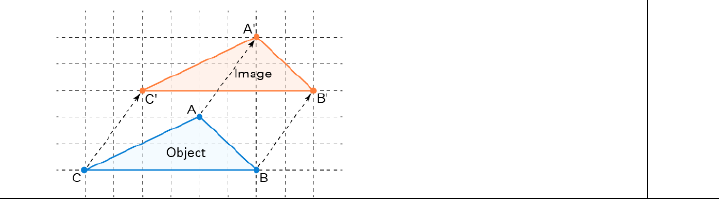
Remember, as discussed earlier, that when performing the translation of the triangle to the left/right/up/down, we move all the points of the triangle by an equal number of units in the same direction.
Using think (ink)-pair share activities: Task learners to research and make presentations on the translation rules. Learners must talk about the safe ways of using some technological tools as they make presentations of their work.
Example: Translation Rules
- If a shape moved towards the left by k units, x is replaced with x - k.
- If a shape is moved towards the right by k units, x is replaced with x + k.
- If a shape is moved up by k units, y is replaced with y + k.
- If a shape is moved down by k units, y is replaced with y - k.
In mixed groups, task learners to perform translation on a plane. Encourage the use of computer applications to perform the translation and discuss the appropriate use of technology in everyday life.
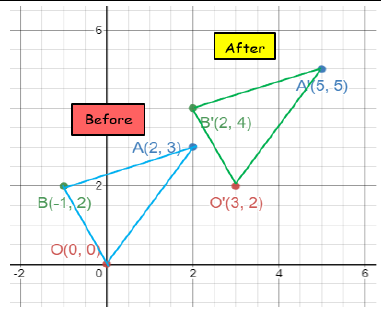
Example 1: Triangle OAB with vertices O (0, 0), A(2, 3) and B(-1, 2) is translated under the vector (3, 2). Find the image vertices and illustrate the object and the image.
Solution: To find vertices of the image after translation, we use the given vector; (3, 2) x' = x+3 and y' = y+2 Before translation After translation (preimage) (Image)
O(0, 0) O'(0+3, 0+2) ==> O'(3, 2) A(2, 3) A'(2+3, 3+2) ==> A'(5, 5) B(-1, 2) B'(-1+3, 2+2) ==> B'(2, 4)
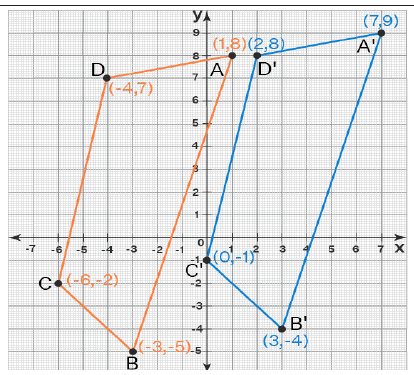
Example 2: A shape is formed with vertices A(1, 8), B(−3, −5), C(−4, 7), and D(−6, −2). Plot the image of this shape with respect to the translation (x, y) → (x + 6, y + 1).
Solution: To find the vertices of the image after translation, we use the given vector (6, 1) Before the After the Translation Translation A (1, 8) (1 + 6, 8 + 1) = (7, 9) = A' B (−3, −5) (-3 + 6, -5 + 1) = (3, -4) = B' C (−4, 7) (-4 + 6, 7 + 1) = (2, 8) = C' D (−6, −2) (-6 + 6, -2 + 1) = (0, -1) = D'
Using a Collaborative Learning approach, learners discuss and establish the rules of translation of functions. As learners talk about rules of translation, encourage discussions on the need to obey rules and the consequences of doing otherwise in everyday life.
Example 1
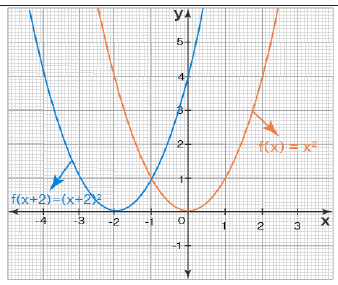
From the graph, the image is f(x + 2), and the preimage is f(x). The f(x) has moved left by 2 units (instead of right by 2 units) to give f(x + 2).
Note that this is the case with horizontal translations of functions. However, this is not the case with vertical translations. Vertical translations work just like how they work with the translations of points on the coordinate plane.
Example 2: Find the image of y = 2x 2 under a translation with vector (3, -2). Solution: Let us find any three points on the parabola. Vertex of the parabola is (0, 0) If x = -1, then y = 2 If x = 1, then y = 2 So, three points on the parabola are V(0, 0), A(-1, 2) and B(1, 2) The image has to be translated along the vector <3, -2>. (h, k) ==> (3,-2) x' = x+3 and y' = y-2
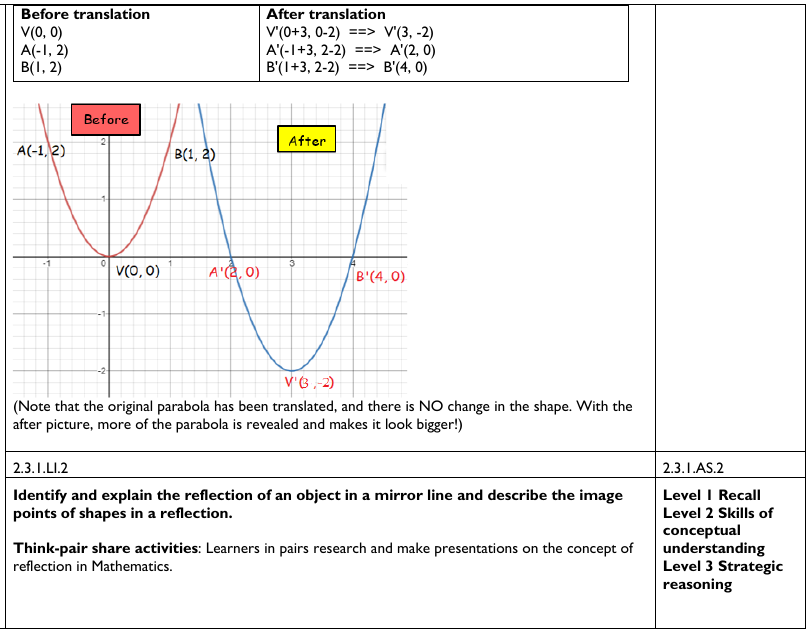
 Before translation After translation V(0, 0) V'(0+3, 0-2) ==> V'(3, -2) A(-1, 2) A'(-1+3, 2-2) ==> A'(2, 0) B(1, 2) B'(1+3, 2-2) ==> B'(4, 0)
(Note that the original parabola has been translated, and there is NO change in the shape. With the after picture, more of the parabola is revealed and makes it look bigger!)
Teaching and Learning Resources:
- Mathematical sets. Graph sheet.
- Technology tools such as computers, mobile phones, etc.
- Computer software applications like
- GeoGebra.
- Compass
- clock face, etc.
Assessment (2.3.2.AS.1). The document marks these depth-of-knowledge levels for this indicator: Level 2 Skills of conceptual understanding; Level 3 Strategic reasoning.