KG1 Integrated Learning · Term 2, Week 12
History and Celebration of Ghana's Independence
Full lesson notes coming
Notes for this lesson are being prepared. The curriculum details below are complete and ready to use for your planning.
Curriculum details
- Strand
- My Nation Ghana (Strand 5)
- Sub-strand
- History and Celebration of Ghana's Independence (5.1)
- Content standard
- K1.5.1.1 - Demonstrate knowledge of the history and independence of Ghana
- Indicator
- K1.5.1.1.7 - Compose and decompose numbers up to ten
- Suggested placement
-
Term 2, Week 12
(Week 24 of the year)
Term is the curriculum's own; the week within it is our suggestion, laid out in curriculum order. Follow your school's scheme of learning.
- Curriculum reference
-
Kindergarten Curriculum (KG1 and KG2), 2019, p. 64
Transcribed from the official NaCCA publication. Check this page against the source.
Exemplars (from the NaCCA curriculum)
Learners decompose a group 10 bottle tops, e.g. 6 and 4 or 5 plus 5. Teacher Scaffold learners to understand the terms Decomposing and composing numbers. Composing means putting numbers together to make a whole and Decomposing means breaking down numbers into their sub-parts.
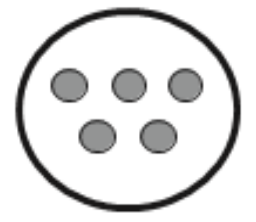
Learners also use dot cards to decompose numbers (0-10), Learners look at a dot card (e.g. with 5 dots) and say how many dots they see' If the teacher asks, how many dots do you see?
The child says, 'I see 3 and 2 dots'
*
Have learners draw a line to join or circle the 3 dots and 2 dots separately e.g. Learners repeat activity with different number of dots
5 2 and 3 4 and 1
*
Give learners cards with different number of dots e.g. 5, 6, 9, etc. and in pairs let them play the game "Pick and circle" (cut out cards with different number of dots. Write two figures under each circled dots into which the dots should be decomposed. Have learners decompose the dots in different forms and talk about their work e.g. 6 (2 and 4, 3 and 3, 5 and 1), 7(2 and 5, 3 and 4, 6 and 1), etc.
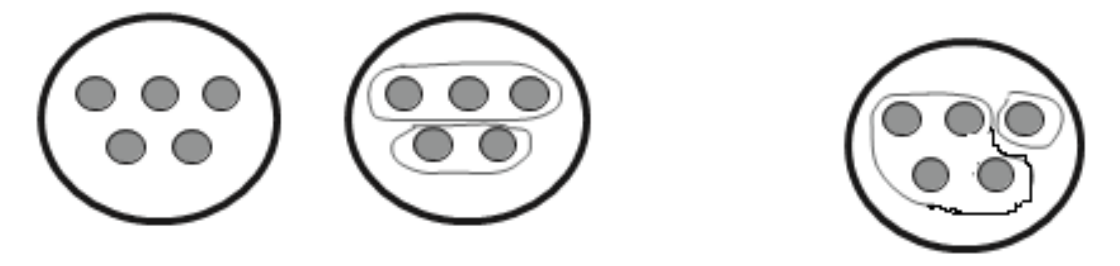
e.g. 5 (3 and 2, 4 and 2)