B6 English Language · Term 1, Week 12
Word Families, minimal pairs and Common Digraphs
Lesson notes
Learning Objectives
Indicator: B6.2.3.1.1 - Use common minimal pairs to decode words
By the end of the lesson, learners can:
- Define a minimal pair as two words that differ by only one sound.
- Identify the single sound difference in given minimal pairs such as goat/coat, boat/coat, road/load.
- Sort words into pairs based on their single sound difference.
- Pronounce both words in a minimal pair clearly, showing awareness of the different sounds.
- Read aloud short sentences containing minimal pairs, decoding the words accurately.
Sign in with your phone number to read the full note and download the GES plan - free.
Sign in with phone numberCurriculum details
- Strand
- Reading (Strand 2)
- Sub-strand
- Word Families, minimal pairs and Common Digraphs (2.3)
- Content standard
- B6.2.3.1 - Identify minimal pairs and common digraphs The code B6.2.3.1.1 is printed on **two different indicators**: "Use common minimal pairs to decode words" (printed p.169, under sub-strand heading "Sub-Strand 3: Word Families, minimal pairs and Common Digraphs" and content standard B6.2.3.1) and "Use words with centering diphthongs..." (printed p.170, under the heading "Sub-Strand 4: Diphthongs" and content standard **B6.2.4.1**). Both are transcribed with the code the document prints, so this CSV deliberately fails validate.py with one duplicate error. Everything on printed p.170 says its indicator should be B6.2.4.1.1 - its own standard cell, its heading, and the sibling grades, which code diphthongs B4.2.4.1.1 and B5.2.4.1.1 - but renumbering is a human decision, not the transcription's.
- Indicator
- B6.2.3.1.1 - Use common minimal pairs to decode words
- Suggested placement
-
Term 1, Week 12
(Week 12 of the year)
Our suggestion, laid out in curriculum order across three terms of twelve weeks. NaCCA does not fix the week, so follow your school's scheme of learning.
- Source document note
-
The official curriculum document has a fault in this entry, so the curriculum text above is transcribed exactly as printed:
- content standard text - pp.169-170
- exemplars - p.169
- Curriculum reference
-
English Language Curriculum (Basic 4-6), 2019, p. 169
Transcribed from the official NaCCA publication. Check this page against the source.
Exemplars (from the NaCCA curriculum)
- Give examples of minimal pairs
- Using "think-pair-share", let learners come up with more examples of minimal pairs.
E.g. Two sounds One sound difference difference goat, coat, boat, road, loan wall, ball train, chain Bridge, fridge
- Introduce and revise these and other similar spelling patterns using examples (two or three patterns at a time).
- Drill the pronunciation of the sounds.
- Have learners read several words having the spelling pattern.
- Let learners also read the words in context.
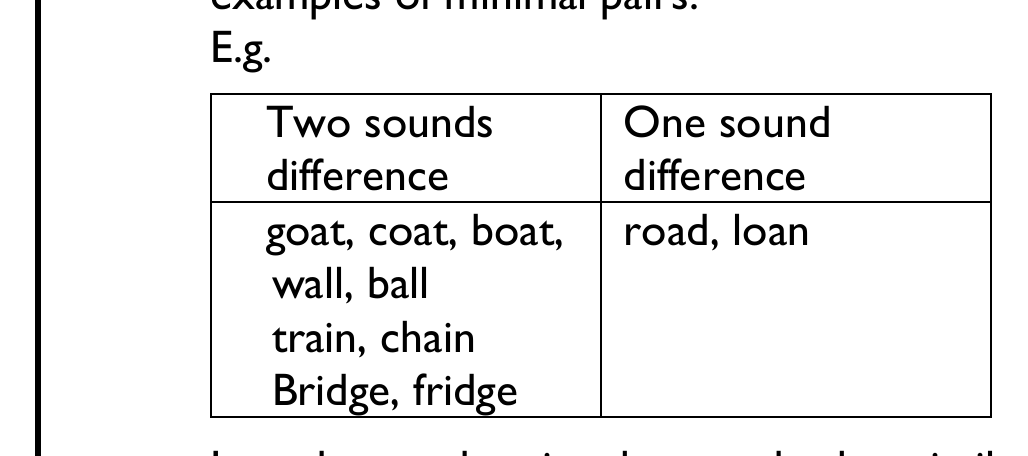
The minimal-pairs example is a drawn two-column table ("Two sounds difference" / "One sound difference") whose cells arrive in the text layer as one run of words; the figure shows it.