B2 English Language · Term 3, Week 4
Controlled Writing
Lesson notes
Learning Objectives
Indicator: B2.4.7.1.2 - Match parts of sentences to compose meaningful texts
By the end of the lesson, learners can:
- Match the beginning of a sentence to its correct ending to form a meaningful sentence about a familiar topic.
- Write at least three complete, correct sentences about their own house or home after matching sentence parts.
- Read aloud a matched sentence and explain why the beginning and ending fit together.
- Check a partner’s matched sentences and suggest corrections where needed.
Sign in with your phone number to read the full note and download the GES plan - free.
Sign in with phone numberCurriculum details
- Strand
- Writing (Strand 4)
- Sub-strand
- Controlled Writing (4.7)
- Content standard
- B2.4.7.1 - Write simple compositions
- Indicator
- B2.4.7.1.2 - Match parts of sentences to compose meaningful texts
- Suggested placement
-
Term 3, Week 4
(Week 28 of the year)
Our suggestion, laid out in curriculum order across three terms of twelve weeks. NaCCA does not fix the week, so follow your school's scheme of learning.
- Source document note
-
The official curriculum document has a fault in this entry, so the curriculum text above is transcribed exactly as printed:
- exemplars - p.62
- Curriculum reference
-
English Language Curriculum (Basic 1-3), 2019, p. 61
Transcribed from the official NaCCA publication. Check this page against the source.
Exemplars (from the NaCCA curriculum)
- Let learners talk about the topic (My House) by using descriptive words in sentences.
- Write the sentences on the board.
e.g. i. My house is big. ii. The walls are blue. iii. The house has many windows. iv. The windows are big. v. The doors and windows are blue.
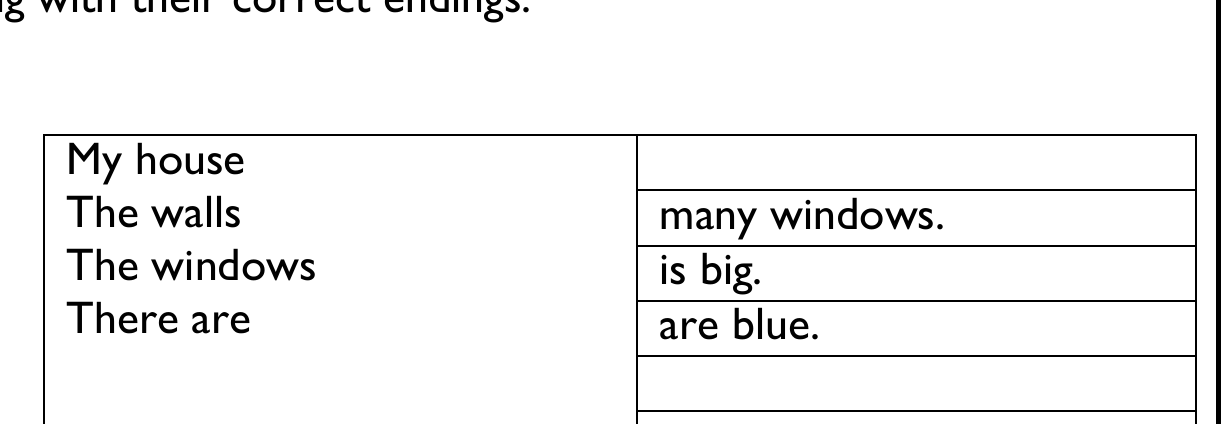
- Write the sentences and break each into two parts for learners to match the beginning with their correct endings.
e. g. My house The walls many windows. The windows is big. There are are blue.
- Encourage learners to do peer editing.
The sentence-matching table is drawn, and its cells arrive in the text layer as one run of words; the figure shows it. Its last two rows are printed empty.