B1 English Language · Term 1, Week 9
Giving and Responding to Commands/Instructions and Making Requests
Lesson notes
Learning Objectives
Indicator: B1.1.9.1.1 - Give and respond to commands and instructions
By the end of the lesson, learners can:
- Identify at least five common classroom commands and instructions when they hear them spoken.
- Respond correctly with physical actions to at least five different commands and instructions given by the teacher or a classmate.
- Give clear commands and instructions to a partner using correct words and appropriate voice tone.
- Follow a three-step oral instruction sequence correctly (for example, draw a circle, then a triangle inside it, then a square inside the triangle).
- Demonstrate respectful behaviour when giving and responding to commands, using words like “please” naturally without yet being formally taught the full polite-request lesson scheduled for Week 10.
Sign in with your phone number to read the full note and download the GES plan - free.
Sign in with phone numberCurriculum details
- Strand
- Oral Language (Strand 1)
- Sub-strand
- Giving and Responding to Commands/Instructions and Making Requests (1.9)
- Content standard
- B1.1.9.1 - Demonstrate understanding in commands, instructions, directions and requests
- Indicator
- B1.1.9.1.1 - Give and respond to commands and instructions
- Suggested placement
-
Term 1, Week 9
(Week 9 of the year)
Our suggestion, laid out in curriculum order across three terms of twelve weeks. NaCCA does not fix the week, so follow your school's scheme of learning.
- Source document note
-
The official curriculum document has a fault in this entry, so the curriculum text above is transcribed exactly as printed:
- exemplars - p.14
- Curriculum reference
-
English Language Curriculum (Basic 1-3), 2019, p. 14
Transcribed from the official NaCCA publication. Check this page against the source.
Exemplars (from the NaCCA curriculum)
- Give commands and instructions to learners.
e.g. Command:
- Keep quiet.
- Hands up.
- Sit down.
- Bring your books.
- Start work, etc.
- Pair learners to give/obey commands.
- Have learners listen to simple instructions and act in response.
- Let learners practise by giving commands in pairs, etc.
e. g. Instructions:
- Draw a circle.
- Draw a triangle in the circle.
- Draw a square in the triangle.
Response:
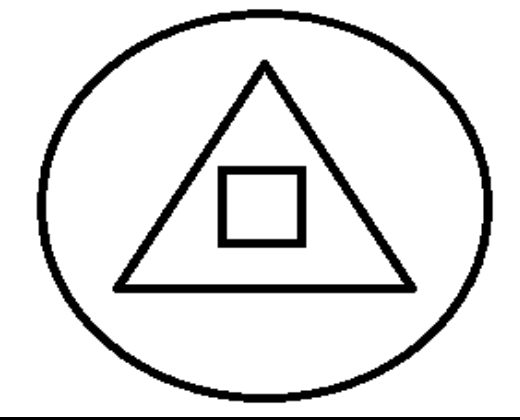
The exemplar ends "Response:" and the response itself is drawn, not written: a square inside a triangle inside a circle. The figure shows it; the text layer carries nothing.